





One could argue, no pun intended, that Darcy James Argue is one of the most interesting artists in contemporary jazz. His approach to big band music is to rethink what a big band is today rather than mimic what has been done before. The result is music that is fresh, exciting and always has a unique point of view.
On Saturday, July 26th, Darcy James Argue’s Secret Society and the Aaron Diehl Trio will present the world premiere of Argue’s A Banquet for the Birds at the 92nd Y in New York. The concert will be live streamed so you don’t have to be in New York to see and hear this concert. The live stream will remain available for 72 hours after the conclusion of the concert.
Argue and pianist Diehl have known each other for quite some time. They both have worked with Cécile McLorin Salvant and have admired each other’s own works.
Yesterday, in his only break from rehearsals for Saturday’s concert, I spoke with Argue about A Banquet for the Birds which is inspired by Emily Wilson’s translation of the Iliad by Homer. In our conversation he talked about the musicality of her translation (as voiced by Audra McDonald in the audiobook he listened to), his writing to text that will not be heard in the piece and about some of the surprising influences that find their way into his music.
What follows are excerpts from our conversation that have been edited for length and clarity. To see the full interview, please go to our YouTube channel.
Q: Given how important storytelling is to you and to your music, what is the overall narrative structure that you’ve assembled for this concert on Saturday?
Secret Society is going to play some tunes from our repertoire. Then we’re going to swap out our bassist and drummer for the members of the Aaron Diehl Trio who will be joining us and will be playing Aaron’s great extended suite Organic Consequence which I arranged for him; originally for the Frankfurt Radio Big Band. We’ll be giving the the New York premiere of that and also my big band-ization of Aaron’s wonderful arrangement of Bob Doro’s Nothing Like You which he originally wrote for Cécile McLorin Salvant. It’s an arrangement of a tune that I really love so I decided to take his version of that tune and big band it. Then we end with this just completed suite for Aaron, a three part suite inspired by the Iliad called A Banquet for the Birds.
People will have to come to the concert or tune into the concert to see how that works. Mainly I’m concerned with the storytelling in the suite itself. So just within the final three-part version of A Banquet for the Birds, people are going to hear a structure that hopefully feels cohesive and recursive and mirrors in some ways the structure of the Iliad itself.
Writing music is not as simple as writing music. Commissions are an important part of the business of creation. So how did this commission come about through NDR Big Band and 92nd Street Y? How much of it did you have conceptualized in your head?
The commissioning partners were the NDR Big Band in Hamburg and we previewed the first movement there in a concert that I did back in March with them. The 92nd Street Y was the other commissioning partner for their world premiere and I’m very grateful to both of them. It was nice to be able to preview bits and pieces of the suite before the world premiere. [That] allows me the chance to make some revisions, to see how things are working, to get a sense of the the overall flow of the piece so it’s not just all in my head before the first rehearsal with live musicians. Then you can you can have some surprises, of course, especially when writing for improvisers.
The piece is something that I’m very excited about. It’s a new technique for me in composition, which is to take text and to use that text as if I were setting it to be sung, but it’s never sung. It is only meant for instrumentalists to play. But the rhythm of the text and Emily Wilson’s wonderful translation of the Iliad, that was really the impetus for this. Her setting, her translation, is metrical. It’s in iambic pentameter. The original Greek is in a meter dactylic hexameter that sounds wonderful in ancient Greek and doesn’t work at all in English.
This blank verse translation has a real rhythm to it. It has poetry and meter. And it sings when spoken aloud, especially if you’re listening to my audio book version of it as narrated by Audra MacDonald, the great Broadway singer and performer currently on Broadway in Gypsy. So Audra’s been in my ears all throughout this process and her interpretation informs my thinking about the meaning of the text and the rhythm and the musicality of the texts. So all of that came together in this piece and it really helped unlock some different melodic possibilities that I would not have gravitated towards had I not started first with the text. Not just the meaning of the text, but the rhythms of the text as well.
When you’re dealing with the meanings of the text, you clearly have an idea of how you want to express it. How important is it for an audience member to understand your intent?
They will not be privy to all of the inner workings of it because, again, the text is not heard. Although the people who will attend, they’ll have a little pamphlet so they can see what the text was that I used. Hopefully that informs their listening if they look at the program in advance. But if they don’t, then I hope it’s a journey for them. But the most important thing is the final musical result. All of these things that we do in our creative process, using existing text or using a 12-tone row or a particular intervallic* set or whatever the compositional tools of the trade that go into it, those are just tools that allow us to access parts of our creativity that we might not otherwise. It’s good to have constraints to push against as a composer. If you don’t set up some rules for yourself to push against, then you will never grow as a composer. Part of my growth process was taking this text that I really found incredibly moving and inspirational and meaningful to us in the present moment and to use that as the basis for beginning the piece.
When did you first become acquainted with Aaron?
I’m not sure when we first met in person. I’ve known about Aaron through his recordings for quite some time. I know for certain that we met in Istanbul in 2014, but I don’t remember if we interacted before that. Cecile’s group, which Aaron was playing in at the time, and Secret Society, had a double bill at the Istanbul Jazz Festival, so that was our first more extended meeting. We’ve, of course, been in touch since then and talked about collaboration for a long time.
How much did Aaron provide feedback in terms of what he would like to see in this?
Aaron was a great collaborator through this process. He memorized everything. That was big on his list to make sure that he had it all up in his head. He’s very invested in seeing the scores. There are moments where his piano part doesn’t have all of the text that is used in the piece. Sometimes that text is instantiated or performed by some of the saxophone section or the trombones or the whole band. Aaron was really invested in tracking the the poem throughout the piece; figuring out which instruments have the the words, what they are and what the meaning of the text is within the the overall structure of of the piece. The three excerpts that I selected were all, as you can probably guess from the title, related to scenes of birds in the Iliad.
One of things that helped me really connect to the characters, the world and the setting described by Homer is these remarkable descriptions of scenes involving birds. Of a serpent devouring these sparrow chicks and then finally saving the mother for the last, or an eagle swooping down and grabbing a fawn in its talons and then dropping it on the altar. The Iliad has these incredible similes and one of them is this flock of starlings or jackdaws and then a peregrine falcon diving into them and likening that to the dive of Hector and Aeneas into the Greek army and the Greeks just scattering like birds being attacked by a raptor. That’s some of the imagery that really struck me as I was reading and that I wanted to make sure that I reflected in the music.
One of the things I’ve loved about the music that you’ve created is that you are expanding the definition of what a big band is. You’re bringing it into a very modern era without sacrificing what a big band is. In listening to these first two movements it seems that you’re flirting with the idea of the structure of a concerto. How much do you see the musical totality of A Banquet for the Birds as being a hybrid of those two things?
Given that it’s a feature for Aaron, there are certain orchestrational things, stylistic things, formal things, that come from the wonderful, expansive world of classical piano concertos. Certainly there’s certain things that you need to have in a piece like this.
You obviously need some moments where Aaron is alone, unaccompanied. Sometimes that’s going to be music that I compose for him, sometimes that’s gonna be purely improvised, sometimes it’s going be a little hybrid of it. Sometimes I’m writing in a way where I hope the audience thinks it’s an improvisation, but then it is orchestrated for the ensemble. You sort of reveal the trick a little bit. Writing for big band and piano with the piano as a feature is also an interesting challenge because you have this very powerful wind section of five saxophones and a nine brass and they can easily overpower the piano. Trying to write around that and write in a way that is still very dynamic and exciting and allows the band to reach those peaks but still allows the piano soloist to come through is one of the specific challenges that I had to solve in this particular piece.
What do you hope an audience takes away from when they hear A Banquet for the Birds? What would you like them to at least consider reflecting on?
First off, I just hope they get swept up in the narrative of the music, the way I was swept up in the narrative of the poem. I hope that it gives them some visceral thrills and some space for contemplation and everything in between. One of the things for a longer piece like this of pacing and structure and trying to figure out where to get fast, where to slow, where to get loud, where it gets soft, all of those things in the service of creating something larger. Often it is an intuitive process of just getting to a point where you feel like, OK, well, we’ve got to hit triple time here, or we’ve gotta have a sudden stop and then like a corral. All of these things are very hard to gage until you get to the end of the process and then kind of sit back and reevaluate and figure out, well, did this story unfold? Are the bones strong? Does the story have the right pacing when it’s drawn out over the full 30 minutes?
You have a contemporary approach to big band music, which I think should enliven anybody who thinks that big band music all has to be done one way. At the same time, jazz, and particularly if you look at the lineups of music festivals these days, seems to be firmly embracing hip hop as a way perhaps of acknowledging the number of jazz pieces that have been used as samples in hip hop, but also trying to broaden the audience. I feel like hip hop and your music approach expanding the definition of jazz in very different ways. Do you feel like there’s any kind of dialog or conversation that both approaches are having?
I’m born in 1975, so hip-hop has been a part of my youth. [I] grew up listening to Public Enemy and Ice T and LL Cool J and all of the greats of that golden era of hip hop, which I really love. It has made its way into my music in a variety of ways and maybe not all of them obvious to the outside observer. What I like to do when I’m thinking about how am I going to take the stuff that I love from like LL Cool J’s flow and bring it into my music is to try to go and to look beyond the surface qualities and to to look deeper into what it is specifically that is going on in terms of like someone’s relationship to the beat. Someone’s accent pattern. All of that vocalization of it. This is obviously something that was very much on my mind writing this piece: how does the natural rhythm of text inform how you write a musical line and should the pacing be the way you would say it?
Even in instrumental music, you’re still thinking about line and melody and pacing and phrasing in a way that hopefully evokes lyricism and singing and what makes a good melody for an instrument to play. You could imagine someone singing it, and you can imagine someone singing through the instrument, and that there is a sense of like, the phrase is a phrase that you can perform in one breath. So all of that is something that comes into my music. But for me, the most important thing is just to feel like, well, what is right? What are the needs of the music? And what can I bring to it from my own constellation of influences that’s going to make the piece stronger.
I know you’re a big fan of Charles Mingus. He’s quoted as having said, “I admire anyone who can come up with something original, but not originality alone, because there can be originality and stupidity with no musical description or any emotion or any beauty the man has seen or any kind of life he has lived.” How do you see the music that you’ve put out in the world so far as having given us musical description of this life you have lived so far?
I really like that quote a lot because originality is not an end in and of itself. I feel like originality is something that comes from someone who has worked very hard to master their craft and understands how to use that craft in service of their personal voice rather than pursuing originality for its own sake. If you are true to your voice then it will sound like you. It will sound original to you. But it’s very easy to go down this rabbit hole of just trying to be ostentatiously new and not serving the music. That’s something I try to be conscious of in my own work and try not to be too precious about trying to impress people with how original I can be because what’s the point of that? The point is to try to create something beautiful and authentic and personal and the originality comes through serving that singular vision that you hopefully have as an artist. As opposed to just deciding, at the outset, what can I do that hasn’t been done yet? That’s not a way of creating art that resonates with me.
So by following that belief system, is that how we get an understanding of who you are and the life you’ve lived?
What I hope is just that people listen to the music, whether it’s on the recordings or live, and that it means something to them. That they come out at the end of the piece transformed in some small way that makes them feel something that they didn’t feel before the piece started. That is why we all do this. To try and create that personal connection with the listener and to have some kind of a story that we want to tell that will change something about the life of the person who receives it.
To watch the full interview with Darcy James Argue, please go HERE.
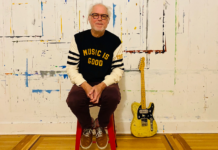
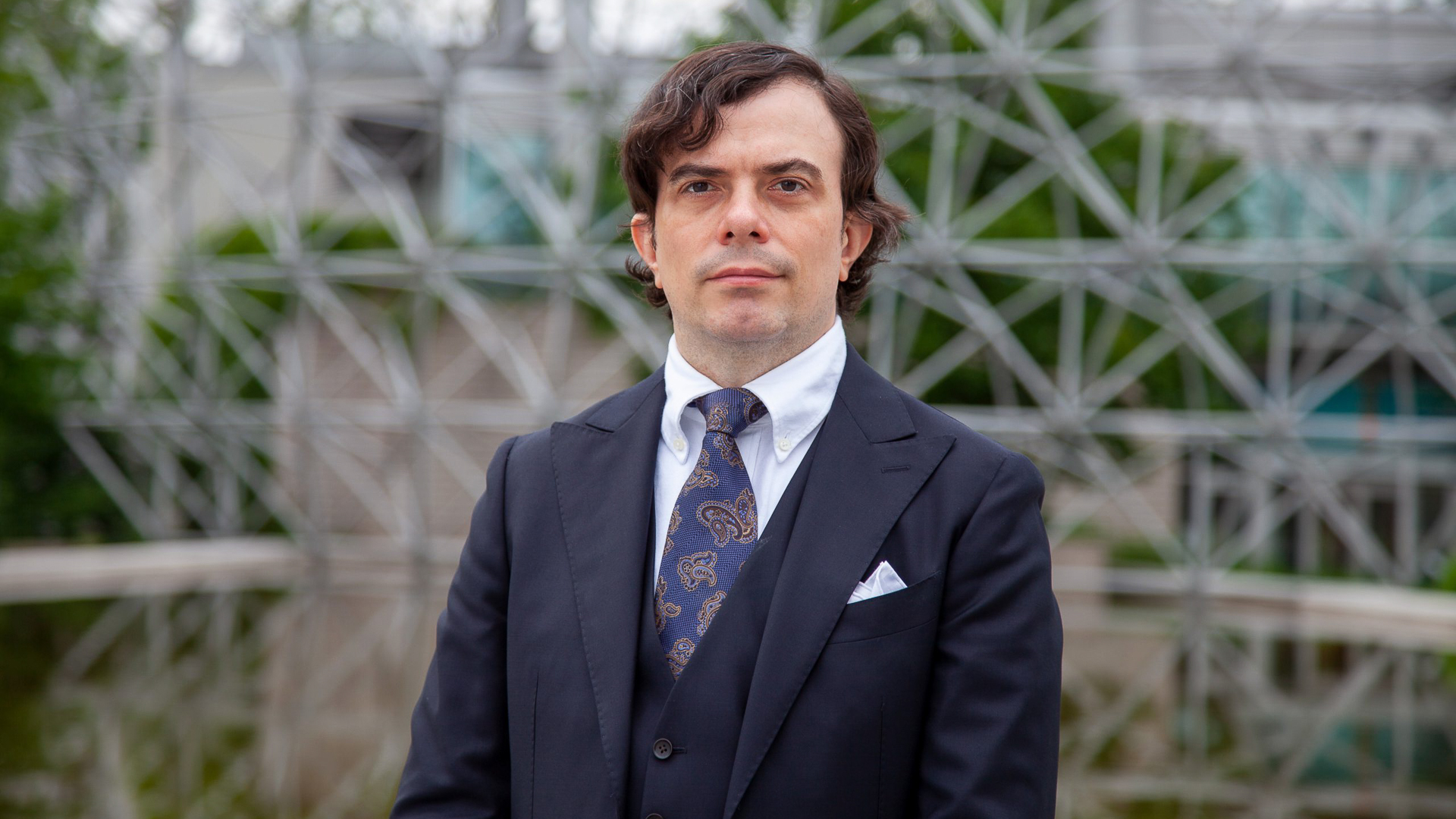
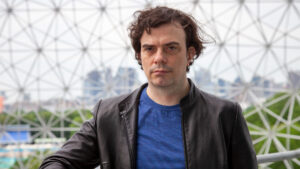
Main Photo: Darcy James Argue (photo by Lindsay Beyerstein/Coutesy darcyjamesargue.com)
*Intervallic refers to the distance between two notes