









To celebrate their 30th anniversary, the Miró Quartet released Home last year. The album features works by American composers Samuel Barber, Kevin Puts, Caroline Shaw and George Walker. Puts and Shaw contributed newly commissioned works for the album. That was the first of several releases for their Pearl Anniversary.

Last Friday, Miró Quartet released Ginastera: String Quartets which finds them performing all three of Argentinian composer Alberto Ginastera’s string quartets. It’s a wonderful album and if violist John Largess and the quartet have their way, these Ginastera quartets will be more regularly performed and more universally celebrated.
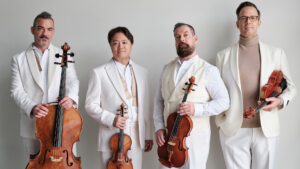
Miró Quartet serve as the Quartet-in-Residence at this year’s Orcas Island Chamber Music Festival in Washington which runs August 1st – August 16th. They will be performing Ginastera’s String Quartet No. 2, Op. 26 in concerts on August 15th and 16th. The other members of Miró Quartet are Daniel Ching (violin), William Fedkenheuer (violin) and Joshua Gindele (cello).
In early June I spoke with Largess to discuss Ginastera, how these string quartets fit into their 30th anniversary and if the Miró Quartet is already discussing what to do for their 40th anniversary.
What follows are excerpts from our conversation that have been edited for length and clarity. To see the full interview with Largess, please go to our YouTube channel.
Q: What made this year and Miró Quartet’s 30th anniversary, the right time to record and release an album of Alberto Ginastera’s three string quartets?
For us now at 30 years, I know it sounds kind of funny, but we definitely have reached a level of comfort and maturity with each other. And also a point of reflection and trying to be objective about what our legacy, particularly in recordings, will be. For sure we’re past the midpoint of our career. We chose four different projects to do all around this time and the Ginastera figures into that bigger picture. We did something core, we did something about us, about home, about who we are and where we live now. But we wanted to go back to some composers that we loved and played a lot and that were not played as much.
Ginastera came to mind immediately. We wanted to bring those a little more into the public eye. We wanted to do something that was off the core repertoire. We also love the music a lot, and it’s just really different from everything else and all the other albums. We felt like Ginastera, of those maybe less known composers, feels like the one that we’ve invested in the most and identify with the most and love playing the most.
How has your relationship and the quartet’s relationship to his music evolved over that time?

As young musicians, we loved the intensity, we loved the driving rhythms, we loved the virtuosity. Frankly, we liked the in-your-face character of some of the music a lot. After having played the three pieces for a long time, I feel like we now are more in tune with the atmospheric, the mysterious, the magical, the diaphanous and the maybe like more subjective qualities of all three pieces. We’re a little bit more sophisticated as musicians now.
I hear more of the magic and more of hallucinogenic qualities of some of these pieces. While still they are very hard to play and very virtuosic and require a lot of intensity for some of the louder movements, we bring more dance and I think more folkloric qualities to the more driving music in the first and second quartet than maybe we did earlier as younger people. I would also say that we do play them just technically better.
In looking at previous recordings of these three string quartets, I noticed that your recording is overall at a slower pace than most people do. How has your familiarity with these quartets and your life experience with them led you to a place that made that the right tempo for these pieces?
We spent a lot of time in the studio trying to figure out exactly which tempos to do for each of the different movements of the quartets. In the first quartet, we’re trying to play more of his metronome markings. The first movement of the first quartet is a little bit on Slow 144 to the quarters, a little bit on the slower folky side. It’s easy to play it wild and flighty, but compared to his metronome marking for the first movement of the second quartet, it’s a lot slower and that second quartet is a lot faster. So we did do cross referencing between all three pieces.
We are trying to bring a little bit more clarity to things. We’re trying mostly to do his metronome markings as he marked and bring out the differences. Then, if anything, a little more restraint and clarity with that so that, as much as we can on the microphones for this album, you can really hear the detail of what’s going on.
There was a letter that Ginastera wrote to Aaron Copland in 1953. Copland was one of Ginastera’s teachers. Ginastera said he wanted to, “Be not a voice, but the condensed voices of a whole country.” How do you see these three quartets, which were composed in 1948, 1958, and 1973, as accomplishing his goal?
I would say the first two quartets absolutely accomplish that goal. The first quartet, though it sounds very Bartokian, I feel like the influence of Copland and what he did with sort of North American source material; folk music source material and making it modern, making it dissonant but tonal, making accessible and dance-y with shifting rhythms. I feel like the first quartet is very much a Latino version of that in string quartet form. And there are like the Malambo rhythms, which are the gaucho dance rhythms. It’s very clear in that piece, both in the first movement and the last movement, this is gaucho music.

Ginastera writes in his letters about the slow movement of the first quartet and how that’s supposed to be an evocation of nighttime on the pampas*: gauchos by the fire, beneath the stars, strumming the guitar, which is that opening hexachord. I feel like he achieved that goal for sure. I think [if] an Argentinian would hear this music, if they didn’t know him, would recognize these elements immediately. Because this is the Latin sound from the 20th century. This is folk music, but modern.
If somebody were to do a documentary about Argentina right now, wouldn’t they use Piazzolla before they would use Ginastera?
That’s a really good thing to ask and it’s interesting to me. I think you’re correct, because Piazzolla is better known. Piazolla is so specifically tango and all of Argentinian culture is not just summed up by the tango. Certainly for foreigners, it is. I personally feel like if you want to get an idea of what the diverse nature of Argentina and its music and its culture, I think it’s a stretch to say that all of that’s contained in one string quartet or two string quartets, but there is more of the landscape of non-urban cowboys of Argentina, not the city tango dancers of Argentina. It’s a different level of things. I haven’t thought of this before.
In the liner notes that you wrote for the album, you’ve described the three different quartets as “Full of mystery and virtuosity. The second is unlike anything heard in the string quartet literature ever before. And the third, bewitchingly elusive and mysterious”.” What is the quartet’s responsibility in making these things that are mysterious and unlike anything you heard before, not so mysterious and something that can become tangible for an audience?
When we play these pieces live, we always speak about them before we play them. Even the first quartet, which is more accessible, because most of our audiences in North America, for example, don’t have much context. I feel like setting each of these quartets in context makes them less unfamiliar, less strange. I would love it if they would join the kind of top five 20th century string quartet composers in the core repertoire. You know, we talk about Bartok, we talk Shostakovich. I think most of our audiences like and identify with all three of these Ginastera quartets more than a Bartok quartet.
One of our hopes with this album and with performing these more is I want our students to play these pieces more. I want to be coaching these more when we’re traveling and touring and doing masterclasses. I would like to see, certainly in North America and also Europe, that Ginastera is just more frankly on the pedestal with the other great 20th century international composers that I think he was when he was alive. He was just as famous as Shostakovich, if not more so, when he was alive.
He sort of slipped in our awareness. Maybe I’ll be a little political. I think that’s mostly because he’s a Latino composer. There’s something about a European composer and string quartets and European people playing European music. He certainly hasn’t slipped in classical music venues in South America. People play his music all the time. But aside from a few specific orchestral pieces, maybe the harp concerto and the piano concerto that certain performers have wanted to play, Variaciones Concertantes, Estancia, maybe five Ginastera [pieces] get played in North American venues all the time. Everything else, I think people don’t.
2016 was the 100th anniversary of his birth. Trinity Wall Street was involved with a festival that really wanted to try to bring his reputation back to the fore. Has the needle moved at all? Has any progress been made in nine years?
I would say slightly, but mostly no. I think COVID got in the way of that because COVID shook up for about three or four seasons, everything that classical musicians in all genres were thinking of programming. We started playing much more music of composers of color from the 20th century, which I think is great. We did a lot as a community in North America. Classical music tried to embrace more diversity of voices and actually there’s much more programming of contemporary commissions and premieres.
I think the challenge with Ginastera is that people think of 12-tone, 20th century music from the 60s as just being ugly. People would rather hear Philip Glass, John Adams, and the next style from the 80s on of minimalism or contemporary voices now in the United States. Ginastera gets lost under that umbrella because people don’t know a lot of the music.
One reason why we want to rehab him a bit and bring him out is many of those composers from the late 50s through 70s who are writing in this style, I think he’s unique in the fact that he was able to do it with such a nationalistic, accessible way. He really was able to write in a contemporary language that all of his peers respected, and yet nobody sounds like him. Nobody else was trying to evoke this kind of nationalistic flair using this style, and I think he was super successful at it.
If Ginastera string quartets are the best way for Miró Quartet to celebrate its 30th anniversary, what do you envision will be the right things to do for a 40th or 50th anniversary?
Whenever we come to our anniversaries, we try to look backwards and also look forwards. And the Ginastera for sure is us looking backwards to a composer we loved at the beginning, that we’ve played for our whole three decades together. Then also looking forward and that we want to keep playing it.
I would say at 40, there are absolutely some other composers that we played in our very early days that I think we’d love to bring back. I know our 40th anniversary, there will be some release of new commissions that we will have done, hopefully the best of our new commissions over the next 10 years. That will be both looking forward and looking backward. I can see us doing an album or several albums when we look back to core repertoire that’s meant a lot to us over our career and also new pieces that we feel like we want to bring forward in front of our audience and make into the new core repertoire of the future. That’s probably what we’ll be recording.
As exhausting as the life of a professional musician is and the effort that it takes, you are still looking forward to a 40th anniversary?
I’m pretty confident the Miro Quartet will be here in 10 years. I hope that it’s with all four of us. Again, as we age, that’s making sure that we all keep our bodies healthy and can keep balanced with our lives and our professional life and our personal lives. I think that’s our intention as a quartet. In some ways, the longer you stay around, the easier it is to stay. Until you get too tired and old and then we want to just all retire and have a break. But yes, that’s what I think is our intention. I think we’ll have some pretty exciting things coming out in the next 10 years on that journey.
To watch the full interview with John Largess, please go HERE.
*pampas are low grasslands
Main Photo: John Largess (©Jeff Wilson/Courtesy MKI Artists)