









Last Friday, Sono Luminus released the debut album by cellist Tamar Sagiv. It is called Shades of Mourning. While sitting at her grandmother’s deathbed, Sagiv began composing what became the title track of the album. From there she explored all the various stages of grief through eight additional compositions.
The album is powerful and moving. It’s a bold statement from an artist many people may know from her multitude of TikTok videos. Beyond singles, the other recording you can find is her student project: The A Train which featured performances of music written by Jeremy Pelt (best known as a jazz trumpeter) and two other composers. It also features an opening track, When Falling, and the closing track, Longing For, that Sagiv composed.
Earlier this week I spoke with the Isareli-born Sagiv about Shades of Mourning, her grandmother and the worldwide grieving that many parts of the world are facing right now. What follows are excerpts from our conversation that have been edited for length and clarity. To watch the full interview with her, please go to our YouTube channel.
Q: At the age of 12, you saw a video of cellist Jacqueline Du Pré that really influenced you. She is quoted as having said that, “Playing the cello is a journey of self-discovery and self-expression.” How would you describe the journey that led to the creation and the recording of Shades of Mourning?
I came from a very classical musician tradition. And classical music tends to be very rigid. It has all these rules and all the things that are accepted. And sometimes not accepted. The way you perform and the way that you interpret the music. So for most of my life, this is what I was doing. When I started writing my own music, I think that’s when I found my own expression. Before that, I had to stay in the lines of what was given to me and what was accepted in terms of interpretation. That’s a whole artistry on its own. But when I started writing my own music, I was definitely more connected to myself and to what I wanted to express and how I was seeing the world and how I was interacting with people around me.
The composition of Shades of Mourning began when you were at your grandmother’s deathbed. Tell me about your grandmother and what she meant to you.
My grandparents were like my parents. She was a very strong woman and she really taught me discipline. She was very, very disciplined. And she loved classical music. There was always like a Brahms symphony or Tchaikovsky symphony playing. When I was a child, I would always see her work and listen to music. Music was really important for her and she loved music. And I think that she also loved the fact that I was playing the cello.
When she was dying, it was a surprise. We didn’t know it’s going to happen, but it took a while. She slowly passed away. I was next to her most of the time. It was very difficult seeing someone you love dying and seeing them suffer. That’s heartbreaking. I just started composing because I needed to express; to journal in a way. That was me journaling. The day she died…I don’t know how much of it she knew or what was going on around her, but I had the beginning written down and I played it for her. I hoped she knew that she would be remembered in this way with music. That was really important.
What do you think your grandmother would say about this recording if she could hear it?

Wow. You know, I don’t know. The past few days have been crazy. The album went out and I started writing it three years ago. I wished she were here to listen to it and hear a lot of comments from people of how much they connect to the music. I think that would have meant a lot for her. I hope she would have loved it.
You were able to journal through your composition and through, I’m sure, the performance and the recording process. But if this process started three years ago, you’ve been in this world of grief and mourning for three years. How have you taken care of yourself through that whole process?
I think that throughout this whole time, I had this expectation that when the album [was] out, I would feel relieved. I didn’t. I think what helped me take care of myself was music. I know that I was listening constantly to music. I was making music, I was writing music, and these compositions, most of them, I didn’t think they would see the light of day. I thought I was just writing it for myself.
Does this experience and the ultimate release of Shades of Morning, inspire you to do something that goes in another direction that is more contemplative or more joyful or more frenetic or whatever path you wanna take yourself down? I’m assuming you’ve already gone down another path.
I did. And now it’s also a question of whether it’s the right path or not. Someone has said to me that it’s going to be a hard life to live if I will forever be the mourning cellist. Mourning and grief, it’s like a part of our life that you cannot take away. It’s always going to be there. But I think that there are so many other aspects of life that I want to explore through music.
This album is about more than just your grandmother. You have the tracks Roots and Imaginary World. Roots, of course, refers to your having been born and raised in Israel. That’s part of the world that’s going through profound loss. As is Gaza right now. Towards the end of the album, you have Imaginary World where you’re looking forward to a world where there’s always peace. Do you feel that what you’ve put out into the world now is a commentary on what’s going on in the world and that there may be better ways than what’s happening now?
100 percent. Most of the pieces on the album actually were written after October 7th. You go through that and then you go through the war. Then seeing what’s going on in the other side while you are still experiencing what’s going on with your side. You’re thinking, why do we even have sides? You’re all human.
One of the things that was really important for me in the album was, specifically in Roots, which I think is the most aggressive piece that I wrote in the album, it was really important for me to think about humanity and how much beauty we can create. There was so much aggressiveness and so much violence and there is still a lot of aggressiveness and violence and cruelty. As humans we can create all of that. Which is insane to think about what we can do to each other and at the same time we can also create beautiful things and we can also treat each other with beauty and also do things to the world. I really wanted to say I choose to do something that is beautiful.
In 2023, you told All About Jazz that the sound of cellist Truls Mørk had been very influential for you, but you were distancing yourself from his recordings. You said, “Because I’ve been trying to find a sound that is more unique to me.” Have you found that sound and how would you describe it?
I love Truls Mørk. It’s funny because I have a lot of friends who make fun of me for loving him so much because I can say that if he was even playing completely out of tune, I would still love him because I just love the sound so much. I think that at a certain point I realized that it was limiting me the way that I was listening to him and how much I loved it. I think when I started studying with Matt Haimovitz, that’s when he encouraged me and showed me in a way that you can experiment with more things, with more sounds and there are so many other possibilities. I don’t know if I completely found it yet. I know that I’m on the way of finding it. I don’t know if you ever find it. I think it’s like a work in progress all the time. It’s always evolving.
In that same interview you said, “I believe that in order to be good at what you do, and stay relevant in the music industry, you always have to reinvent yourself and break rules, especially in classical music, where there are a lot of rules that can be broken.” How important do you think rule-breaking is for the long-term viability of classical music in the future?

I think it’s very important. One thing that a lot of composers come and say right now when they hear my music and this album is that it’s not contemporary enough. Maybe in the way that, you know, I didn’t hit the instrument with a bunch of sounds. I come from classical backgrounds. Obviously my ear goes in a certain direction. The composition is affected by that. It’s not really experimental music in the way that contemporary music nowadays can be.
I think that there is definitely a place for that kind of music to be made. I did that for many years and I will continue probably to do that as well as part of experimenting and learning new things. And at the same time, I felt that we can also do something that is taking influences from Bach and the Beatles and from that experimental phase all at the same time.
I have a TikTok account that a lot of young people are on and I think that the reason that they are able to connect to this music that is very classical. Because a lot of the influences are coming also sometime from pop and rock. Reinventing this genre that so many people did already before me is so important for classical music to exist today.
Russian writer Leo Tolstoy is quoted as having said, “Only people who are capable of loving strongly can also suffer great sorrow. But this same necessity of living serves to counteract the grief and heals them.” How has writing, performing and recording Shades of Mourning healed you?
Just having an outlet that was creative was already a big step in healing. The first piece, Shades of Mourning, was the hardest to record. I don’t know if it was because of the emotional baggage that it had or also because it’s a more difficult composition because it’s very gentle and technique-wise, it’s very difficult. I didn’t find particularly healing. But the past few days since I see people and I hear people listening to the album and connecting to it, that has been the most profound part of the healing.
I don’t know what is healing. Can you heal from grief? I don’t know. But I do know that there was a time when I was writing the album that I couldn’t find anything good in the world. I was really thinking that there is nothing. Now I see people and I think that there’s so much good that people can do and be. And I think it’s very encouraging.
To watch the full interview with Tamar Sagiv, please go HERE.
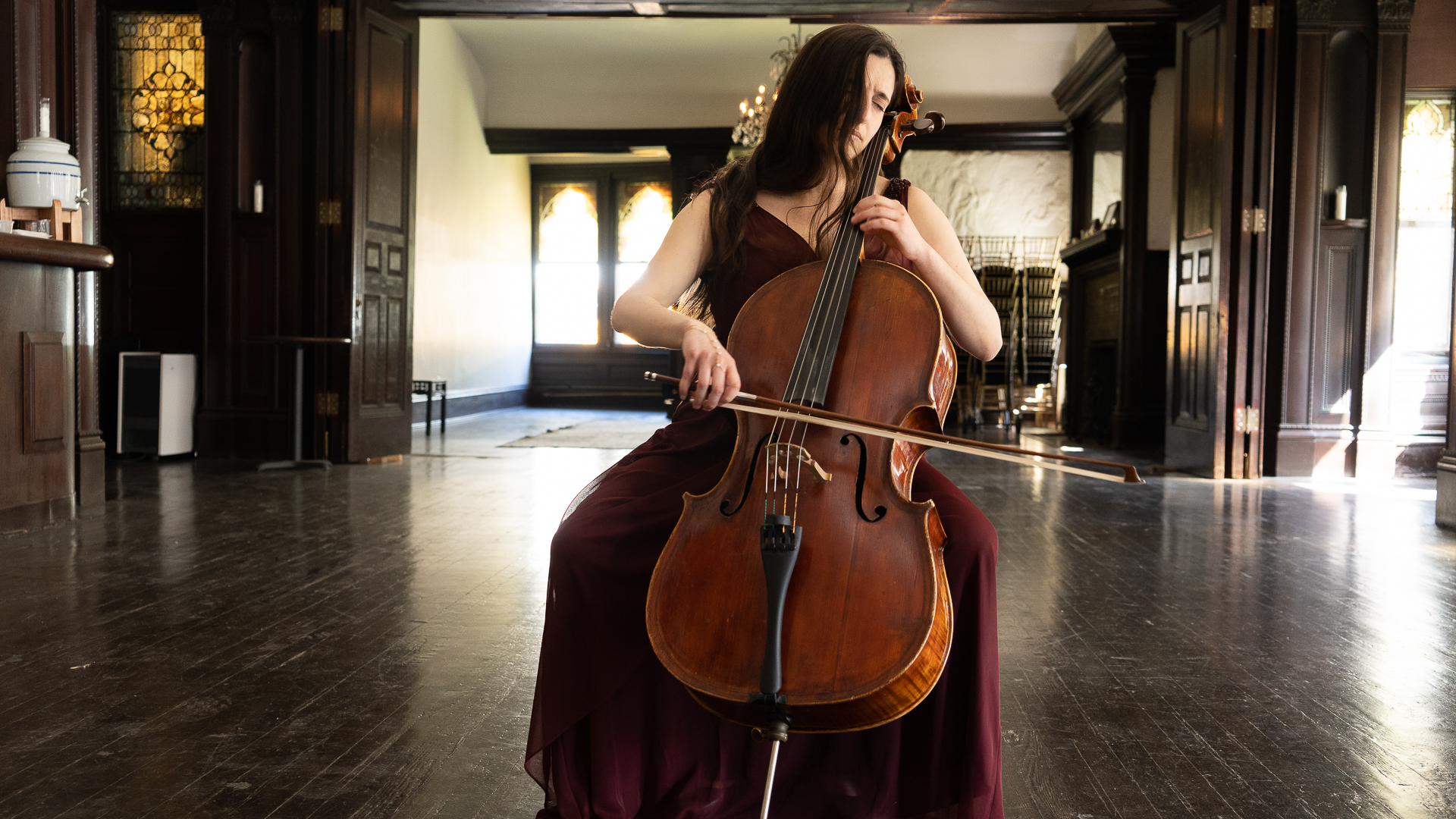
Main Photo: Tamar Sagiv (Photo by Apar Parakhol-Courtesy Jensen Artists)