

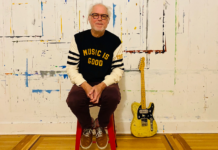
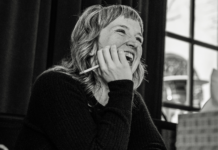




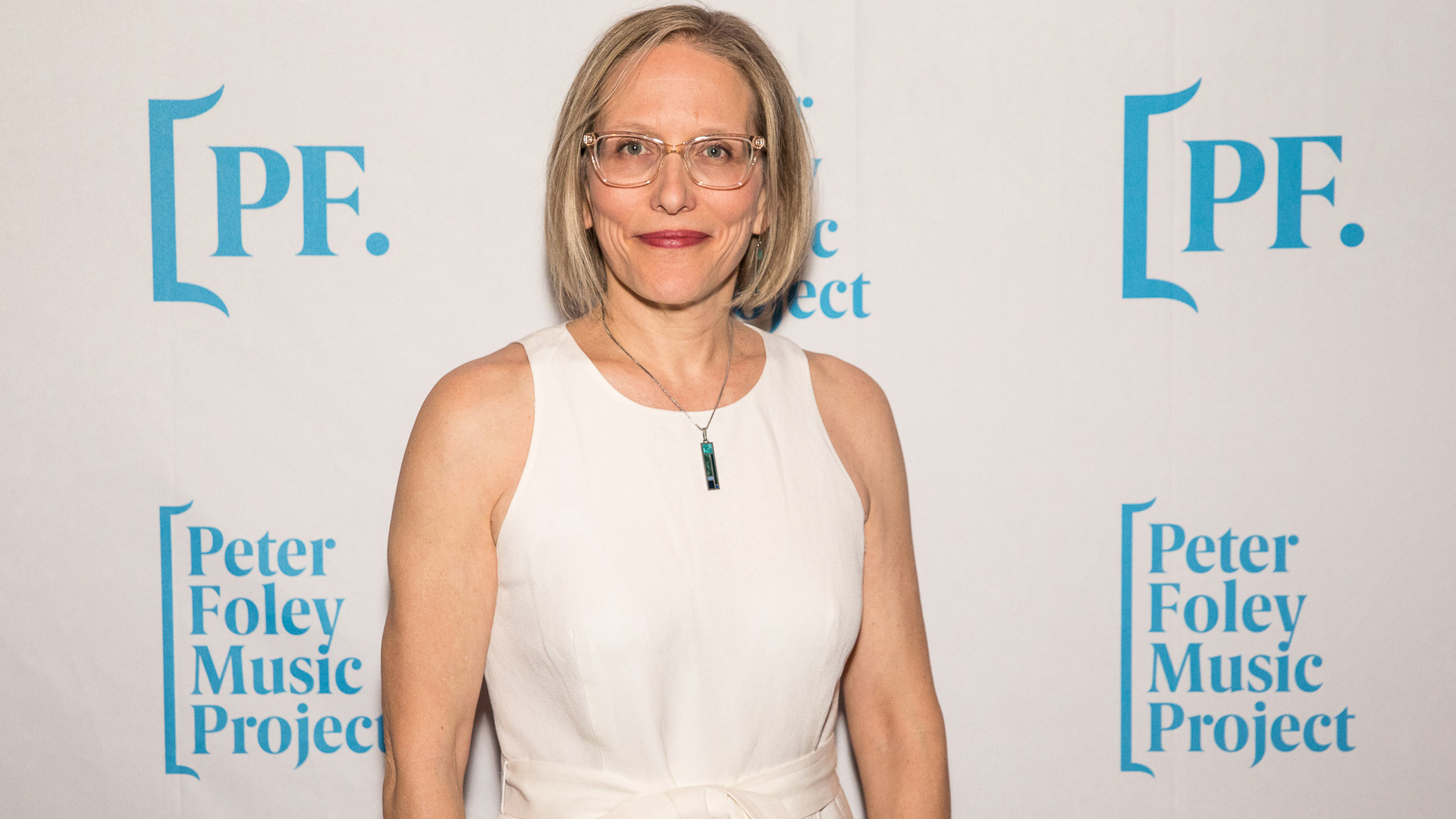

When composer and lyricist Peter Foley passed away in 2021, he left behind an extraordinary body of music—works that challenged, delighted, and spoke with rare honesty. His widow and longtime collaborator, Kate Chisholm, has devoted herself to preserving and sharing that legacy through the Peter Foley Music Project, which has already produced a concert, a critically acclaimed album, and new access to his scores.
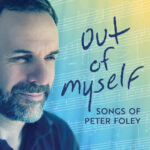
The album, Out of Myself – Songs of Peter Foley, showcases his music as performed in that concert by Kate Baldwin, Mikaela Bennett, Max Chernin, Elisa Davis, Melissa Errico, Manoel Felciano, Ashley Pérez Flanagan, Jason Gotay, Marya Grandy, Darron Hays, Christian Probst, Sam Simahk and Michael Winther. It was my top pick for New In Music This Week: July 25th.
In this conversation with Cultural Attaché, Chisholm reflects on Foley’s brilliance, his resilience in the face of setbacks, and the deep love that bound their lives and work together. What emerges is a portrait of an artist whose music still feels urgent, timeless, and profoundly human—and of a partner determined to make sure his voice continues to be heard.
What follows are excerpts from our conversation that have been edited for length and clarity. To see the full interview, please go to our YouTube channel.
Q: For those who don’t know, who was Peter Foley and what was your relationship with him?
Peter Foley primarily a composer and lyricist. He was also a music director, arranger, orchestrator, and really an expert in music notation. That’s how he made a living. He did a lot of music preparation for Broadway shows. He and I met in college. He was actually one of the very first people I met. We were both actors at that time auditioning for the same shows. We were in singing groups. So we were acquaintances. Our senior year, he wrote a full length musical as his senior project, which I got cast in as one of the leads opposite Melissa Ericco. Our romance started as these things tend to do. We were together for 32 years, married for 27.
Do you remember the first time you heard one of his songs?
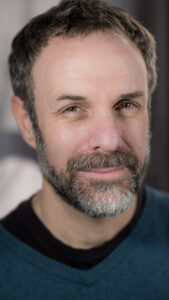
This is a funny story. My freshman year I was dating someone else who had to do a big composition project. [He] came home with the cassette recording of his piece. Do you want to hear it? He played it. I said oh that was you know that was lovely. He said do you wanna hear something really amazing? He fast-forwarded to a recording of a piece that Peter had written.
I knew Peter at that time and I was blown away by this instrumental piece. When I was thinking about auditioning for this show, he had made a demo recording of the entire show and you could go listen to it at the drama school library. I remember just sitting with the headphones on and just being completely blown away by the music. So sophisticated. It reminded me of Sondheim, but Peter just had a harmonic language that was really completely his own.
That student production was of Whitechapel. What do you remember most about that experience—because you were one of the very first people to sing his songs?
When in high school I had done, you know Jerry Herman musicals and those were fun, too, but this was really a whole new experience for me as a singer. They really felt like monologues; like a complete journey. That was very exciting as a singer-actor. It was so exciting. We all felt like we were at the beginning of something really amazing.
Coming out of that experience, what kind of hopes did you both have?
At that time, there was definitely a sense [that] Peter Foley is brilliant. He’s going to go to New York and take over Broadway. That was really what everybody thought. Then it turns out that it’s not that easy to get shows produced. Especially at that time. This was the early 90s and coming out of the mega musical era of the 80s.
Peter talked about the works of Stephen Sondheim. These were sort of ushering in this new era of musical theater. But actually, they’re kind of an anomaly. He had Hal Prince and other people and ways of getting his very daring, adventuresome work produced at that time. We just found it a lot harder to get the shows produced.
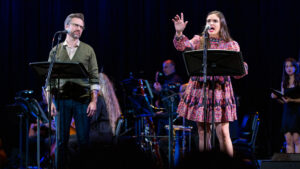
In 2022, I interviewed Ricky Ian Gordon, who said, “Unfortunately or fortunately, a lot of us or some of us thought Stephen Sondheim was an open door. And we walked through that door and thought, this is what musical theater is going to be. And then, you know, he was just an aberration. Then we all wrote the way we wrote and the critics were just like, that’s post Sondheim.” Given Peter’s passion for Sondheim’s work, how much do Ricky’s words mirror Peter’s own experiences?
It’s hard for us to remember now that there was a time period where Steve’s work was not necessarily thought of as the most commercial, huge success, established in the canon, the way it is today. So I think that’s totally true. Adam Gopnik wrote about this in a beautiful piece he wrote about Peter for the New Yorker a few years ago. It really was not an open door.
One of the things that stands out to me about listening to Peter’s music – and I didn’t know it before I got to hear this recording – is that there is another layer to them and that all of it fit together, words and music, seemingly effortlessly. Which, of course, is impossible for that to be true. Peter said that if he had spent time writing all the lyrics for his songs, he would have never gotten anything completed because he was such a perfectionist. Do you see a difference in Peter’s style when he was the lyricist versus when he wasn’t?
I know that he really loved writing both music and lyrics because you just make the decisions. And I think that his lyrics fit so perfectly on the music in every phrase. With other lyricists I think he always said that he was very good at setting text. And he was. If you look at these drafts he’s got all these hash marks for rhythms and circling something to be a recurring phrase and crossing stuff out. There was definitely back and forth with the other lyricists he worked with partly because he had such high standards for lyric writing.
But I also think that musically, maybe some things came out that might not have if he had written those lyrics. Particularly with the final show that he wrote, The Names We Gave Him, with the playwright Ellen McLaughlin, who writes very poetic lyrics. What Peter did with that show musically was just extraordinary.
You were one of his collaborators. You wrote The Hidden Sky with him. Tell me about that experience, because I know there were a lot of good things that came out of it and there were a lot of hard lessons that came out of it as well.
We started writing that, I’m going to say around 1993, 94. Peter actually got an NEA New American Works grant. We were living in Brooklyn at the time and going to see everything in the Brooklyn Academy of Music. All of this really innovative international theater all over the map stylistically.
Peter always said that was his grad school. We loved that actually a lot more than the commercial theater at the time in New York.
We only had the first act written. And then we were trying to get a theater in New York to do a reading of the show. No one would do it with the first act, even though we had quite a chunk of change to be supporting that. Our assistant stage manager had worked at the American Music Theater Festival in Philadelphia*. She said they would love this. It was another few years of development with them. We had a big production in Philadelphia that wasn’t really what we had envisioned. Parts of it were really great, but I think that was Peter’s first really big time of feeling like this is my shot. Then just being really disappointed by some aspects of it.
Did he feel like that was going to be his only shot?
Peter kept having these setbacks, but he just kept finding the next show and writing the next shows. We had this small, almost community theater production of that show in Connecticut. We are just rewriting the show on our terms. We did that and we were able to also see it. Very shortly after that he met Ellen McLaughlin and they started working together.
He also started working with some college friends on a show about the 17th-century Dutch tulip mania called Bloom. He got a commission from Signature Theater in Virginia. At the end of that sometimes a theater will do your show and sometimes they don’t. In Peter’s case they didn’t. [He] created this incredible work, but ultimately those shows did not get produced or have not yet been produced.
You talk how Peter kept getting set back after set back, but still pursuing. What does it say about his resilience and his commitment to his art that he didn’t let it stop him?
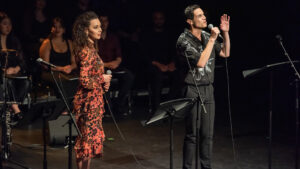
It was really hard. It was hard for both of us. Amazingly he did not become embittered. He would make a catty remark here and there. But I think he just loved it so much. He believed in, not only his talent, but in things he wanted to say through his work and he stayed true to that. When he died, so many people….just said what a model of persistence he was. Of staying true to yourself and what you wanna do in this life and what do you wanna as an artist. He could have done commercial work. But that wasn’t where his interests lied. And I think he wanted to keep really challenging himself, too.
What are your hopes that that this album will actually lead to greater and deeper explorations of his work through productions?
We’ve just been going step by step with the Peter Foley Music Project. First it was we needed a good website to introduce people to his work. We didn’t set out to make an album. We just recorded the concert because you should have that as an archive. We were going to maybe rebalance things for the video. Then when our mixer, Pete Karam, did such an amazing job, we decided to make an album I’ve been thinking about this album was kind of like, OK, now we’ve completed this big thing. But what I’m realizing it’s actually a beginning. I would like it to become a calling card and introduce people to some of these shows
What has this journey been like for you emotionally?
Peter passed away almost exactly four years ago. Before that he struggled with a rare cancer, ocular melanoma, for over 10 years. That was the journey of our family. I’ve been thinking a lot about love and different forms of love over these years in my grief. I realized that as much as I loved Peter as a person, but also, when I fell in love with him, I was falling in love with his music at the same time. Working on all this since he died has been, in a way, to kind of continue that love.
If we hadn’t done any of this, I would feel so heavy. So burdened knowing that there was this incredible treasure chest downstairs in the basement of the most gorgeous music. That would be another form of grief for me. Every once in a while something would just take me by surprise. I could hear Peter playing the piano or singing and those moments are hard. But that’s just love, right?
Of all of Peter’s songs, whether they’re on Out of Myself or not, what do you think is the one song that best represents not just the composer with whom you worked and collaborated, but the man to whom you were married?
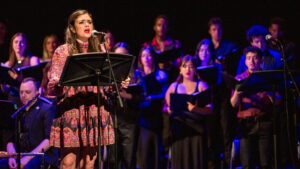
At the end of The Hidden Sky set, there’s a song excerpt from a 20 minute sequence in the show, Revelation: All Is Number, where this character’s been working on stuff and she starts to see these patterns that connect everything in the universe. She’s basically having a mystical revelation on stage in real time and we’re watching it and we’ve sort of seen everything leading up to that. I feel like that feels so essentially Peter to me as a deeply spiritual person Someone who was always contemplating his purpose for being here and the nature of the universe and reality.
Then the final song on the album, Yellow Field, was kind of Peter at the end of his life. I mean, it’s actually sung by a man who’s dying. And at one point, what is he remembering at these very final moments of his life? It is love, his great love. When we had that listening party, when he was in hospice, this was a virtual gathering to listen to his demos. We played Yellow Field. I can’t remember if it was the last thing in our set.
I only saw Peter cry a few times in his life. He was very emotionally open, but not someone who cried. And that lyric, that moment in that song, he cried.
To see the full interview with Kate Chisholm, please go HERE.
All song titles referenced contain links to videos of performances of those songs. So do the performance photos.
Correction: An earlier version of this story indicated that Peter Foley passed away in 2019. He actually passed away in 2021. Cultural Attaché regrets the error.
*American Music Theater Festival in Philadelphia is no longer in existence.
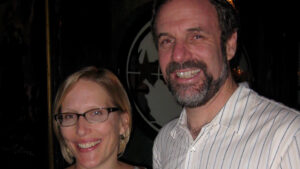
Photo: Kate Chisholm (Photo by Tricia Baron/Courtesy Peter Foley Music Project)