









Few contemporary plays have tapped so directly into the anxieties of modern life as Jonathan Spector’s Eureka Day. First staged in Berkeley in 2018, the play dissects a private school community torn apart by debates over vaccination—a topic that, at the time, was not yet tethered to partisan identity. Then came the COVID-19 pandemic, and suddenly Spector’s prescient comedy-drama looked less like satire and more like a mirror.
In the years since, Eureka Day has traveled from regional stages to Broadway, winning the Tony Award for Best Revival of a Play. This fall alone, multiple theaters across the U.S. are staging productions, including Marin Theatre Company where it is running through September 28th and the Pasadena Playhouse where it will play through October 5th.
Audiences laugh at its sharp observations, but they also leave wrestling with deeper questions: How do we talk across divides? What happens when consensus fails?
I spoke with Spector about the play’s evolution, the role of listening in an age of polarization, and what it’s like to see his work live so many different lives onstage. We also touched on his newest play, Earth Right, and the delicate balance between artistic curiosity and political urgency. What follows is our conversation, edited for length and clarity. To see the full interview with Spector, please go to our YouTube channel.
Q: Eureka Day has had quite a run—winning the Tony Award for Best Revival of a Play, playing at Marin Theatre in Mill Valley, and now playing at the Pasadena Playhouse among six other productions this fall. You must feel pretty good about all this success.
Yeah, it’s been… I mean, you know, it’s an incredible gift as a playwright. To get any play produced at all is tough. So to have a play get this much life—it’s really special.
To what do you credit the play’s popularity, especially since the play itself suggests consensus is nearly impossible?
I don’t know. Any play with a high-profile, well-received New York run tends to have a long life afterward. And there’s an obvious relevance, in a way I could never have anticipated—particularly with the dismantling of the CDC and FDA, and the government actively taking away vaccines. That’s a very particular moment tied to the ideas the play is wrestling with.
Also, the play had a long journey to Broadway. A lot of regional theaters had been wanting to do it, but the rights weren’t available. So I think it’s all those things coming together.
You couldn’t have predicted seven years ago that it would land at exactly this moment, when trust in government health institutions is unraveling. On some level, it’s the perfect news cycle for your play.
Yeah, though it’s like the monkey’s paw—you never want your play’s relevance to come at the cost of people being sick and dying. That’s not something I’d wish for.
But the play was written before COVID. Back then, vaccines weren’t politicized in the same partisan way. If you only knew someone didn’t vaccinate their kids, that didn’t necessarily tell you the rest of their politics. Now it’s much more correlated—you see rising rates of unvaccinated children in red states. Trump and COVID scrambled all that.
So initially the play was about a place where everyone shared the same worldview—except for this one thing, where they lived in separate realities. That feels less true now, as we’ve become siloed in almost every aspect.
In a previous interview, you said social media entrenches opinions and prevents people from hearing opposing views. What role do you think “not listening” plays in how we move through life?
You always want to be cautious about romanticizing the past. But it’s hard not to feel things were better before social media. It doesn’t just create bubbles—it distorts your sense of how widely held your opinions are. You think many more people agree with you than actually do, and you think those who disagree are a smaller, more extreme minority. That makes it much harder to have conversations.
I’ve read the play but haven’t seen it. What struck me was that everyone in Eureka Day speaks in the language of inclusivity and giving space, but no one really hears each other. Was that deliberate?
I think early on, they are trying to listen to each other. Their process of finding consensus, as tedious as it is, has worked for them for a long time—until they encounter this thing you can’t really find consensus about.
And it’s interesting: when we did the original Berkeley production seven or eight years ago, the characters felt very particular to Berkeley. Now, those same patterns of speech and engagement are everywhere. That’s disorienting.
In the published script, you write that “words in parentheses are not to be spoken.” What’s the purpose of leaving words unsaid?
That’s really just to help the actors. In natural speech, we often don’t complete our sentences or we interrupt ourselves with new thoughts. The parentheticals show where a character was going before changing direction or being interrupted. It’s not unique to me—just a way to clarify the rhythm for actors.
You’ve said you didn’t set out to write a satire. You just depicted people as they were, and it turned out funny. How has the play changed once you put it in the hands of actors, directors, and audiences?
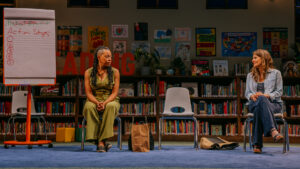
Theater is strange that way. The play has had so many iterations, and it lands differently depending on the city, the country, or the cultural moment. It felt very different in 2018, then again in fall 2021 when COVID was consuming everything, and now again with more distance. Plays are living things—they’re always a little different. That’s beautiful and maddening, because you can never lock them down.
But if the world sees it as satire and you didn’t write it that way, how do you respond?
Very often if you put things on stage exactly as they are, they seem over the top—even if they’re true.
When we first did it in Berkeley, audiences saw those characters as authentic: “these are just like us.” But the farther away the play travels, the more people see it as exaggerated. Some London critics, even those who liked it, wrote, “Nobody really acts this way.” I think that’s just unfamiliarity with how we are in California.
I’d imagine the key for directors and actors is not to play it for laughs.
Exactly. And I’ve been lucky with really good actors—they naturally seek authenticity and truth. Of course you still hit the jokes, but if you squeeze every laugh early on, you’ve got nowhere to go in the second half.
Any good comedy exists for more than just laughs. What do you want audiences to take away beyond enjoying themselves?
If people leave the play and continue thinking about it afterward, that’s a success. Most of what we consume, we forget instantly. I don’t write thinking, “I want the audience to walk out believing X.” That’s a fool’s errand—everyone comes in with their own background, mood, and energy. My hope is just that they’re not bored, and that the play lingers in their minds.
But there must have been an initial impulse behind writing it?
Sure. It was something I was curious about, so I thought it would make an interesting play to explore.
How many of the play’s characters are people you know?
All of them, in a sense. No one is directly based on a single person, but everyone is a composite of people I know.
At one point, Eureka Day was scheduled for the Kennedy Center but canceled. Was that a curse, a blessing, or both?

Both. I grew up in D.C., so my parents were excited about me having a show there. But once Trump took over, it would’ve been complicated—morally gray territory. If your show does well there, does it become something they can point to as proof of success under Trump? You can’t win in that situation.
That sounds like the same kind of conundrum your characters face at their school.
Yes, balancing different values and deciding which ones get greater weight when they conflict.
You premiered a new play, Earth Right, this spring in Miami. What was that experience like, and what’s next for it?
That was wild. The theater announced it before I’d even written it, which was crazy-making. But it came together in a really special way. It looks like it’ll be in New York next year, late spring or early summer.
Did having that kind of deadline help push you through the writing anxieties?
Deadlines are crucial. And in this case, the play wasn’t really finished when rehearsals started. I was getting up at 3 a.m. every day to rewrite before rehearsal. Brutal, but having that collaboration—knowing I had to bring in pages each day—was what made it possible.
I spoke earlier to K. Todd Freeman, who mentioned Tony Kushner still rewrites Angels in America. Do you feel that impulse to keep rewriting?
I don’t think it’s possible to be in rehearsal and not rewrite, at least a little. You’ve changed as a person, the actors are different, certain lines don’t land the same way. Even now, I’ve made tiny tweaks to Eureka Day just bouncing between productions in Marin and L.A. You can’t not do it.
So every production might get small changes?
Not every production—I won’t be in rehearsal for most of them. But when I am, yes, little changes happen.
Deadline Hollywood reported discussions of a feature film adaptation. True?
Yes, I’m beginning work on that. We’ll see.
One last question. You’ve cited Caryl Churchill as an influence. In her adaptation of A Dream Play, she wrote: People aren’t evil and people aren’t good. They live how they can one day at a time. They come out of dust. They go back to dust—dusty feet, no wings. And whose fault is that? That reminded me of your characters. Does that resonate with you?
Very much. I usually begin a play with a question I don’t understand, then I research, interview, and try to understand how other people think. When you’re not trying to convince someone of anything—just listening—it’s so human.
That curiosity is key. I think we recoil from “political theater” because we expect it to be didactic, with characters as mouthpieces. If I started from, “I have something important to say,” it would be awful—for me and for the audience. But if I start with, “I have something I want to understand,” then curiosity can lead me places I didn’t expect.
And one of those unexpected places was the stage of Radio City Music Hall, winning a Tony.
Yes. I certainly didn’t expect that when I started.
To see the full interview with Jonathan Spector, please go HERE.
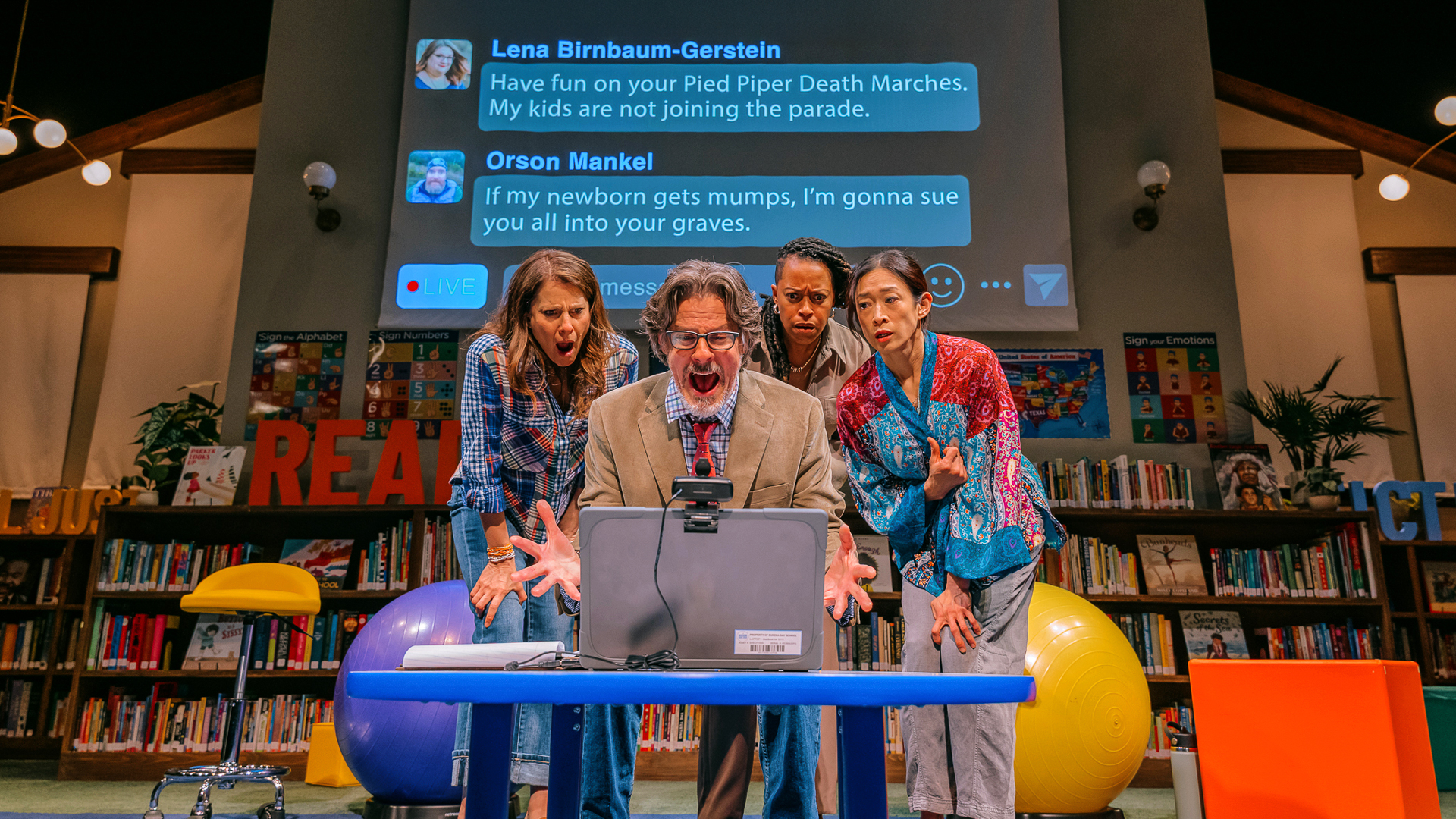
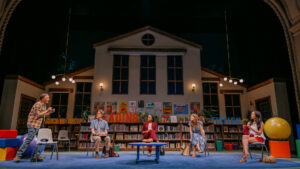
Main Photo: Mia Barron, Rick Holmes, Cherise Boothe and Camille Chen in Eureka Day (Photo by Jeff Lorch-Courtesy Pasadena Playhouse)