

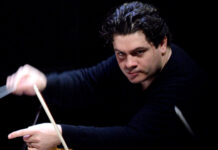
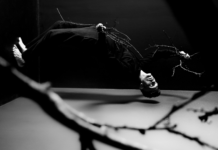





For more than four decades, choreographer, writer, and performer David Roussève has been a vital voice in American dance-theater. Known for his ability to blend storytelling, movement, humor, and raw honesty, Roussève has never shied away from tackling difficult questions about love, survival, and identity.
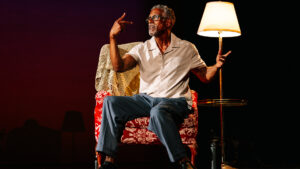
His new work, Becoming Daddy AF, premieres at the Kelly Strayhorn Theater in Pittsburgh on September 26–27 and at CAP UCLA’s Nimoy Theater on October 17–18. Part memoir, part meditation, and part love letter, the piece delves deep into Roussève’s family genealogy, personal history, and the philosophical questions that have guided his art.
In this conversation, Roussève reflects on curiosity, mortality, the search for meaning, and the profound role of love.
He also opens up about vulnerability, catharsis, and what it means to survive—and thrive—through decades of challenges. The result is a powerful portrait of an artist still asking the biggest questions and daring to share the answers he discovers onstage.
What follows are excerpts from our conversation that have been edited for length and clarity. To see the full interview, please go to Cultural Attaché’s YouTube channel.
Q: Your new work, Becoming Daddy AF, is premiering this fall. What were you most curious about when you began creating it?
Curiosity is my guiding principle. When I started Daddy AF, I had just finished a piece about jazz composer Billy Strayhorn. I so enjoyed excavating someone’s internal domain and then I thought, may I can apply that to myself. I was also very aware that I was old. I have less time ahead than behind me. I thought what a perfect time to ask why am I here? Why did I, of all people, make it to 65 when so many others didn’t? That curiosity became the genesis of the piece.
Did you have any fear about excavating your own genealogy and personal history so deeply?
At first, no. But quickly—yes. There were definitely WTF moments. The piece revolves around my former husband’s suicide, my own experiences during school desegregation in Houston and my curiosity about genealogy. One side of my family traces back to free Black ancestors in 18th-century New Orleans as far back as the 1400s. The other side descends directly from enslaved people. My biological body is literally an amalgam of freedom and oppression, privilege and struggle—is literally in my body. How could that not shape who I am?
On your website, you call this piece “a portrait of a man defying death but somehow unable to unabashedly embrace life.” Yet you seem very much to embrace life. Has this exploration gone beyond autobiography into something more universal?
Yes, absolutely. I don’t create autobiographical work just for myself. My goal is always to offer a space where others can see themselves, no matter their background. This isn’t me saying ‘here’s the meaning of life.’ It’s me asking: what might the meaning of life be for you? For me, love emerged as the reason to live, but the piece invites each person to find their own answer.
Do you see the piece offering catharsis?
That’s exactly the goal.
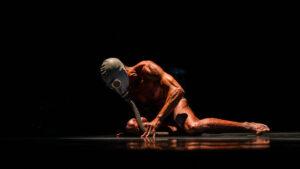
The final image is designed to be cathartic—visually, physically, emotionally. For me, it feels like the crescendo of 40 years of artistic searching. I hope audiences feel that too.
You’ve spoken before about the importance of vulnerability. How vulnerable does this work require you to be?
Very. At first I struggled. Some of the deeper moments felt false because I wasn’t staying open. I had to relearn how to remain present, to really let myself be vulnerable onstage. The piece itself mirrors that journey—from telling stories in the third person, detached, to eventually speaking in the first person, directly to the audience.
Survival has always been a thread in your work. How do you see survival now, at 65?
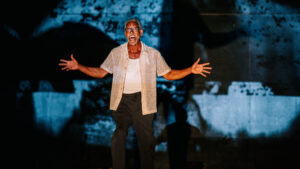
Survival is everything. I was diagnosed HIV-positive in 1992. So many in my community didn’t survive. Just making it to this age is miraculous. I used to measure success in accomplishments. Now, success is survival—and hopefully, thriving beyond that.
You’ve endured tragedies, but you’ve also found love again later in life. How has that shaped this piece?
The piece insists that we can’t just wallow in pain. We acknowledge the tragedies, but also the joys.
I found my husband Stephen at 60, which I never thought would happen. It’s a reminder that joy can arrive at any moment, no matter how much has come before.
As someone often called a master storyteller, how do you feel about telling long, complex stories in the age of social media?
It’s a challenge. Attention spans are shorter. But Becoming Daddy AF reflects who I am—it takes a winding path, with tangents and returns, like life itself. With my dramaturg Charlotte Brathwaite, we worked to keep it moving—like a film—so audiences stay engaged. It’s a big ask, but I believe people are still hungry for deep stories.
We’re also living in polarized times. Do you still believe art can bridge divides?
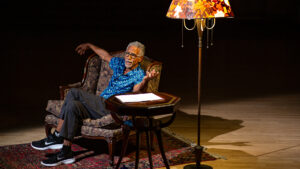
Yes. I believe the arts are what can save the world. They invite us to see ourselves in others—to connect at the level of the heart. That’s why I have to be vulnerable. By opening myself up, I hope audiences, no matter their background, will see our shared humanity.
Finally—back in 1999 you said the best way to get your message out was to be loud. Where’s the volume set now?
It’s lower. The world is already shouting.
Maybe now we need someone who can whisper. There are angry moments in the piece, yes. But mostly, it’s about breathing, going deep, and having a true conversation with the audience.
To see the full interview with David Roussève, please go HERE.
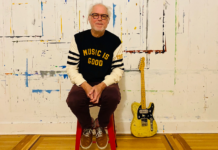
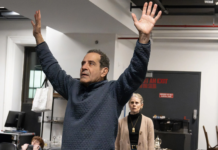
All photos are from the work-in-progress sessions.
Main Photo: David Roussève in Becoming Daddy AF (Photo by Ryan Harper)