









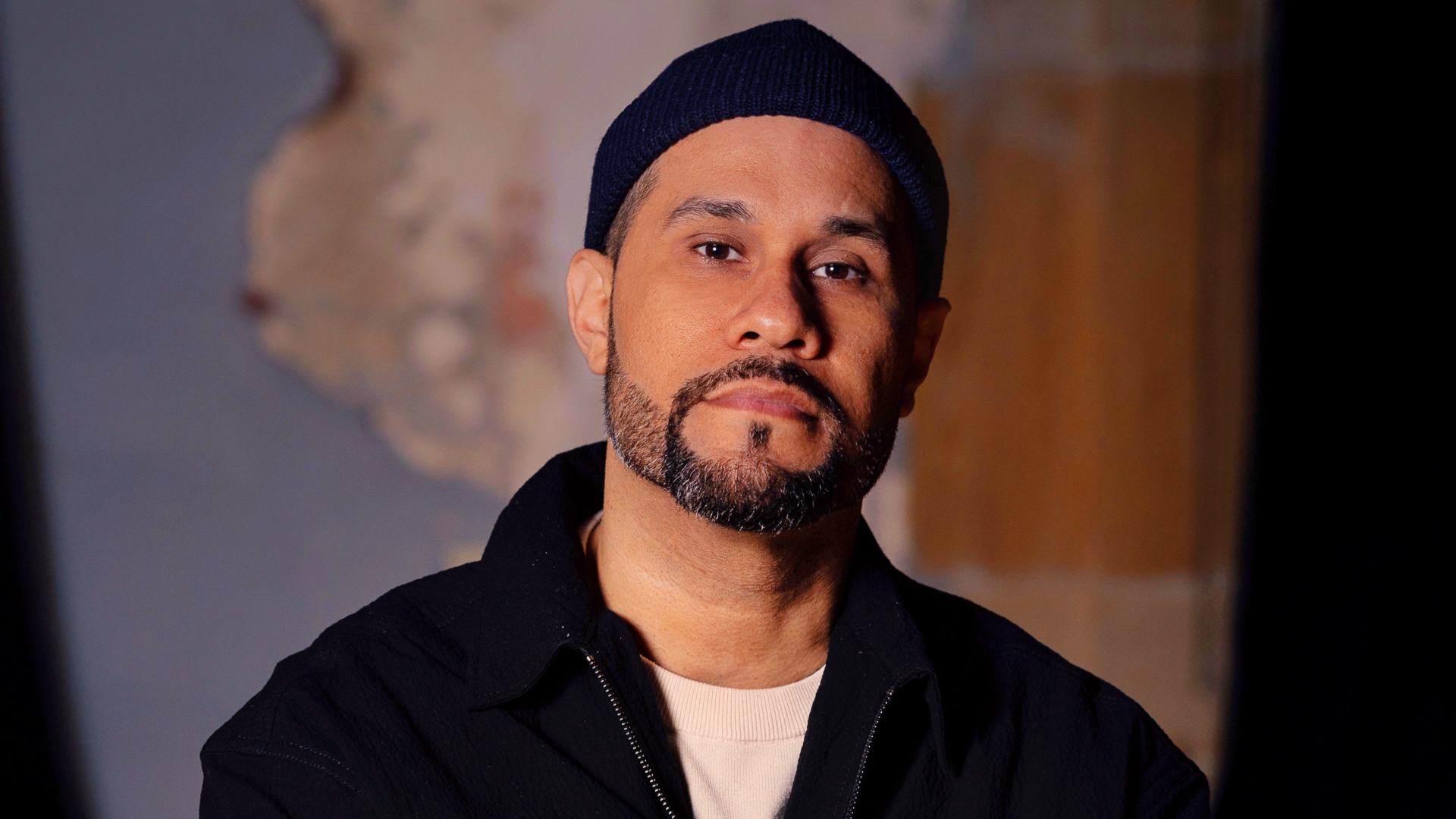

When playwright and performer Rudi Goblen speaks about theater, he does so with the same rhythm that infuses his work—a cadence drawn from hip-hop, dance, and poetry. His new play, Littleboy/Littleman, now having its world premiere at Geffen Playhouse in Los Angeles through November 2nd, continues a creative journey that began in movement and now finds its center in language.

Goblen’s play follows two Nicaraguan brothers, Fíto (Marlon Alexander Vargas) and Bastian (Alex Hernandez), growing up in Miami. It’s a story of love, identity, and survival—a portrait of family caught between cultures and ideas of the “American dream.” Layered with music, spoken word, and dance, Littleboy/Littleman blurs genres while confronting colorism, assimilation, and what it means to belong.
For Goblen, who came to writing after a long career as a dancer and performer, the play is also an act of reclamation: of voice, of poetics, of community.
In this conversation, Goblen discusses how Littleboy/Littleman evolved, what it means to create art for Black and Brown communities, and the ongoing process of finding his own voice. What follows has been edited for length and clarity. To watch the full interview, please go to Cultural Attaché’s YouTube channel.
Q: Fourteen years ago, you told Neil De LaFleur you danced because “it’s the closest I get to flying.” Fourteen years later, why do you write?

I write because I have to—because I need to. When I started in theater in the early 2000s, I joined a company called D-Projects, an all–Black and Brown male dance theater company. It was the first space as a young brown man where I could be vulnerable around other men who looked like me.
As I got older, 20 years later, after having a solo performance career, a dance career, I found myself asking what’s next for me? I thought about creating something like that [theater company] myself.
But what came up for me was understanding that there are not a lot of spaces for Black and Brown communities. There are not a lot of plays, performance arts pieces or characters that people can play – to be specific for Black and Brown artists to play. That very much is one of the things that drives my writing at the moment.
I miss language, like beautiful language in the theater. I miss hearing “I love you” said in a way we haven’t heard before. We have new language and new ways to do things like that, right?
Your show, Fíto – A Concert Play, was performed in 2019 at the Fischer Center for the Performing Arts. What is that plays’ relationship to Littleboy/Littleman

Fíto is like the cousin or sibling to Littleboy/Littleman. There is something that happens to Fíto in Littleboy/Littleman that I want to keep a secret. I started think about what if that didn’t happen. What would be the alternative universe that he would live in. So I wrote the play which is the day of his naturalization ceremony. He’s becoming a citizen after 30 years of being in the country.
You workshopped Littleboy/Littleman at the Geffen before its full production. What did that teach you?
The workshop wasn’t about rewriting the play—it was already my thesis production at Yale—but about collaboration. The script was pretty much in a solid place before we brought it to the Geffen. We wanted to get in the room, me and the director (Nancy Medina), since it was going to be our first time working together. There were a lot of questions that we had around how the music was going to be existing throughout the play. This play is very much intertwined with the music that lives inside of it.
When I read the play, I imagined the music and movement. I’m sure that’s not the optimal way of experiencing your play. Given the way it is staged and performed, you do invite the audience to use their imagination to add to what they are seeing and hearing, right?
Absolutely. It’s why I love live theater, live performance. My goal with my work is always to create a space that is as much for the audience as it is for the performers. Being witnessed by the audience and knowing that they are being witnessed by us. It just creates a different kind of energy that I always search for in every work that I create.
But you wouldn’t mind if you had a show that was so successful it was on at the Winter Garden Theatre in New York, would you? One of the largest houses on Broadway?
(Laughs) Even then, I’d be trying to figure out how to close that circle. It’s just the kind of theatre that I love.
Which of the two brothers—Fíto or Bastián—is most like you?

They’re both very much me. They’re both very much my brothers, cousins, friends — men I’ve known. There’s a lot of everyone in them. They’re very complex characters, very nuanced characters with a lot of hopes and dreams and vast histories. I jump in and out from both characters.
On the surface, Fíto’s desire to be an artist is completely at odds with his brother’s desire to work hard and live the American dream. But I think you can argue that Fíto is also pursuing his version of the American dream.
What do you want to represent most about this relationship between these two brothers and what they want to accomplish with their lives?
The term “American dream” has been coming up a lot. I think it’s easy to think about old versions of the American dream. May now that term is in the most flux it’s ever been since its coining. In the play, the American dream is simple for Bastian. He thinks it’s easy because he wants to change his name, become an American citizen, searching for the atomic family and actually he just wants to survive.
In Fíto’s terms, his American dream is that he is able to dream. He believes that he is free to dream and he runs with that where it’s not necessarily always possible and true because of who he is and how can be to specific people and to specific systems. So I wanted to play with that and explore what kind of conversations can come up while exploring that.
Given what’s happening in the world, the play feels especially timely. Are current events a cruse or a blessing for Littleboy/Littleman?

I don’t know if I would use either word to be honest. It is very interesting, maybe even sad. I wrote it seven years ago. The fact that things that are happening in the play are stilll happening at a much more intense level…it’s interesting how it’s landing in ears. Some audiences maybe imagined that I’m writing this piece as a reply to what is happening.
In the script’s preface, you ask: “How do I get readers and audiences to enter this world without bias?” Have you found an answer?
That’s probably the bane of my existence as a Brown man/writer. There is so much media that has presented Black and Brown communities in specific ways. So it is very hard to combat those ideas, archetypes and tropes.
I play a lot with structure and how I want to tell the story and how music comes in to tell the story. I play with spoken word, street performance, the dream world, the memory world, realism and jumping in and out of those things in a way that felt exciting to me. All I can do is present something that feels good to me, exciting to me and something that I would want to see and want to be part of. My job is as a chef to cook the meal and how people eat it is up to them.
You’ve had talkbacks after each show. Have audiences “seen these men under the umbrellas of love,” as you hoped?
I believe, yes, absolutely. It’s really overwhelming the feedback that we’ve been getting. Perfect strangers who I’ve never met sharing very intimate and beautiful stories with me and family histories that have come up for them during the piece.
In the same introduction to the script you wrote, “I love these men, not only as Brown-bodied characters but as beautiful, compelling humans I’m encouraged by.” How do they encourage you?

I love the way Fíto dreams. There’s a radical imagination to him that I never want to lose. One of my fears is that as I get old is [I] stop dreaming, stop being in awe of the magic of life. Fíto is just entrenched in that radical imagination. Bastian has a methodical diligence and warm rigor where he has to constantly shift from being a parent to being a brother and knowing when to get a little stern but also get stern with love.
I think the root of both traits is compassion between the brothers and that was very important to me. That regardless of the ideas of masculinity that they are wrestling with is also this femininity and the compassion, grace, love and respect that exists within the brothers whether they are conscious of it or not.
There’s a scene where Fíto talks about how people from different countries “all hate each other,” then says, “No one wants to be lumped into one thing.” What are the challenges you have faced in your own career with people who do exactly what Fíto complains about?
First, colorism within the Latinx community was one of the things that I wanted to have a conversation about in the play. I don’t think we hear enough about that. Miami is this special place where you experience colorism in a way that you can’t experience in a lot of places in this country. Miami is a melting pot of Cubans, Guatemalans, Salvadorians, Hondurans, Nicaraguans, Colombians, Venezuelans, Brazilians, Argentinians, Chileans. You get a specific kind of situation that is sometimes hard to explain, but also hard to maneuver.
To answer your question, I can go on for a while talking about the things that I’ve encountered. The micro-aggressions, the racism I’ve encountered as a multiracial body in the industry. But my goal is to show how nuanced, how complex and how a rich a body like mine is.
Without giving anything away, what was the process where you knew you could lead your audience to a place where it would resonate the way you needed it and wanted it to do?

For me, it’s about rhythm, it’s about pace and knowing when that rhythm needs to pick up, when it needs to slow down, when it needs to shift. And it’s something that I’m always keeping my ear on.
We’re at the place in the play where Bastian shows up and they have this moment, him and his little brother. Then we get this beautiful poem from Fíto and we get to see him realize his himself in a way that we haven’t seen him do throughout the play. We see him find his voice. This free voice that can speak in in a way that he’s been trying to find throughout the play. Where he steps away from the microphone and he’s like, actually I don’t need this microphone. All I need is myself. I am enough. That felt like the right moment.
When did you find your voice?
That’s interesting. I’ve been writing for as long as I can remember. I started beatboxing and rapping at a very young age. I have an older brother, who’s seven years older than me, who was very much into the hip hop culture. And so from a very young age, I have been into making sounds with my voice, into riddles, into onomatopoeia, into alliterations, and I started rapping. I think that was when I realized that voice was something that I wanted to embrace.
But it has shifted many times throughout the years, because of interests and the growing that a human that a human does. I think I find my voice with every piece in a different way. I try to challenge myself structurally, textually, every time I create a work. My hope is to always grow in some kind of way and have these plays chronicle that growth years later.
To watch the full interview with Rudi Goblen, please go HERE.
Main Photo: Playwright/composer Rudi Goblen (Photo by T. Charles Erickson/Courtesy Geffen Playhouse)