

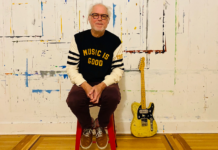
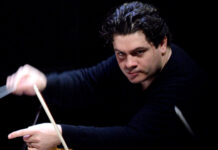




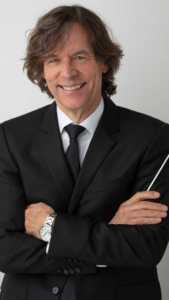
In an era when live orchestral film music is dominated by blockbusters and box-office nostalgia, conductor and composer Scott Dunn is taking a different path. On November 22, at The Wallis Annenberg Center for the Performing Arts in Beverly Hills, he and the Scott Dunn Orchestra will present The Hollywood Modernists – The Second Golden Age of Film Music, an evening dedicated to the visionary composers who reshaped movie scoring after World War II.
The concert, originally scheduled for January of this year, was meant to be the inaugural performance of Dunn’s new orchestra. The fires in the Los Angeles forced the postponement of this concert and another, later, concert served as the orchestra’s debut. So when I spoke with Dunn it was about the beginning of his orchestra as well as the concert itself.
And what a concert it is. Its program revives the scores of Elmer Bernstein, Leonard Rosenman, Alex North, Bernard Herrmann and more — classically trained composers who traded the concert hall for Hollywood studios and forever altered the language of film. For Dunn, their work represents “a second golden age,” when jazz, modernism, and American lyricism collided on celluloid.
In December for 2024, I spoke with Dunn about these musical pioneers, the process of reconstructing lost scores, and why this music still speaks powerfully today. What follows are excerpts from our conversation that have been edited for length and clarity. To see the full interview with Scott Dunn, please go to Cultural Attaché’s YouTube channel.
Q: A lot of people who follow film scores know about the Golden Age. What was the second Golden Age of film scoring?
When I came up with this term, it had to do with my abiding interest in those guys after the war — all New York-based, classically trained composers who were brought to Hollywood and changed the language of scoring from the Teutonic, Wagnerian model to something influenced by modernism, both American and European, and, of course, jazz. I’m speaking of Elmer Bernstein, Leonard Rosenman, Alex North, David Raksin. They all started with Copland and or Schoenberg, and with scores like A Streetcar Named Desire, with its jazzy under-Ellington underpinnings, they really changed the course of film scoring forever.
You can listen to the theme from “A Streetcar Named Desire“ HERE.
Many of the composers from the original Golden Age — Korngold, Steiner, Waxman — were still writing then. Did they stay in their lane, or were they influenced by these newer voices?
As always, when you try to categorize and generalize, you get into trouble. Waxman, as you may know, was a great jazzer and could write really well in that style. So I guess this was something that was probably coming. But this particular generation of guys were a half-generation younger and really a rather singular group.
Once you selected the composers who fit this idea, how did you choose which scores to highlight?
More the latter — the landmark scores. This concert actually grew out of a pandemic-era project. I had just done a live film performance of Leonard Rosenman’s Rebel Without a Cause with the L.A. Phil and had the entire score sitting there. I adapted it into a standalone symphonic suite because that music is remarkable. That inspired me to build a whole concert around the most significant scores of that period — To Kill a Mockingbird, Streetcar Named Desire, David Raksin’s work on Too Late Blues — pieces that I think are just extraordinary.
You can watch the title sequence and hear the music for “Too Late Blues” HERE.
How does your relationship to the music change when you go from listening to it to studying the score itself?
It changes everything. When you think of the time pressures they were under — David Raksin had two weeks to score Too Late Blues because they wanted to prerecord the music so the actors could fake-play to it — it’s staggering. When I look at the contrapuntal writing in East of Eden, it’s just beautiful. These composers had to write so quickly, yet what came out was masterful. Performing the music live also lets you restore passages lost in the final film mix or cut in editing. You weave the cues into something musically complete, and it lets audiences finally hear how gorgeous this music really is.
Martin Scorsese often talks about film preservation. What about preserving film scores? Have things improved?
There’s more interest now, but the losses have been huge. The Warner Archive at USC is remarkable — they actually have managed to keep a lot. JoAnn Kane Music Service also has an incredible collection, as do Paramount and Fox. When I reconstructed Rebel Without a Cause, I found every part and short score. But in other cases, things are completely missing, and you end up doing a takedown by ear. It’s getting better — but sometimes, even five-year-old materials are already gone.
How do you attract a younger audience to a concert like this?
That’s a really good question. We’re not showing any films — just some projected images — so no one will be “subjected” to black-and-white movies. But we’ve got a big social campaign with The Wallis and our team in London on Instagram and TikTok. I hope it works, because this music is incredible. I could probably fill the hall with blockbusters — Jaws, Harry Potter, Back to the Future — but those composers are already getting plenty of attention. My interest is shining a light on this overlooked repertoire.
You mentioned jazz. One of my favorite jazz-influenced film scores is Elmer Bernstein’s The Man with the Golden Arm. Which scores do you feel broke the most ground?
Certainly that one — and A Streetcar Named Desire. Alex North’s score was so jazz-infused the censors thought it was too lasciviously orchestrated. They made him rewrite parts, and in 1996 Jerry Goldsmith restored the original version. Our concert actually includes both Streetcar and The Man with the Golden Arm. I’m also programming the music of Henry Mancini in May — not as a pop songwriter, but as a dramatic film composer. People forget he started as a pianist and arranger for Glenn Miller, worked a decade at Universal, then created Peter Gunn and Mr. Lucky for television. His straight-ahead jazz writing changed everything. Critics called it commercial, but what he did for jazz through that exposure was immense. (Note: The Henry Mancini concert took place in May of this year at The Wallis and served as the inaugural concert of the Scott Dunn Orchestra).
You can hear the theme for “The Man With the Golden Arm” HERE.
Where does Miles Davis’s Elevator to the Gallows fit in?
It’s incredible — and you’re taking all my programming ideas! I actually want to do a concert dedicated to the jazzers next season, with works like that. Even into the ’70s, you hear the lineage — Jerry Goldsmith’s Chinatown, for instance, with that haunting trumpet theme. It’s a rich field to plow, and we will.
You can hear the theme from Ascenseur pour l’échafaud (Elevator to the Gallows) HERE.
We’ve talked about Elmer Bernstein. What about Leonard Bernstein, who famously only scored one film, On the Waterfront? Why just the one?
That’s a great question. Even Copland did five or six films and won two Oscars. I don’t know why Leonard Bernstein didn’t do more, because On the Waterfront is a damn good score. I was close to Leonard Rosenman, who knew Bernstein well, and you can hear the cross-pollination between East of Eden, Rebel Without a Cause, and On the Waterfront. But Bernstein had bigger fish to fry — Broadway shows, then the New York Philharmonic. He wanted to be Gustav Mahler.
You can hear the Main Title for “On the Waterfront” HERE.
Which probably explains why his Mahler recordings are so strong.
Exactly. But for me, his best music is the early stuff — Wonderful Town, On the Town, West Side Story. It’s joyful, full of life. Later he got so serious all the time — I just want to say, “Come on!”
Still, the Candide overture is one of the best ever written.
Absolutely — and Candide is one of the great scores, though it’s notoriously hard to stage. I think it works best in concert, with narration. I remember doing it at Tanglewood with Flicka [Frederica von Stade], and it was perfect that way. You still get all that incredible music without 45 scene changes.
Slightly off topic, but since Stephen Schwartz worked with Bernstein during Candide, how much do you think it influenced Pippin?
A lot. It’s remarkable that Stephen Schwartz now has multiple musicals running and the most famous movie in the world, yet few people know his name. Unlike Lin-Manuel Miranda or Bernstein or Gershwin, he isn’t synonymous with his works — which is fascinating.
Speaking of famous names, John Williams. Beyond his composing, how important has his advocacy for film music been?
Enormous. When he re-embraced the grand symphonic style with Star Wars and Harry Potter, he reawakened the public’s love for orchestral sound. I’m doing a concert soon at Disney Hall with Cody Fry (this concert took place in April of this year) — he’s a wonderful young singer-arranger whose orchestrations are huge, very John Williams-like. Williams has influenced an entire generation. He reminded audiences how thrilling a real orchestra can be, which is a beautiful counterweight to purely atmospheric, electronic scores.
Since you brought up Cody Fry, his Grammy-nominated The Sound of Silence arrangement reimagines a song made famous in The Graduate, the film that ushered in pop songs as scores. How do you view that shift — and what do you think of Cody’s version?
Cody’s version is huge — almost Pines of Rome in scale — with interesting harmonic twists. It feels apocalyptic in a way, giving new meaning to the words. And of course, he sings like an angel, in the same tessitura as Art Garfunkel, which is very effective.
You can watch the Cody Fry (Score Video) for his version of “The Sound of Silence” HERE.
Elmer Bernstein once said that once studios realized there was money in songs, there was trouble — “the problem is the films, not the composers.” What are your thoughts on where film scoring is headed?
I think he was right in part. The use of songs in rom-coms and lighter films will continue, but it’s not as dominant as it was in the ’70s. I’m hopeful. There are great composers working now — Alexandre Desplat, Thomas Newman, Michael Giacchino, Randy Newman. Technology will keep shaping things — the sophistication of MIDI and synths. There’s a drift toward soundscapes and atmospherics, which can be very effective, but I believe the orchestra will endure. Look at the ’70s — difficult years in Hollywood, yet they produced The Godfather, Jaws, Chinatown, Close Encounters. That list just goes on.
I’m just very hopeful that film music will continue to evolve. I can only hope that through my efforts and everyone else’s that John Williams that people will continue to want to hear the real orchestra and film scoring.
To watch the full interview with Scott Dunn, please go HERE.
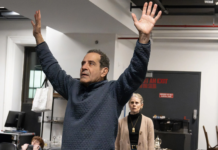
All photos of Scott Dunn (Courtesy of Scott Dunn)