










Patrick Page has built a career on language—how it sounds, how it moves through the body, and how it reveals uncomfortable truths about power, conscience, and human nature. Renowned for his Shakespearean performances and his ability to command a stage with both physical and vocal authority, Page has spent decades inhabiting some of the canon’s most formidable figures, from kings and generals to schemers and tyrants.
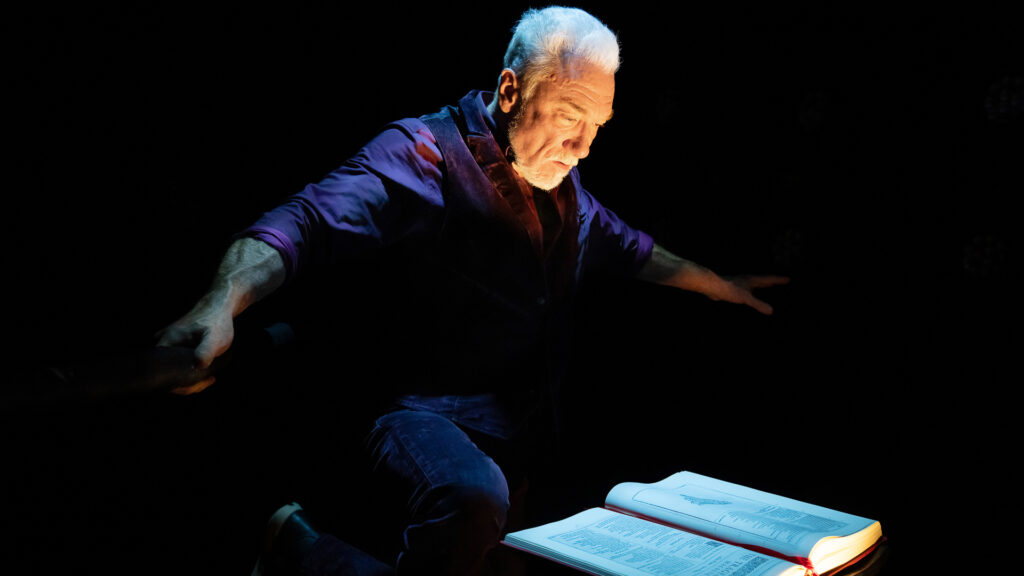
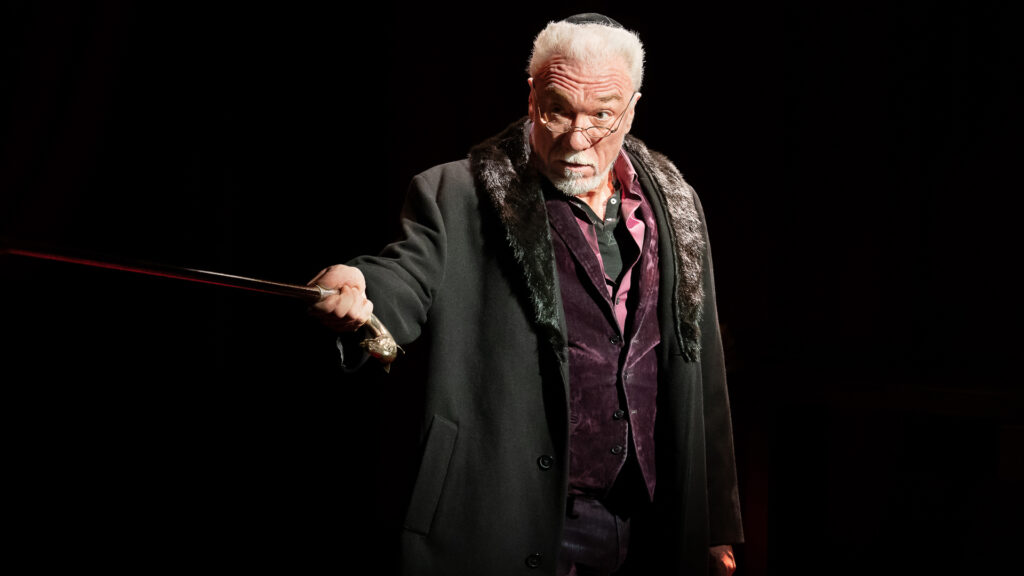
Page brings those decades of inquiry together in All the Devils Are Here: How Shakespeare Invented the Villain, a ninety-minute solo work that traces Shakespeare’s radical transformation of the theatrical villain. His show is now playing at The BroadStage in Santa Monica through January 25th.
Part performance, part history lesson, and part philosophical investigation, the piece follows Shakespeare from the blunt moral allegories of medieval theater to the invention of fully dimensional antagonists—characters whose psychology permanently altered storytelling itself.
In conversation, Page speaks with equal parts rigor and humility, moving fluidly between scholarship, memory, and lived experience. What emerges is not simply an explanation of a show, but a portrait of an artist still asking fundamental questions about the theater, about power, and about the limits of self-knowledge.
.
Our conversation took place the morning after All the Villains Are Here‘s opening night. Here are the top ten highlights.
Q: How did Los Angeles respond on opening night?
It was just magical. It was a full house—there were over 400 seats, I’m not quite sure how many. And the theater is marvelous because it has unified seating. There are no aisles. And for an actor, that’s a really wonderful thing because everybody receives the same story at the same time. They’re not all broken up from each other.
What happens is they begin to kind of breathe as one, and their hearts begin to sort of beat as one. And in this case, I’m taking them through a really thrilling story. I think one of the most thrilling stories that ever actually happened, which is how Shakespeare, at the beginning of his career, took this theatrical device from the old medieval morality plays—the vice character, who was a pure embodiment of evil—and over the period of about twenty years, because of his insistence on telling the truth, kept adding more and more human qualities.
Until eventually they were completely three-dimensional human beings and therefore laid the groundwork for the villains that we have today. Over that period of time, he not only invented the villain, as I say in the title, but he discovered that reality itself worked differently than he had been told. And that’s an amazing journey to go on with an audience over about ninety minutes.
You’ve said in previous interviews that seeing your father perform Shakespeare inspired your love of the work. What inspired your love of Shakespeare’s villains?
Well, I imagine one of the first plays that I became deeply acquainted with was Richard III, because when I was three, four, five years old, my father had a long-playing double album of Laurence Olivier’s film of Richard III. And I would listen to it when I went to sleep.
It’s actually a very good way to learn how to speak Shakespeare’s verse, because Olivier relied almost entirely on consonants—very clipped delivery. If you’re familiar with Olivier’s voice, it went something like, “Now is the winter of our discontent made glorious summer by this son of York.” (Watch the interview to hear his impersonation of Olivier)
The following scene was John Gielgud playing Clarence. And Gielgud’s style of verse speaking was famously exactly the opposite—he spoke in vowels. “Oh, I have passed a miserable night, so full of fearful dreams…” So by combining those two approaches—this emphasis on consonants and this emphasis on vowels—I think I came up with some kind of happy medium. (He also impersonates Gielgud in the video)
But Richard III was my first villain that I fell in love with. And then after that, I used to watch Dark Shadows, which was a Gothic soap opera in the 1970s, with my grandmother at four o’clock in the afternoon. And I fell in love with Barnabas Collins, the vampire.
How do you think Shakespeare’s villains evolved from someone like Cardinal Beaufort in Henry VI, Part I to The Tempest, where it’s debatable who the villain even is?
By the time he gets to The Tempest, he’s not dealing in those terms anymore. He’s not dealing in terms of good and evil in that way. The Tempest is an allegory. The plays that Shakespeare loved as a boy were medieval morality plays, which were allegories.
In The Tempest, Prospero is the Everyman character. The allegorical embodiments are Ariel, who is his spirit—his creativity, his imagination, his fancy—which Shakespeare had been overworking his entire life, making it work fifteen, eighteen, twenty hours a day in order to write thirty-seven plays over the course of about twenty years. And Caliban is the body.
If you notice, when Caliban first comes out of his hole, he wants to eat. Then he wants to have sex with Miranda. Then he wants to drink. And what both Ariel and Caliban want most is to be free. Prospero is the master and commander, as you and I are master and commander of our imaginations and our bodies. And the play is about what he ought to do with them, which is to forgive his brother.
The first character I would say is really Shakespeare’s villain, in the sense that he’s built off that vice character, is Richard of Gloucester in Henry VI, Part III. The other characters—Queen Margaret, Joan of Arc—are less villains than they are pawns in the game. Richard of Gloucester is the first genuine attempt at writing a creature of evil. And from that, Shakespeare builds.
In the early part of the 21st century, you played Iago, Malvolio, and Claudius in relatively close succession. From an actor’s perspective, what differentiates those villains?
The contrast between Claudius and Iago couldn’t be starker. Claudius is the first character where Shakespeare is successful in giving the villain a conscience. Hamlet is a revenge play, and in revenge plays, once everybody knows the villain did it, the villain gets killed.
Shakespeare questions that form. At the moment everybody knows Claudius is guilty, he gets on his knees and tries to pray. And the audience is forced to confront a soliloquy of guilty conscience. That’s not a cartoon anymore. That’s a man who loves his wife, believes in God, regrets killing his brother, but is unable to give up the things he gained by it. And Shakespeare forces the audience to ask, “Do you still want this?”
Iago is where Shakespeare confronted the reality that there are a very small subset of human beings—about four percent—who have no conscience whatsoever. In Iago, he writes a clinically precise portrait of a psychopath: a man without empathy, without remorse, driven by a will to power and by a delight in the suffering of others, particularly the need to destroy that in which he cannot participate, which is love.
You talk in the show about administering a psychopathy test to the audience. Without giving too much away, what does that entail—and have you taken the test yourself?
In 1972, Dr. Robert Hare, a Canadian psychologist, created the Psychopathy Checklist. It’s still used today. It’s a twenty-point test, with each trait scored from zero to two. A score of thirty or higher in the United States indicates psychopathy.
Some of the traits involve past behavior, which Shakespeare doesn’t give us, but in terms of what you can score, Iago scores in the highest percentiles. The traits include glibness, superficial charm, lack of empathy, lack of remorse, shallow affect. It just goes down the list.
What’s surprising in the show is that as you do the checklist, you begin to recognize other people—people who are running nuclear arsenals around the world—who score very highly as well.
We throw around the word “psychopath” pretty casually. Why is it important to be precise about what it actually means?
Because psychopathy is a very specific condition. When people say someone is “psycho,” they usually don’t know what they mean. In American Psycho, Patrick Bateman is a psychopath. In Hitchcock’s Psycho, Norman Bates is not—he’s psychotic. Those are two entirely different things.
A psychotic does not have a rational view of reality. A psychopath does. Ted Bundy was not insane. He knew precisely what he was doing. The people who run nuclear arsenals now know precisely what they’re doing. They’re not insane—they simply lack empathy, conscience, guilt, or the ability to feel for others.
Early in your career, you played Brutus at Utah Shakespeare in Julius Caesar. How did that experience shape your relationship with Shakespeare?
It was my first chance outside of school to tackle a leading Shakespearean role. And it’s a very good one to start with, because Shakespeare begins his deepest inquiry there. We have imaginations that can do anything, but actions are irreversible. And the most irreversible action is murder.
Brutus believes he’s acting for the good of Rome, but Shakespeare understood that people don’t actually know why they do what they do. He was way ahead of Freud. Brutus is driven by ambition and unconscious desire. Shakespeare shows this by giving him a soliloquy in which his logic doesn’t actually work.
What Shakespeare does there—and later with Henry V—is dismantle the myth of the perfect hero. When he dismantles the myth of pure evil, he’s also forced to dismantle the myth of pure good.
After decades of living with these plays, what have you learned about yourself?
That I don’t know myself. I can read the plays, I can be aware of my blind spots, but I can no more see myself than I can look at the color of my own eyes.
How do you live with that realization?
You have to respond with constant awareness that you might be mistaken, and you have to try not to let that paralyze you. Shakespeare’s realization led to Hamlet—a man unable to act because he cannot be sure of his own mind.
Eventually Hamlet arrives at the point where he says, “The readiness is all.” The awareness that one is not necessarily in the driver’s seat makes you want to be prepared, awake, alert. And it makes me very slow to judge, because everyone else is in exactly the same position.
In this show, you’re taking the villainy out of villains rather than condemning them. What do you hope audiences take away?
I wouldn’t say I’m taking the villainy out. I’m demystifying it. If anything, what I take away is this: I am the monster. You are the monster. We are the monster.
Shakespeare says, “Hold the mirror up to nature.” A mirror doesn’t point outward—that’s a camera. A mirror points inward. That’s the domain where you have agency. That’s the domain you can clean up a bit.
That, to me, is the proper use of theater. Shakespeare took a form that was a dramatized sermon and turned it into something that asked questions instead of delivering answers. And that’s why his work still matters.
To watch the full interview with Patrick Page, please go HERE. To see more of our interviews, please go to Cultural Attaché’s YouTube channel.
This conversation with Patrick Page has been edited for length and clarity.
Main Photo: Patrick Page in All the Villains Are Here: How Shakespeare Invented the Villain (Photo by Julieta Cervantes/Courtesy BroadStage)