





Two world premieres in two cities might suggest momentum. In Beth Hyland’s case, they suggest reckoning. With Sylvia Sylvia Sylvia at the Geffen Playhouse and Fires, Ohio beginning previews at the Alliance Theatre, Hyland finds herself in conversation with two towering literary figures — Sylvia Plath and Anton Chekhov — and, by extension, with the burdens of artistic inheritance itself.
Both plays interrogate how stories are transmitted, distorted, and revived: how myth calcifies around artists; how humor coexists with despair; how authorship becomes both ego and stewardship. What emerges is not simply a season of premieres, but a meditation on what it means to stand in the shadow of genius and write anyway.
Q: We’re going to talk about not one, but two world premieres that you have going on in the first quarter of 2026. The first is Sylvia, Sylvia Sylvia at the Geffen Playhouse. Then you’ve got Fires, Ohio at the Alliance Theatre. What’s the Sophie’s Choice equation you have to make to juggle both?
Yes, you’re exactly right. Luckily, I was spared making a really difficult choice because the leadership at the Geffen and the leadership at the Alliance were unbelievably generous and flexible and collaborative. They could have said, no, we don’t want you to do this.
The way it timed out was that during tech at the Geffen, I went to Atlanta and had the first week of rehearsal at the Alliance. The folks at the Geffen were saying they were pleased I wouldn’t be there for the first week of tech because playwrights historically get a little anxious watching everything in real time get worked out.
In the moment, it was hard not to be in two places at once, but in hindsight I’ve learned that was actually kind of a very lovely gift.
Q: Are you one of those playwrights who gets angsty during tech?
Me? I would never.
Tech is, in some ways, the most stressful time for everyone other than you. You can make small changes — and I was making changes and am making changes at the Alliance through previews — but basically you sit there and eat the nice snacks, and everyone else is putting themselves on the line.
Q: You’ve talked about the challenges of writing about real people and our culture’s hunger for “real” stories at a time when it’s growing increasingly difficult to really know what is real. What do you think the responsibility is as an audience to sniff out what is real and what is the artist’s responsibility to help point us in a direction towards authenticity?
That’s a beautiful question. It resonates with me completely. It feels sometimes like there’s an overload of overwhelming minutiae — facts. And now with AI, I’ve found it incredibly disturbing that we can’t trust that a photograph is real. That feels like a scary shift.
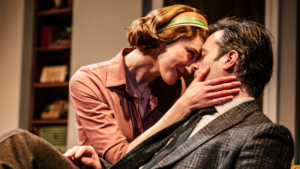
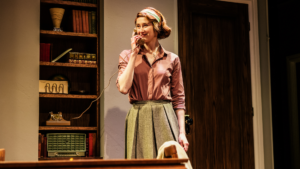
It’s been interesting talking to loved ones and people who came to see Sylvia because people understandably ask, “Is that real? Is that true?” Ted and Sylvia were eccentric. They were self-mythologizing, larger-than-life figures. There are scenes where it would make sense for people to think I invented them, but I did not — including the fact that they would hypnotize each other, use a Ouija board to try to predict the future, and were into astrology and what some might call the occult.
Within the play there is a frame where part of the subject is the difficulty of truthfully representing another human being, particularly one you have never met and will never meet.
Even though the play is clearly fictional and the events are imagined, I didn’t take it lightly discussing real people. These are people who have children and families. I can imagine how I would feel if someone misrepresented my mom or my dad. So it’s a responsibility I wrestled with a lot.
Q: When the audience is familiar with one couple and unfamiliar with the other, how did you make them equally invested?
That was one of the major challenges of the writing and revision process. Famous figures have a gravity about them. Fictional people who are not famous require a huge amount more investment and specificity on the writer’s part. You have to win the audience’s interest in them.
The whole cast is stellar. Each of them has different challenges — inhabiting mythic figures, and making the non-mythic people compelling.
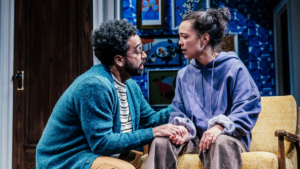
There may be a slight tonal difference. With Ted and Sylvia, you can sometimes have a sense that it’s like a millennial writer’s impression of the 1950s. With Theo and Sally, the contemporary couple, those people are so close to my friends and me that the level of granular detail in their interactions is what becomes pleasurable.
With Sylvia and Ted, there’s a little escapism or fantasy. With Sally and Theo, the hope is that the pleasure is closeness and recognition.
Q: This play began during your first semester of grad school. How has it evolved?
It has changed enormously. The architecture has stayed the same, and there are entire scenes that have stayed roughly the same, but other scenes have had fifty drafts.
The structure has very little room for error. It has to work like a line of dominoes. I rewrote it more than I’ve ever rewritten anything. Some changes were very micro. Jo Bonney, Olivia O’Connor, and the folks at the Geffen were instrumental in helping me shape it.
The last preview happened to be on the anniversary of Sylvia Plath’s death. I think making a piece of art can be about our self-expression and ego, but if there is an element of this that is generous or other-minded, it has mattered increasingly to me to be one way to dispel some of the cultural myths around Sylvia Plath and the misogynistic and dismissive way people speak about her and her work.
Nothing has pleased me more than when people say, “I’m going to go look her up after seeing the play.” If that can happen for one person, I’ve become deeply convinced of the genius and greatness of her work.
Q: In the draft I read, Sally asks, “When you’re writing, do you ever feel like you’re speaking directly to God?” Does your writing process ever feel like that?
I love that you pulled that line out. Part of that line is a strange Sylvia Plath reference. Toward the end of her life, she started invoking being used up by God or touched by God. There’s a late poem that says, “When one has been seen by God, what is the remedy?”
Many people have said this about the creative process: the things in your work that you end up feeling happiest with, you don’t know where they come from. They arrive. The things you feel least happy with are the ones where you know it came from your brain.
It feels like if something comes to you that you love, you weren’t responsible for it. That’s kind of how I feel.
Q: Sally certainly suffers, in part, from her inner saboteur. Do you battle your inner saboteur while writing?
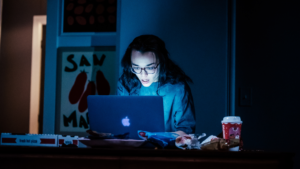
Absolutely. Especially when I was beginning writing, that was almost the major obstacle — getting out of my own way and out from under the anxiety, even to open the document.
Therapy was one answer. But what helps most are collaborators. Having the right collaborators buoys you. Other people can believe in you in a way that you cannot do alone.
Sylvia and Ted were calling each other geniuses years before anyone else did. They truly believed in each other. I was lucky to have friends and early directors who believed I could write a play. Surrounding yourself with people who have faith in you grounds you.
Q: What does an audience teach you?
So much. Between undergrad and grad school, I was in Chicago making storefront theater, self-producing plays. We would sell the tickets, sell the beer, then sit directly behind the audience in a tiny forty-five-seat black box.
That was its own grad school because I learned to be accountable to my audience. You can see when people sit back or lean forward. You start to feel the rhythms of an audience.
At the Geffen, having a full preview process was wonderful. We could make micro changes in lines and see how it helped the audience understand or land in the right place. That was really wonderful.
Q: Do critics teach you anything?
Of course. It feels fabulous when someone reflects your work back to you and you feel understood. I have learned from negative reviews. I’ve read a negative review and had that sinking feeling of, “Oh man, yeah, that’s right.”
Sometimes you’re insecure about something, and a reviewer pulls it out kindly. That can be confirmation. With this show, I didn’t have that experience, but I learned new interpretations of how things were landing on people.
Q: You’ve appeared on stage yourself. How did acting influence your writing?
Massively. I wanted to be an actor before I wanted to be a playwright. I didn’t write a play until I was a junior in college.
You feel what is fun to do as an actor. You know what scenes feel juicy. That can point you toward writing a scene like that.
You also respect how difficult and vulnerable acting is. Even in a workshop, actors are asked to improve and change in front of everyone. It’s with their bodies and their selves. When people give notes, even if it’s about the character, there’s a way it can’t not feel personal. It’s really difficult.
I’m so thankful I came to writing from that perspective.
Q: How large a shadow does Chekhov cast over Fires, Ohio?
He’s my hero. I’m happy to stand in his shadow. Getting to do an adaptation means you’re in conversation with him. Sometimes you argue with him, sometimes you revel in the footsteps he put down.
Fires is the third Chekhov adaptation I wrote. Early on I learned not to feel wedded to every particular. You don’t have to keep every character. You need permission to let go.
It’s important to me that people can enjoy the play even if they have never read or seen Uncle Vanya and don’t know who Chekhov is. Chekhov is extraordinarily famous to theater people, but not necessarily to everyone else. I don’t want to contribute to a narrow audience. The play has to stand on its own.
Q: Was there a design on your part, I haven’t read the script, to mirror that balance between light and dark throughout it, humor and drama, because the drama only lands because the humor is so good and the humor only lands because the trauma is so great.
The humor is it. The humor is the thing. Sometimes it’s been difficult to translate. But the humor is of the utmost importance to me.
There’s a moment in Three Sisters when a very sad moment is interrupted by someone wearing a fake beard, and it feels like a hand from the past. People have always been the same.
The humor in Chekhov is life.
Q: I’ll close with a Sylvia Plath journal entry from May 14, 1953. “I want to write because I have the urge to excel in one medium of translation and expression of life. I can’t be satisfied with the colossal job of merely living. Oh no. I must order life in sonnets and sestinas and provide a verbal reflector for my 60 watt lighted head. Let me live, love and say it well with good sentences.” Do you agree with her perspective and what propels you to continue writing?
She was 21 when she wrote that. It’s gorgeous.
Yes. One thing that drives me to write is striking the balance of expressing the deepest and scariest and sometimes funniest parts of ourselves — the parts that are difficult to touch in everyday life — and through doing that, connecting to another person.
To duplicate the experience I’ve had as an audience member, where my emotional life has been changed by seeing something — that’s the north star.
It’s lucky and amazing to have our lives enriched by art.
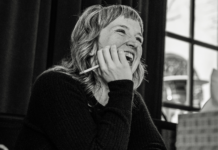
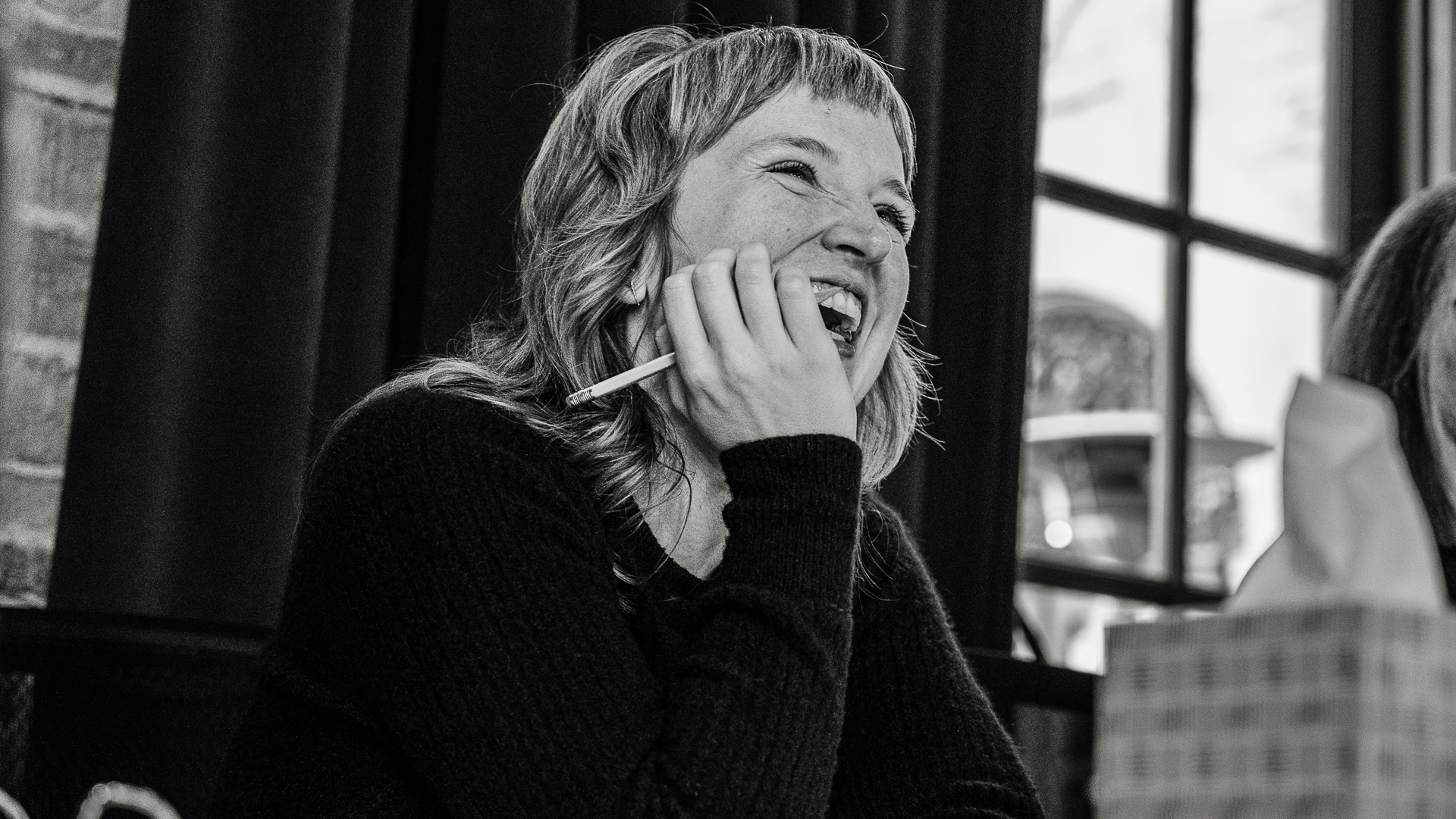
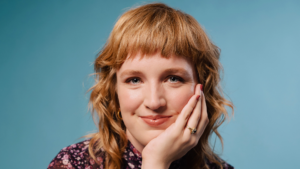
Main Photo: Beth Hyland (Photo by Jeff Lorch/Courtesy Geffen Playhouse)