






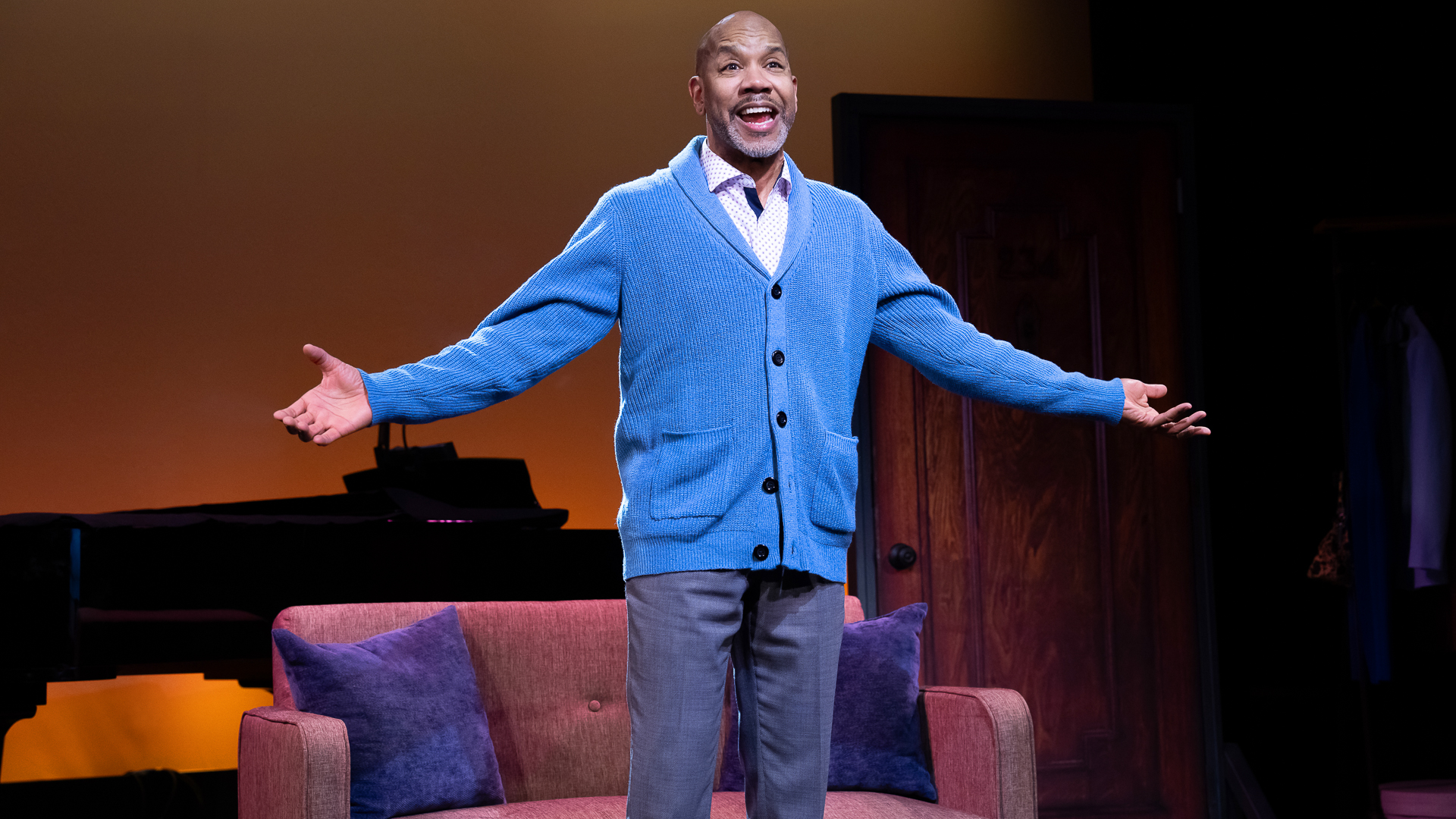


Darius de Haas has built a career singing some of the most challenging and rewarding music written for the stage—from Adam Guettel and Michael John LaChiusa to the incomparable Billy Strayhorn. With Maltby and Shire’s new musical About Time, he finds himself exploring a different kind of material: songs that reflect on the so-called third act of life, where experience begins to reshape how we understand the past and imagine the future.
In this conversation with Cultural Attaché, de Haas reflects on the emotional resonance of “What Do I Tell the Children?”, revisiting Strayhorn’s “Lush Life,” and the perspective that comes from a life spent pursuing artistry. This interview has been edited for length and clarity.
You’re appearing in the new Maltby and Shire musical About Time. For those who may not know the show yet, what’s your elevator pitch?
About Time is a show about life, love, and laughter in your third act and it is written by a legendary writing team, Maltby and Shire, who have given us such great songs as Starting Here, Starting Now, and the Broadway hits like Baby. They have written for such great artists ranging from Barbra Streisand to Shirley Bassey, but who have had an amazing partnership for over 50 years, I think close to 60 years.
And so this is their trifecta show, having written the revues Starting Here, Starting Now and Closer Than Ever. And this is the third in that trifecta of revues about life and love and how wonderful it is for people in the third act of their life.
The show ends Act One with the company singing about looking backward while also looking forward. The show first appeared at Goodspeed Musicals and later had a concert at 54 Below before arriving in New York. How has it evolved since you first became involved?
Well I’ve been involved with it since last year where we did a workshop prior to the Goodspeed run and really it—like with a lot of musicals in development—it’s trial and error.
They have a lot of songs. The great thing about Maltby and Shire is they just keep spinning them out. They’re roughly the only ones in their generation who are still doing this. They’re out of the generation of Kander and Ebb—John Kander is a little older—but they sort of came out on the heels of that generation. So the fact that they are still churning it out is extraordinary.
What we were discovering was what works and how best to convey what one is experiencing at this stage of life. We’re in a very youth-oriented culture—it’s quick, quick, quick, let’s move on to the next thing. The fact that they are taking their generation and saying, “Look, we are of worth as well and we have a lot to say,” is very powerful.
Experientially we are living in the world as well, and how do you convey through these songs what people discover in this stage of life? Everything from finding love later in life to being able to find your missing keys—or not—to what is happening in this very polarized world.And how do you convey your supposed wisdom of being in the third act to a younger person?
Your biggest moment in the show comes with the song “What Do I Tell the Children?” What resonates most with you when you perform it?
For me it’s a song where I have to allow myself to discover it each performance. So that means starting it as simply as I can and then seeing how it hits me. I certainly have my parameters where I know where we get to in the song, but really allowing myself to kind of be on a high wire without the net.
Because we’re in a time where you are hit with a new atrocity basically every day. It bubbles through my being and through my experience and my whole world experience. There’s great power in being able to say, “Look, I don’t know what to say.” All I know is what I’ve been taught by my elders and mentors and trying to apply that to what I see happening in the world.
Trying to do the best you can and being able to speak out against the racism, the sexism, the homophobia, the political atrocities that have been perpetrated. So all of that sits right here. And then we bring it out.
The show also allows you to inhabit a wide range of experiences—from someone searching for lost keys to someone celebrating decades of marriage. What are the challenges in making each of those characters feel fully realized?
At first I feigned being insulted by some of those songs. I thought, “I’m not in the third act yet—how dare they?”
But the truth of the matter is I have had issues with finding keys and getting so far ahead of myself that I’m combing through my kitchen and my living room going, “Where did I put my stuff?” So it’s actually not far from my experience at all. The more I can just be in the situation and let it come up through me without trying to force anything, the more effective it is.
That’s the magic of Maltby and Shire. They present these situations—sometimes very earnestly—but when you really invest in the words it’s funny how things can hit you. Because they’re writing from real life.
If you were to create a three-show musical review of your own life, what would those three acts look like?
The first act would be growing up in a musical family. My father was a bass player, my mother’s a singer, and there were a lot of performers on my mother’s side of the family. So it would be living in the world of my influences—going from jazz clubs seeing my father perform to seeing my mother perform in all these great shows.
The second act would be the struggle. You jump in thinking everything is going to happen and then you discover something doesn’t quite fit. You feel like a square peg in a round hole and no one quite gets you.
And then the third act is self-acceptance. Finally being able to bring all those experiences together and really appreciate what life has afforded you—even the awful things, the challenging things, the funny things, the silly things.
That’s really what About Time is about as well.
I absolutely loved Shuffle Along. You got to work with a couple of upstarts you’d collaborated with before—Billy Porter (Langston in Harlem) and Audra McDonald (Marie Christine). What stands out most when you think about that experience?
The first thing that comes to mind is George Wolfe. I had been intimidated by the prospect of working with him but also really wanted to work with him. So many people that I admired had worked with him and I hadn’t, and I thought maybe I just wasn’t his cup of tea.
The audition process was actually one of the easiest I’ve ever had because he has such a quick mind. He can visualize what he wants right away. It was almost like, “Okay, it’s you, it’s Audra, it’s Billy, it’s Brian, it’s Josh…” and suddenly we were all in the room together.
The explosion of talent in that rehearsal room is something I will never forget. Being in the sandbox with those artists every day and discovering all the iterations the show went through—it changed so many times before we even got to what we eventually put on stage.
But it was extraordinary.
One of the things I’ve always admired about you is that you don’t shy away from difficult material—Michael John LaChiusa, Adam Guettel, and works like Myths and Hymns. What is it about tackling challenging material that fulfills something in you as an artist?
Very early in my career I was thrown into challenging material. After Carousel I did a piece by John Adams called I Was Looking at the Ceiling and Then I Saw the Sky. Doing that somehow made casting directors aware that I might be someone who could handle that kind of music.
Suddenly I was working with writers like Adam Guettel, Jason Robert Brown, Michael John LaChiusa, Ricky Ian Gordon, William Finn. Working with those really hungry, brilliant writers helped shape the artist I wanted to be.
And honestly sometimes I think, “Man… can I just sing ‘Mary Had a Little Lamb’?” But I don’t think I would be honoring my instincts if I did that.
Even when I recorded a holiday album last year I ended up putting some pretty challenging musical material on it. But that’s what gives me joy as an artist.
Since the themes of About Time deal with looking back at your life and still being able to look forward and live in the moment, I do have to ask you about a song that you recorded for your 2002 album, Daydream, and that is Lush Life. Billy Strayhorn wrote Lush Life at a very young age, yet it’s a song that seems to deepen with time. I would assume that that song takes on a different meaning for you now than it did when you first recorded it. How do you think Lush Life sums up the lived-in experience of any human being? [Note: de Haas also played Strayhorn in a musical, Billy Strayhorn: Something to Live For and Billy Porter was a producer on that show.]
Thank you for that question. I really appreciate you asking that.
Billy Strayhorn died at 51 years old. When I first recorded it I had to research it very carefully and work methodically to give any sense of having lived that kind of experience. There’s the lyrics, but there’s also how you lean into the music—it’s so specific.
Now, having lived more life and having sung Strayhorn’s music for years, it’s a very interesting practice.
He wrote that song when he was so young, and I think he was a genius. I think the song was aspirational in a way. I think it romanticized what that life might be. And in a strange way I think he could see what his life would become.
So returning to that song now becomes a study in how one moves from the romanticized idea of life to understanding what it actually is—and the tug of war between those two things.
When you look back at your own journey—from your early days performing in Chicago to where you are now—what stands out most to you?
When I was very young I was riding a crest. I had just done the first regional production of Dreamgirls and then went straight into Hair. My mother had done Hair years earlier with André De Shields and Joe Mantegna, so there was a bit of family legacy there.
But when I came to New York it was like starting over again. There were stretches where nothing happened, and then suddenly things would crest again. I always felt a bit like I was on the outside observing things rather than being in the vortex of everything that was happening.
Billy Strayhorn’s music helped me find my voice at a time when I was very frustrated. Now I’m beginning to understand that you are where you’re supposed to be and that you’ve accomplished more than you realize.
And now it’s wonderful to feel things coming together in a quiet way—not with people waving flags and saying “now we get Darius”—but just a quiet understanding.
And to work with Maltby and Shire, whose music I’ve listened to since the Barbra Streisand People album, and think: look how the journey has come around. I’m extremely grateful.
About Time is now playing at the Marjorie S. Deane Little Theater in New York.
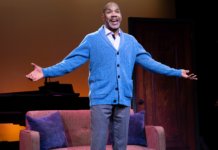
Main Photo: Darius de Haas in About Time (Photo by Julieta Cervantes)