






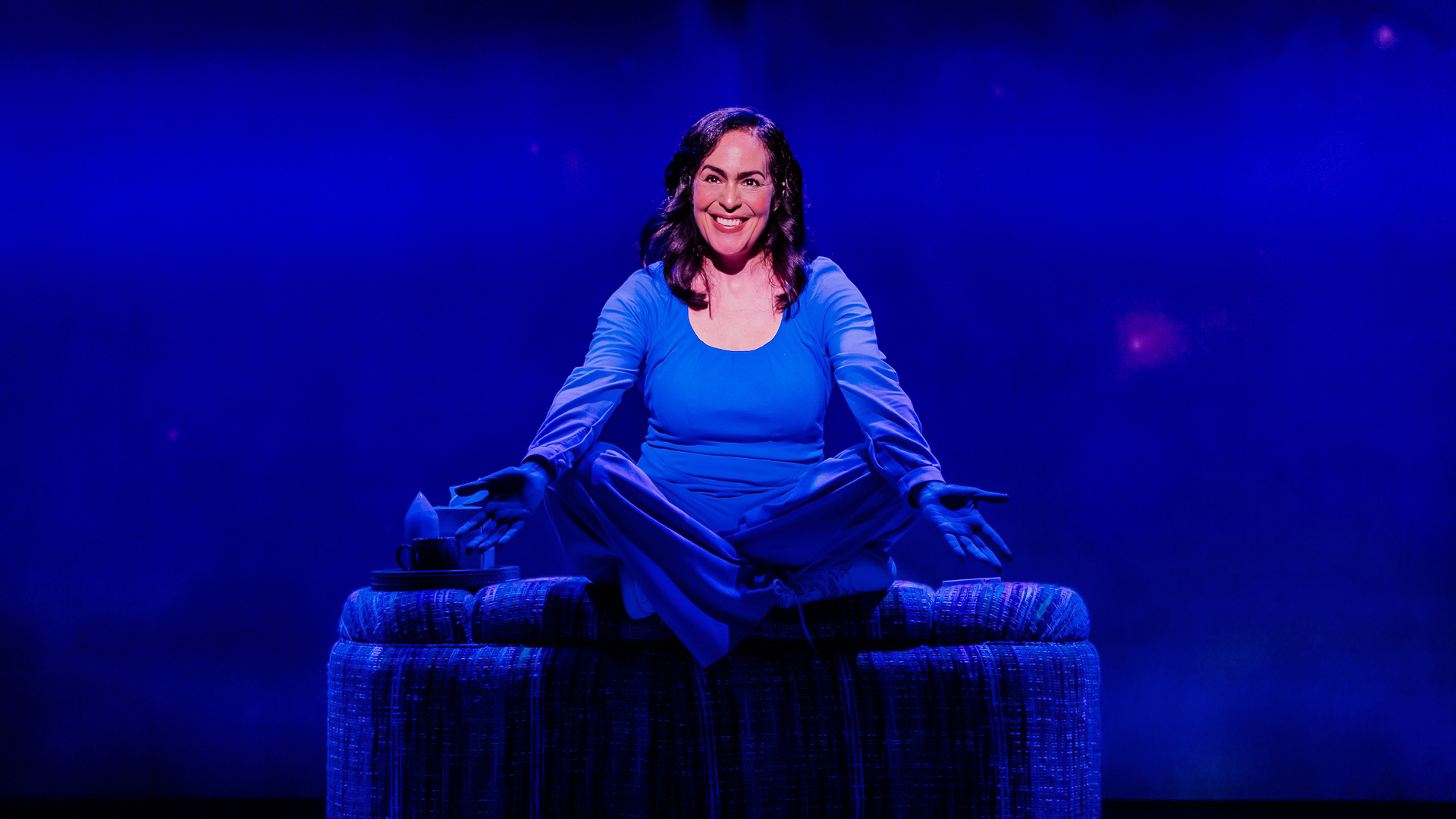

Roxana Ortega has spent the last decade shaping her deeply personal solo show Am I Roxie?, premiering at the Geffen Playhouse in Los Angeles. What began as an attempt to capture her mother’s journey with Alzheimer’s evolved into a meditation on caregiving, identity, and the power of laughter in the face of loss. Known for her comedy and voiceover work, Ortega now steps into the spotlight with a story that is equal parts heartbreaking, hilarious, and universal.
Am I Roxie? has its official opening tonight and will play through October 5th. While in the early stages of rehearsals, I spoke with Ortega about her parents, how her experiences informed the show she created and her process of finding her voice. What follows are excerpts from our conversation that have been edited for length and clarity. To see the full interview, please go to our YouTube channel.
Q: Your name is Roxana, but the play is Am I Roxie? Is there a difference between Roxana and Roxie?
Everybody always called me Roxie growing up in my family. I feel like a Roxie. In Spanish, Roxana is—well, I like that. My mom would call me Roxanita, but I tended to be assaulted with the Police song my whole life, “Roxanne.” So just saying, “Call me Roxie,” was a way to avoid being sung at. And it feels like me. That’s really my name, what I associate with.
Unless someone starts singing “Chicago” to you.
Exactly. And that I appreciate. Or old school “Roxanne, Roxanne.” Sometimes I even go “Rosanna, Rosanna,” which isn’t my name, but I appreciate the shout-out.
You’ve said on Instagram that you’ve been working on this material for ten years. What were the highs and lows of that decade-long journey leading to the premiere of Am I Roxie?
The highs have been discovering my voice. My first writing on a stage was sketch comedy through The Groundlings Sunday company, writing comedy and characters—often from my own family. This show started as me trying to capture what was happening with my mother as I was helping care for her. I told myself I wasn’t going to take any class. I was going to listen to storytellers at places like The Moth, open mics, shows here in L.A. I’d listen, see what I liked, experiment, and I really found my own voice.

The lows were—oh my God, what is this? What am I writing? I didn’t know how to do this. At first it was just stories. Then I wondered, how do I put this together? I didn’t want to outline; I wanted it to pour out of me. I kept saying, let it tell me what it wants to be.
The final stage was in 2023 when I joined Ammunition Theater Company’s writers lab. I said, I’m not a playwright, but here’s my piece. They were awesome—more experienced than me—but they supported my voice. They let the comedy, the poetry, and the beauty come out and helped me find structure.
You did a workshop reading of the play before it went to the Geffen. What did you learn from that?
It culminated in a reading. My goal was just to get it out of me and say it in front of people. Someone from the Geffen was in the audience. I was blown away by the response. With a solo show, you’re by yourself—writing it, playing 20 characters. It’s solitude. Then you bring it out and suddenly you’re receiving all this energy. People were moved—crying in my arms, laughing, crying. They kept calling it “magical.” I didn’t write it to be magical!
After that, the Geffen said they wanted to do the play. We went into development, chose designers, and collaborated on what it would look like onstage. I learned the piece could be very big and magical and funny, but also very intimate and small. It’s a ride.
Do you remember what you were thinking after you said the last word at that reading?
I’m very proud of the last moment. I’m playing my mother, who’s dying from Alzheimer’s—don’t ever write that for yourself! The last moment is hers, and it has quite a poetry to it. The audience had a real reaction. Then I went offstage, buckled over, and sobbed. I had finally said it in front of people. I had no idea of the journey ahead.
How does it feel to finally be in rehearsals after ten years of writing?
We are deep in rehearsals. After writing for ten years, to have it on its feet—I get to move. As a voiceover actor, you can’t move from the mic. Here, I get to take up space, embody characters, find behavior. It’s so fun.
The play deals with your mother’s Alzheimer’s and your father’s passing. What did you learn most through that time?

That’s what the show is about. Watching a parent exit this life brings up your own mortality. You see what you’re made of. There’s humor in realizing how selfish you are—thinking, Who’s going to give me a bath when I’m older? I better get on the dating scene!
With Alzheimer’s, if you even say the word, people recoil. It’s the saddest one. But with long-term loss, there’s opportunity. You come out saying, I got through this. I know what I’m made of now.
In the show, you see me use everything—my play, imagination, improv spirit—to learn to play with my mom in her dementia. There’s real beauty and fun in that.
You’ve said your mother was the only one in the home who really got you. What was that relationship like?
My mother had been an actress in Lima, Peru, for a hot second. She was this brilliant brain, creative, wrote poetry, had all these dreams. She came to the U.S. at 22. But she wasn’t actualized—some of it was the times, some patriarchy.
When I finally became an actor, I felt like I was pursuing a dream for both of us. As a child of an immigrant, you carry that—wanting to make it worth it. Then she got sick. Do I give it up for her the way she gave it up for me?
The show is about dismantling the story I created about her sacrifices. It wakes me up to how I was living my life in reaction to that story. It’s about reconnecting with her like I did as a kid, but with the changing of the guards. Very Circle of Life-y. And yes, I dance to Circle of Life briefly.
That role reversal—when the child becomes the parent—can be brutal.
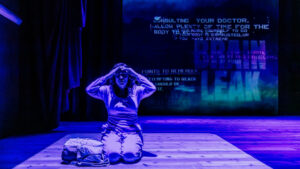
Humor is essential—sometimes gallows humor.
There’s a whole sequence where I’m trimming my mother’s pubic hair to the Star Wars theme. You have to laugh. The caregiving system is horrifying. If you’ve fallen down that rabbit hole, you know. You better find a way to laugh.
Your story is deeply personal, but do you feel it speaks to broader immigrant or social issues?
The show itself doesn’t speak to ICE raids or current events, but there’s resonance in seeing someone like me, the child of immigrants, tell this story. My mom was a citizen, my father a Chicano from East L.A. There’s something about talking about immigrant dreams—the bravery it takes.
Also, the people taking care of my mother were immigrants. That whole caregiving system is immigrant. So while my job is to stay true to the story, I’m proud to highlight and celebrate our community.
And at the same time, this is universal.
Completely universal. Even if you haven’t lost a parent, you feel it coming as they age. Or if you’ve been a parent yourself—you know the rabbit hole of caregiving. It resonates deeply with anybody who has a soul.
Was there relief once your mother passed?
She passes in the show—spoiler alert. There is an exhale. I think audiences will exhale too, have catharsis.
But in real life, it’s not one exhale. It’s long, complex: thank God it’s over, thank God she’s not alive during COVID, and also I miss her so much. In rehearsals now, I’ve unlocked grief again. It’s alive in our cells.
That grief never really goes away.
Right. As I say in the show, it’s like really, really bad food poisoning. You think you’re done, and then—blegh!
One-person shows have a long tradition—Whoopi Goldberg, Lily Tomlin, John Leguizamo. Who inspired you?
So many. I’ve been a connoisseur of solo shows before I even knew I’d do one. I saw Marga Gomez in the Bay Area. Lily Tomlin. John Leguizamo—that’s the gold standard for me. I love the energy, the quick pace, the comedy. I’m proud this show has highs and lows like life. I loved Lackawanna Blues. So many people have inspired me.
There’s the expression, dying is easy, comedy is hard. But they are linked. What’s the balance?
I don’t think you have comedy without death. Comics understand life’s depth. We’re all on an escalator to one end. That’s why terms like “I killed” or “I’m dying” exist. Standups are really in touch with darkness and sadness.
This show is about survival and spirit. There’s a defiant, triumphant comedic tone while navigating a difficult topic most people don’t even want to discuss.
Hopefully the play helps people be less afraid of those discussions.
I hope so. Even just talking about the show—“Oh, you’re writing a solo show about Alzheimer’s?”—it sounds like, why? Who would want to see that? But it’s about so much more. I like going into these areas of life. They’re ripe for comedy. Maybe I have a particular ability to find it there.
Let’s talk about Latino talent. The big breaks haven’t yet happened. What does the future look like?
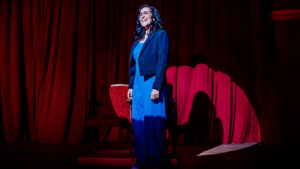
Who knows? But I’m excited about Latinas Acting Up, formed during the strike by Diana Maria Riva and Lisa Vidal. With Gina Torres and others, they’re building community. People are developing projects. We have to keep creating, make ourselves decision-makers, elevate each other, tell our stories. We live in such a rich, diverse country. I hope the future is one where we hear all these stories—especially from Latinas.
And maybe casting directors will stop assuming everyone’s Mexican.
Unfortunately, we still have to be the educators. But that’s the way it is. In my show, I’m playing myself in all my media blanquita —in between cultures. I play Peruvian, Chicano. There are references to our diversity just within the Latino community.
In May you wrote on Instagram that you wanted to do what felt funny and true and find your voice. How is your voice different now than when you began this journey?
My voice is a lot stronger now—literally. I’ve been working on my instrument for a year and a half. I do 20 characters in the show, vocal Olympics. I’m proud of myself vocally. And my artistic voice is stronger. I’ve allowed a vulnerable, poetic side to sit alongside comedy. Sometimes broad, sometimes grounded characters, sometimes clowny. This show is everything I am up to this point—my theater days, improv, sketch, cartoons. It’s a circle of life moment to be back on stage with a whole new voice as an artist.
And it’s your voice, not somebody else’s.
Yes. There’s something empowering about that. To have my voice heard, and my first play going up at the Geffen—it’s a real boost of confidence. Sometimes it takes someone outside of us to say, “Good job. We like this.” And then you think, okay, maybe I’ll continue.
To watch the full interview with Roxana Ortega, please go HERE.
All photos: Roxana Ortega in Am I Roxie? (Photos by Jeff Lorch/Courtesy Geffen Playhouse)