




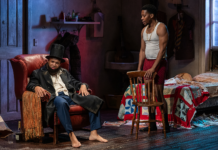







For more than three decades, K. Todd Freeman has built a remarkable career on stage and screen, moving seamlessly between Broadway, Steppenwolf, and film and television. Known for his versatility, depth, and daring choices, Freeman is both a celebrated actor and an emerging director. This fall, he takes on a demanding double role: directing Rajiv Joseph’s Mr. Wolf at Chicago’s Steppenwolf Theatre Company while also performing in Prince Faggot at Studio Seaview in New York.

Mr. Wolf is in previews and officially opens at Steppenwolf Theatre Company on Sunday, September 21. Kate Arrington, Emilie Maureen Hanson, Tim Hopper, Caroline Neff and Namir Smallwood star in the play about the impact the sudden rescue of a long-missing young girl impacts the family that feared the worst. It will run through November 2nd.
Prince Faggot is now playing at Studio Seaview in New York City where it will run through November 9th. Freeman rejoins this play by Jordan Tannahill next week after Mr. Wolf opens.
The play begins with the idea that Prince George is gay and he brings his boyfriend to meet his family. Where it goes from there has led to overwhelmingly positive reviews and sold-out performances.
In this wide-ranging conversation, Freeman reflects on his latest projects, the questions theater must ask, and what it means to survive, adapt, and challenge audiences. What follows are excerpts from our conversation that have been edited for length and clarity. To see the full interview, please go to our YouTube channel.
Q: Playwright turned politician Vaclav Havel once said, “Theater is there to search for questions. It doesn’t give you instructions.” What are the fundamental questions that Rajiv Joseph asks of us as an audience in Mr. Wolf?
It’s about hope, about getting through suffering to get to the other side of suffering through hope. Be careful what you wish for. Just because you get your miracle doesn’t mean it will be great on the other side. It’s about a group of people whose miracle comes true, but that doesn’t mean everything’s easy now that has happened. But never give up hoping for it. It’s about the struggle to survive.
You said in a video for Steppenwolf that this was a page turner that grabbed you from the first page. What was it about the story that excited you most?
The first scene to me is a complete play. At the end of the first scene, that would usually be the climax of a play. So I was like, oh my gosh, where is this going? Usually when I’m reading new plays, I figure it out ten pages in. I know where it’s going. But with this I couldn’t, and that’s what excited me—it stayed ahead of me. That’s rare. Most of the time we can figure out the end before we get there. It’s rare that a writer can surprise me this way.

When I read the play, I didn’t make any assumptions about the characters.
That’s the point. You don’t want to give it away in the first scene. That’s the fun of the journey through the play, discovering what’s going on. That was the excitement for me.
Mr. Wolf debuted more than ten years ago and received mixed reviews. Has Rajiv Joseph rewritten it since then?
Major rewriting. It was a two-act play; this is now a one-act play. It’s condensed, streamlined, much more economical. To me it’s closer to Beckett—really concise. There’s a simplicity to this version I enjoy, similar to Beckett’s writing or Cormac McCarthy’s The Road. There’s a bleakness there I find interesting.
in 2021 I interviewed Rajiv Joseph about his play Letters from Suresh and we talked about the concept about forgetting about the person he used to be and whether that was a good or bad thing. And he said, “I don’t think it’s good or bad, but it may be a sad and necessary thing.” It seems like that concept can also apply to the three adults who are not Mr. Wolf. In your working with your cast, or even approaching your own style of directing for this play, what perception did you have or did you discuss with your cast about having as a difference between who they were when the inciting incident happened versus who they are today?
We discuss what happened, what caused the tragedy that affected them, and who they hoped to be versus where they are now. Be careful what you pray for. What they thought would happen when their prayers were answered is not what happened. They have to deal with that and figure out a new path. You can’t hold on to who you thought you’d be. It’s going to be something else entirely.
What is your role as a director in making sure that your cast doesn’t make it easy for the audience to pass judgement on these characters and their actions?
I don’t judge the characters. First of all, you can’t. You just have to accept these people as Rajiv has given us and approach them each as humans trying to do the best they can. They’re just like us.
I’m mainly an actor, and the worst thing you can do is judge your character. You must be empathic. I approach it the same way as a director: stay true to the moment-to-moment work that’s going on between the people in the scenes, honor that and make no judgments. They can judge others, but you can’t judge themselves.
We live in a society quick to judge. Is it important for the audience to remain neutral and just experience it?
You can’t control an audience. Everyone brings their own baggage. All you can do is stay true to the situation. A good playwright doesn’t tell you what to think, and Rajiv doesn’t. The ending isn’t tied up neatly. There are questions left at the end. The audience has to do Act Three on their own.
What do you hope audiences see when they look in the mirror of this play?
I want people to check themselves. I like doing plays where audiences reevaluate their ethics and morality, to be less confident about what they’ve decided. Like in Downstate by Bruce Norris [in which Freeman appeared at Steppenwolf in 2018], about a group home for sex offenders—you have to ask yourself, what are my ethics? What’s my morality? Can I live with them? Mr. Wolf isn’t as extreme, but it makes you question faith and belief in a higher power. Even Mr. Wolf has a warped but present relationship to a higher power.

You’re experiencing your own parallels universe right now by directing Mr. Wolf while also going back to Prince Faggot with its transfer to a larger theater. How do you juggle both worlds?
Honestly, it’s not that difficult. That play is down now, so I don’t have to refocus until this opens. Then I fly back to New York and go into rehearsal. I just make sure I don’t forget my lines. I’ve gone from job to job before—it’s no big deal. The only thing is no days off, but after the strikes and the pandemic, I’m glad to be busy.
What sets Steppenwolf apart from other theater companies?
At Steppenwolf, ensemble members push each other. We try not to do the easiest thing, but to push beyond, to challenge ourselves. I don’t often experience that elsewhere. Too often people are out for themselves. At Steppenwolf, if you do your best, you make me do mine. The rehearsal room is safe to fail as long as you’re striving for the larger goal. I’ve learned so much from my fellow members. It’s been a blessing.
How has directing Mr. Wolf challenged you?

I’ve been thinking about this play since January. It’s been obsessively in my brain. There are many technical elements—music, projections—new for me as a director. It’s a simple play in terms of acting, but technically complex. Marrying those elements has been stressful. Usually I’ve directed kitchen-sink dramas. This lives in a slightly other world, even magical. So I’ve had to think about the overall picture, the endgame.
Is it important for you to take on things that challenge you or that might even scare you?
Absolutely. What’s the point if you’re just going to do the same old thing? Sometimes you do that to pay the bills, but the excitement comes from challenges.
I saw you in Tony Kushner’s The Intelligent Homosexual’s Guide to Capitalism and Socialism with a Key to the Scriptures. I’ve spoken with other people who appeared in that play and they regularly say that Tony keeps reworking it and reworking it. I don’t think he’ll ever be satisfied with it. Do you think that play has a future?
Tony keeps reworking Angels in America. So that’s just Tony. He never stops tinkering. Even in rehearsal he would rip out whole acts and start afresh. That’s rare, especially for a writer. Writers sometimes can be really precious and Tony is not precious that way. That’s what makes him spectacular. He’s always searching to be better.
I’d love for that play to have another life. I think the world needs to see it. I was just thrilled to be in that play. It was fantastic to be a part of it. I love developing new plays—that’s my favorite thing.
Would you like to direct that play at Steppenwolf?
Oh no. I could never direct that play. It’s too much for me. Michael Greif did a great job.
You’ve worked with Kushner, directed plays, acted in film and TV, and received amazing reviews for Prince Faggot. What do you still want to do in the next 10 or 15 years?
More money. [He laughs]
That’s going to require a healthy television run, right?
Exactly yes. That’s what I’m looking for, hopefully. A healthy television run. I’ve done some TV, but shorter runs. I’d love to do something long-term. Whatever it is, it must be interesting. I don’t want the mundane. My resume hasn’t always brought wealth, but the projects have been respected and well received. That’s most important to me going forward.
The characters in Mr. Wolf have to reconcile what they expected their lives to be. Looking back on your career, how do you think your recollection of your memories today align themselves with the thoughts you had of them as they were happening?
I think about the challenges—the Mount Everests I had to climb. I like to think I’m seeing them with objectivity, though we never fully can. We see things through our baggage. Still, I try to hold on to the challenges I overcame, which then became successes to me.
To see the full interview with K. Todd Freeman, please go HERE.
Main Photo: K. Todd Freeman (Photo by Joel Moorman/Courtesy Steppenwolf Theatre Company)