








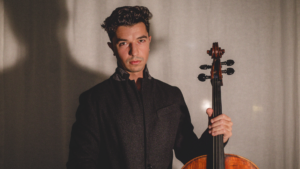
For classical musicians, few milestones carry the symbolic weight of a Carnegie Hall debut. On December 13, cellist Gabriel Martins, joined by pianist Victor Santiago Asunción, will experience that defining moment for the first time. It is a major step in what has already become an impressive and unusually thoughtful young career — one grounded not in spectacle or self-promotion, but in deep artistic sincerity.
Born in Bloomington, Indiana, Martins has emerged as one of his generation’s most sensitive and introspective voices on the cello. His approach reflects a rare combination of intellectual clarity, emotional depth, and genuine humility. He has spent years cultivating his musical identity, most visibly through his striking decision to introduce himself to the public by releasing recordings of all six Bach Cello Suites as individual EPs — a bold move for any young cellist, and one that speaks to his belief in long-term artistic growth rather than momentary splash.
With his Carnegie Hall recital approaching, Martins reflects on interpretation, the pressure young artists face, the future of classical music, and the emotional complexity of being a performer. What emerges is a portrait of an artist grounded not in performance bravado, but in an unwavering commitment to honoring the music itself.
What follows are excerpts from our conversation that have been edited for length and clarity. To see the full interview, please go to Cultural Attaché’s YouTube channel.
Q: You’re making your Carnegie Hall debut on December 13th with pianist Victor Santiago Asunción. How does one prepare for a Carnegie Hall debut?
Well, that’s a very extensive process, as you can imagine. These are pieces I’ve been working on for a very long time. Many of them I started when I was a teenager. Now it’s a matter of putting together a particular program, rehearsing the program a lot, putting all the different logistical matters together, and trying to make the best that we can out of this opportunity.
There’s also the mental component. For classical musicians, Carnegie Hall is still the holy grail, isn’t it?
I suppose so, yeah. I try not to let that alter my artistic process too much. Of course it’s something we take very seriously and treat with a lot of respect. But that’s also something I try to do for every performance. So yes, it’s a very important performance, but it’s also just another chance to do our best with this music and share the best that we can.
And that would be the same if you were playing in a high school auditorium in Sacramento, too, right?
Absolutely. Yes.
Pablo Casals said that the art of interpretation is not to play what is written. He also said, “Don’t play the notes — play the meaning of the notes.” What role does interpretation play in your performances versus fidelity to the notes on the page?
I think that’s always a great question, and for me they’re very much combined. You can’t have one without the other. If you start from the text, you start from the notes, and try to present them in the best, most honest, most beautiful light possible, then interpretation comes naturally. The more time you spend with a piece of music and get to know it, the more the interpretation evolves and comes out of that.
And the more you play it, the more you discover. Every musician says that discovery continues until the day you die. Now, I like the bold way you started your career by releasing each of the six Bach Cello Suites as individual EPs. Yo-Yo Ma made his first recording at age 27, but he had already recorded nine other albums. You launched your career with what many consider the pinnacle of cello music. What was your thinking?
The Bach Suites are the music that has been most important to me in my life. I’ve spent more time on them than any other music. When I decided to record those, I had in mind that this would not be the last time I do it. Many cellists record the Bach Suites once and then ten years later do it again. So for me, I wanted to have a record — at least at this place in my life — and I’m sure I’ll come back to it at some point and do a new version.
They were released sporadically over the last two years. Did you record them all at once?
I recorded them all separately, individually, at different points. All six suites at once is about two and a half hours of music. It’s certainly possible, and several cellists perform all six suites in one day. I’ve done that once in my life. But when you play that much music at once, you can’t give as much individually to each one. So my idea was to do one at a time and give everything I can to it. They were separated by usually three or four months in between.
I assume you did them in order, one through six?
Yes.
So by the time you released number six, it had been a couple years since you recorded number one. How do you hear number one differently now?
That’s a good question. It’s usually hard for artists to listen to our own recordings, especially older ones, because every day our feelings about the piece are growing and evolving. When I recorded that first suite about two years ago, I was in a particular headspace as an artist, and that produced that interpretation. Now it could be totally different. But that’s part of the reason I’m sure this won’t be the last time I do it.
Yo-Yo Ma has recorded it three times. Is there anything that stands out when you listen to that first suite? Either good or bad?
To be honest, it’s probably more of the latter — noticing flaws or things I want to correct. The older I get and the more time I spend with music, the pickier my ear becomes. You hear more flaws, more things you want to improve. But sometimes I listen and think, “Oh, I used to do it that way,” and maybe there’s something youthful and free about that. I learn from that as well.
What is your thinking now about the best way to break through to an audience? Classical music audiences statistically have been dwindling. How do you break through to a level of success that gives you the freedom to do what you want?
My feeling is that classical music will never be something that has a huge audience. It’s always going to be appreciated by fewer people, but for those people it means everything. It’s very serious music. When you sit down, you have to allow yourself to enter this emotional experience, and most people after a long day at work just want to relax. So I think classical music will remain niche.
As an artist, the most important thing is to give it all you can, devote yourself to it, and do it the way you believe to the best of your ability — rather than trying to alter it just to reach more people. That’s changing the essence of the art.
But you have robust Instagram and TikTok accounts. Are you finding that niche audience on those platforms?
Absolutely. If there wasn’t that niche audience, this wouldn’t be possible because nobody would be interested. So yes, there are people for whom it means the world, and those are the people we should be playing for.
What pressure is there as a young artist to make a name for yourself quickly?
This is an increasingly impossible business. To make it as a performing artist — soloist, chamber musician, recitalist — is very hard. The audiences are decreasing and there are fewer opportunities, while there are more great musicians because training continues. So these opportunities, like this debut at Carnegie, come with a lot of pressure.
But I try to live my life in service of the art. I decided when I was very young: if you’re given the option to be a famous artist or a great artist you respect and admire, it’s a no-brainer — I would choose the second. Whenever I feel pressure or doubt, I lean into that and do more of the work.
How important is it for you to have fun playing serious music?
I wouldn’t describe that experience as fun, or at least it wouldn’t be the first word. It’s fulfilling. Deeply, deeply fulfilling. But being a very emotional art form, devoting yourself to that emotion can be tough. One of the challenges is to go into that mindset for a performance, and then in the rest of your life be happy and easygoing. That’s a balance you have to figure out.
But is there joy?
I would describe it as feeling fulfilled. Joy is not the first word I would use.
When mapping out the Carnegie program, what were your priorities so people could understand who you are as an artist?
This was very much in collaboration with Victor Santiago Asunción. We wanted to feature as many different sides of music as we could — at least the music we love and care about. This program goes from Bach to Ginastera to Brahms. It features many different sides of what music can be.
Tell me about the Ginastera.
He was one of the greatest Latin American composers ever. His music is unique in that he encapsulates a totally fresh style. It’s extremely vibrant in sound, color, rhythm. The piece we’re playing — the Pampeana No. 2 — is a perfect example. It’s about eight minutes long, but you go through all sorts of musical extremes. We felt it certainly had a place in the program.
What is your philosophy about the best way to present music in front of an audience?
This is something I’ve been thinking about a lot. When you’re recording in the studio, there’s no distraction — it’s just you and the music. That’s a situation where I feel I thrive. I enjoy creating music for music’s sake. A lot of my colleagues feel stressed in that situation, and feel they have to play for people.
On stage, my approach is similar. I create this music in a sort of world, and I hope I’m inviting people to come in and be part of that world. I never want to force things on people. That’s my worst nightmare. I want to create something meaningful that I enjoy hearing myself, and then invite people into that.
Is there music that scares you to perform?
Yes. Many pieces. Bach is always daunting because it matters so much to me. I think of that music as a pinnacle of artistry. As a performer taking it on stage, sometimes I feel like my only job is to not mess it up. It’s not that I have to do something special — it’s just, don’t mess it up. Other pieces are daunting for technical reasons. Every piece has its challenges. The preparation process is to minimize that fear and become comfortable so you can present it naturally.
Is there music you feel you need to wait on?
I know a lot of people feel that way. But since a young age, my teacher’s philosophy was: play everything as soon as possible so it becomes part of you. Then when you come back ten or twenty years later, you already have experience with it. If I put something off, it’s like procrastinating. You take it up at the last minute and have little time with it. I prefer to have as long as possible.
That means having a lot of music ready to go.
As cellists, we’re fortunate our repertoire isn’t as large as piano or violin. We have few enough standard works that any concert cellist feels somewhat comfortable having those main works. From there, the process is endless in terms of perfecting them. But to have them at a baseline — especially if you develop them young — is possible.
As someone from Bloomington, I have to ask about the film Breaking Away. What was its significance in your community?
I’ve seen that movie probably ten times. It was a family favorite. Classical music was used really well. I remember Mendelssohn’s Italian Symphony, and I think Barber of Seville too. Beautiful. Whenever my dad hears the Italian Symphony, he brings up that movie.
The Carnegie recital is supported by the American Recital Debut Award, created in honor of Lynn Harrell. Harrell said, “There’s a need to feel a great deal of confidence, but you have to be very sensitive to the inward, frightened, timid side of human nature.” Do you agree?
Oh, that’s a great quote. I absolutely agree one hundred percent. We have to remember that the music we’re playing should evoke the whole human emotional experience, ranging from total confidence to shyness, self-doubt, sadness, depression — the full spectrum. A very authentic performance should show that. Sometimes we think of great performers as totally fearless, but it’s something different to embody the human experience. Most people are not fearless. If you want to create something relatable, it takes a different approach.
Note: Victor Santiago Asunción was Lynn Harrell’s pianist and founded the American Recital Debut Award concert in Harrell’s honor and to continue his legacy of supporting young artists.
To watch the full interview with Gabriel Martins, please go HERE.
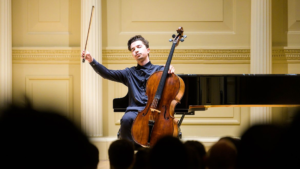
Main Photo: Gabriel Martins (Photo by Martin Allison/Courtesy Gabriel Martins)