





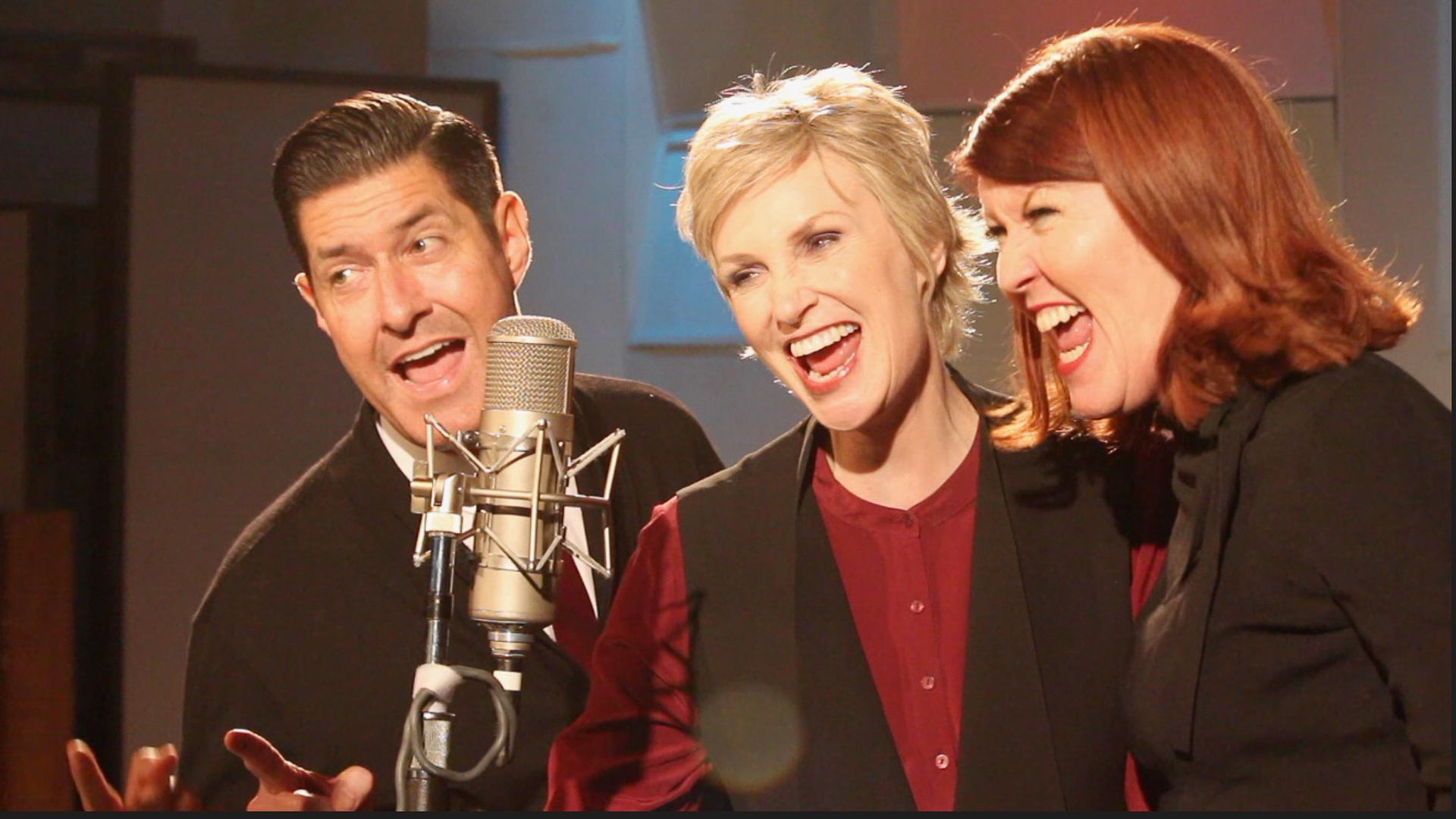

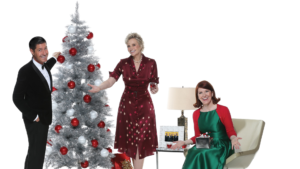
For more than a decade, Jane Lynch has been one of America’s most versatile entertainers — a performer equally at home belting out a standard, landing a lightning-quick comic turn, or commanding a stage with effortless presence. This December, she returns to Southern California with Jane Lynch’s A Swingin’ Little Christmas, the holiday concert she performs with longtime collaborator and dear friend Kate Flannery.
Already mid-tour, the show is next performed at the Bloomington Center for the Performing Arts in Bloomington, IN on December 12th; Hancher Auditorium in Iowa City on December 13th; the Plaza Theatre in Palm Springs on December 15, the Cerritos Center in Cerritos, CA on December 16, before bringing its jazzy, joyful energy to the BroadStage in Santa Monica on December 17.
This interview was originally conducted in January 2022, shortly before their scheduled performances of Two Lost Souls were postponed due to COVID related issues. With A Swingin’ Little Christmas now returning for the 2025 holiday season, Lynch’s reflections on collaboration, connection, and the joy of live performance remain as resonant — and as timely — as ever.
Lynch and Flannery’s chemistry — sharpened over decades of friendship and performing together — has become the heart of their seasonal concert tradition. They are joined by their tight, stylishly retro band, offering audiences an evening filled with harmonies, comedy, and the kind of holiday warmth only two true friends can deliver. “A Swingin’ Little Christmas” has become a fan favorite across the country, but Southern California remains its spiritual home.
In this conversation with Cultural Attaché, Lynch reflects on her creative partnership with Flannery, the art of being the “straight person,” the legacy of classic duos, what the return to live performance has meant to her, and why artists — from dancers to opera singers — remain essential even when not always properly valued.
What follows are excerpts from our conversation that have been edited for length and clarity.
Q: You’ve been doing this show for a few years now, and I’m wondering how it has evolved since you first came up with the concept?
Well, I don’t know that it’s evolved. It’s kind of this living thing that is new every night. But the mechanics of it are always the same. It’s the same music. It’s the same show we do, but it’s always alive for us in a different way. We’re not setting out to create something different each night, but it definitely is different every night because we’re spontaneous within the confines of this particular show.
You’ve known Kate since the ’80s, I believe. How has your relationship evolved since that time, and how do you see that friendship expressed in this show?
Well, we completely trust each other. That’s one of the reasons we’ve been doing this together for so long. We don’t fight. We get along. And I think that’s just so important. We have the same sensibilities. Sometimes we’re the same person, although she’s 5’4″ and I’m six foot. But we both have an Irish-Catholic background. Our fathers are almost the same person, and we love old music from the late ’50s, early ’60s. One of our songs even goes back to the 1920s. We both have a feel for that old music. So we come together on that.
It’s kind of miraculous when you find somebody who basically shares your sensibilities and you have a chemistry together. We’ve been doing this for a long time. Our relationship started out with trust. When we go out on stage, we always do this thing we saw in a movie where we pat each other on the back and say, “I got your back, got your back.”
You also trust each other enough to take the piss out of each other, to use the British expression. I saw you on Kelly Clarkson, and when she asked who screws up the most, you immediately pointed to Kate.
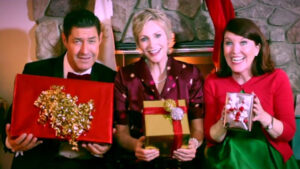
Kate? Yes. Absolutely. I know Kate’s feelings are not hurt. Kate has a particular way about her that is very spontaneous and kind of crazy. I’m much more contained and restrained. And that’s the key to the comedy between the two of us. I always compare us to Eve Arden and Kaye Ballard. I’m kind of the Eve Arden, trying to keep everything on the up and up, and Kate Flannery just takes us off into crazy directions, which I love. I love nothing more than reining Kate in. And of course, it’s a funny thing — I’m not the party pooper.
“Reining in” is not the first description I’d use for you. You can certainly go full-bore into any situation. Is being the quote-unquote straight person a natural fit for you?
I think I have a natural fit into a few personas, but yes, that definitely is a natural fit for me. And it’s also the flavor I use when I host The Weakest Link or Hollywood Game Night or if I host an awards show. It’s kind of the person who herds the cats. That doesn’t mean I don’t get an opportunity to be funny, but it’s just a different point of view.
When I first saw you on The Weakest Link, I thought, “Jane is so nice — it’s hard to watch her be like this.” It feels more like Sue Sylvester than like you.
Right. Well, I definitely have it. My mother was half Swedish, and I always said the Swedish won out because she could be kind of cold and not sentimental. And I understand that. I definitely have that. You scratch below the surface and I can be as ruthless or as cold as anybody.
The show, Two Lost Souls, takes its title from a song, and when I think of that song, I think of a generation of numbers like “Bosom Buddies” from Mame or “Friendship” from Anything Goes — classic songs about friendship. Do you think there are any contemporary songs that represent friendship the way those classics do?
Well, I don’t know Wicked that well, but there’s that one — what is that song? “For Good.” “Because I knew you, I have been changed for good.” I think that’s probably the latest one that’s in a musical. No, I can’t think of anything. I’m not up on the kids’ music. I only know the old stuff. That’s why Kate and I get along so well. We both only know the old stuff.
We should do “Bosom Buddies.” I think we did it at a charity event at some point. When we decided we were going to do a show — just the two of us with the quartet — Kate said, “As the first song, let’s do ‘Two Lost Souls’ from Damn Yankees.” And I said, “I think that’s a great title for this show,” because we are kind of like two lost souls on the highway of life. Together we’ve got each other. We see things in a weird way, but in a weird way together.
Our relationship is unique to us. Maybe a lot of people would have fun with us. When we go on tour, we always get a dressing room together. We don’t get separate ones. And we have our little thing: she puts out her tiny speaker on her iPhone, and we sing Karen Carpenter while we put on our makeup. That’s our pre-show thing. When she wore this specific crinoline dress — she doesn’t anymore — I used to steam it for her. We had our little routines. We are two lost souls on the highway of life.
Now I know why “Rainy Days and Mondays” ended up on your list of songs that make you cry madly — you’ve already been singing it in the dressing room.
Exactly. We do the Karen Carpenter song when there’s no — oh, that rain. Well, that’s love songs, not songs that made us cry. That’s our favorite love song.
What makes a good duo? And are there challenges two women face being a duo that men don’t?
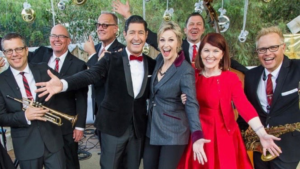
Oh, I don’t know about that. One of the things we say on our poster — our ads — is, “Like the Rat Pack, but with two broads.” We kind of see ourselves that way. I think what makes a good duo is chemistry and trust. And there has to be something that happens comically — comic chemistry — and then musically.
We really blend well. She’s a wonderful soprano. She’s got a late Jo Stafford kind of a voice — late ’50s, early ’60s studio singer voice — clear as a bell, pitch perfect, restrained vibrato she uses so artfully. And I’m a very good harmonizer. So is she, by the way. Our voices mix really well.
So we’ve got that going for us, and we have our own little, as they say in comedy, “our own little bit of business” that we do together.
When I’ve seen clips from the show, I immediately flash back to those great specials Carol Burnett and Julie Andrews used to do together. Did their work influence you?
I’m sure it did subconsciously. We both know those shows and what wonderful friends they were. In fact, one of the first dinners I went to with the woman who is now my wife — we went to this restaurant in Brentwood, and Carol Burnett and Julie Andrews were sitting at a table together. We heard them because they were laughing so hard. They were having such a blast together. This would have been around 1992.
I’m sure it affected us on a subconscious level. I didn’t set out consciously to do that, but yeah, they’re such good friends. They’re so different — Carol’s kind of goofy and Julie’s classy — and you can tell they love each other. They have a blast, and indeed they do.
We were denied opportunities for nearly two years during the pandemic — not able to see you or anyone else on stage. What was it like to be on the other side, unable to perform live, and what does the return to stage with Kate mean to you?
I’m most alive on stage. I’m my happiest. And because I’m with Kate and this band — this band is just amazing — and we all know each other very well. We’re all of a certain age and we all get along. There are no egos. Nobody’s taking us emotionally hostage.
This particular group of people — I really missed them these last two years. We didn’t get to do our Christmas show either. We do a Christmas show every year, touring all over the country. We did it this year and it was such a joy to come back. I missed it. You don’t realize how much you miss something until you’re back.
There was the pandemic, and you resolve that this is what it is, you’ll make the best of it, life goes on. But then you get back on stage with these people doing these songs and you go, “Oh my God.” All of us say it after every show: “This is the best gig in the world.” And if we’re having such a great time, I know the audience is there with us. It would be nothing without them. They’re a big part of what makes it so joyful.
Everybody comes — especially since the pandemic — and the audiences are just so happy to be out, even though they’re masked and showing their vaccine cards. Everybody’s so happy.
During the pandemic, it became clear that anyone who thought artists weren’t essential workers was mistaken. I’m wondering whether you think artists get proper acknowledgment for their contribution to society?
Well, I certainly think television and movie stars do, because they get that adulation and all that money. I think we value less the finer arts — our painters, our poets, our dancers, which is a performative art, not a fine art, but still. Opera singers. It costs money to be an artist. Most people don’t make any. And yet it’s probably one of the least valued aspects of our society.
I don’t know that the pandemic changed that so much. I think what it did change is that we missed our television, and we relied more on what was on. A lot of us watched old movies. But I don’t know that the pandemic changed how we feel about dancers and opera singers. People still go to rock concerts and that’s great, and people missed that. Our stuff — we don’t sell out every time. We get pretty good crowds. They came back and they were happy. We do pretty well.
And you trust that, come what may, you’ll do what you need to do for each show.
I think there’s a great deal to be said about performance. This is the difference between being a pro and maybe not ready for primetime: the audience has to trust you, that you’re in control. There’s nothing worse than being in an audience when you know the performer isn’t 100 percent confident, hasn’t really plumbed the depths of their material, and you’re worried for them. That should never happen.
Main Photo: Tim Davis, Jane Lynch and Kate Flannery (Photo by Tony Guerrero/Courtesy of the BroadStage)
[…] Holiday show returned in December 2025 with California dates (Cultural Attaché) […]