






Few playwrights working today navigate the intersection of poetry, politics, and humanity with the clarity and compassion of Tarell Alvin McCraney. From the aching lyricism of The Brothers Size to the choral intensity of Choir Boy, his work has consistently explored identity, community, and the fragile scaffolding that holds both together. Beyond the stage, McCraney is widely known for his Academy Award–winning screenplay for Moonlight, a film that, like much of his theater, examines the quiet, often unspoken struggles of belonging and self-definition.
With Windfall, now in its world premiere at Steppenwolf Theatre in Chicago, McCraney turns his attention to a question as volatile as it is unavoidable: what is the value of a life, and who decides? Centered on a father’s reckoning after the death of his activist child, the play unfolds as a kind of moral tribunal in which the audience is not merely observing but participating. In McCraney’s hands, the stage becomes a site of confrontation, one that resists easy answers and instead insists on deeper inquiry.
Q: Opening night has just passed. Have you had a chance to exhale?
Tarell Alvin McCraney: I appreciate the thought, but that moment never really arrives. Especially with a play like Windfall, where the audience is such an active participant, every performance feels like stepping into something new. There’s an eagerness and a nervousness that stays with you. Each night brings different responses, different energies, and even different relationships between the audience and the actors. It’s exciting, but it also means you’re constantly aware that anything can happen.
Is that range of audience response something you anticipated?
That’s the point of the play. Windfall engages with what I would call third rail issues, things we tend not to discuss openly, and money is at the center of that. Specifically, how we compensate for harm done to our loved ones.
Structurally, it’s not entirely unfamiliar. It sits in conversation with plays like A Raisin in the Sun. It’s a Chicago story about a life-changing sum of money arriving after a devastating loss. But here, it is a father, Mr. Mano, who must decide whether to accept a settlement after harm comes to his child, who was an activist.
Three figures come to him, each with their own argument, their own logic, their own pressure. What shifts the ground beneath all of that is the audience. They are not passive. They are implicated in the decision-making. They become part of the machinery of persuasion. And that means the play is never the same twice. It can’t be.
When I read the play, I felt a strong connection to Mr. Mano, even without sharing his exact experience. Do you see him as an everyman figure?
I see Mr. Mano as all of us. He represents a generation that believed deeply in a certain version of the American Dream, a generation we don’t always listen to now. They’re at a point in their lives where things were supposed to settle, where the promise was that if you worked hard and did what you were supposed to do, there would be a kind of security.
But that security isn’t there. And now they are being asked to make decisions under pressure, decisions that don’t just affect them but ripple through their families, their communities, their sense of self.
At the same time, they are in conversation with younger generations who see the world differently. Who don’t necessarily believe in that same dream, or who understand it in a completely different way. And that creates tension, but it also creates a kind of reckoning. Mr. Mano is caught in that space, trying to determine what is right, what is acceptable, and what it means to live with either choice.
There’s also an undercurrent that younger generations may not believe the American Dream is achievable anymore.
Not in the same way, no. And that difference matters. It’s not just about whether the dream exists. It’s about how we define it, how we pursue it, and whether we believe it is collectively attainable.
We don’t gather in the same ways anymore. We don’t share space in the same ways. Theater used to be, and still can be, a place where we come together and imagine something collectively. Martha Lavey [Steppenwolf Artistic Director 1995-2015] used to say that theater is a place to practice being human. I often think of it as a place to practice dreaming together.
Because we have so few spaces to do that now, our dreams have become fragmented. Individualized. Disconnected. And then we wonder why we struggle to find common ground.
The act of gathering, of sitting in a room together and engaging with a story that reflects our lives, is itself a democratic act. We may not agree on what we’re seeing, but the fact that we are there together, engaging, responding, questioning, that matters.
That connects directly to the Ubuntu philosophy in the play. Bishop Desmond Tutu said in 2008, “A person is a person through other persons. None of us comes into the world fully formed. We would not know how to think or walk or speak or behave as human beings unless we learned it from other human beings. We need other human beings in order to be human.” How central is that idea to you?
It’s central in every way. And I don’t approach it as an aspiration. I approach it as a fact. As Bishop Tutu says, we need each other in order to be human. That’s not something we can opt out of.
We can try to isolate ourselves. We can use technology, we can use wealth, we can construct systems that create distance. But at some point, something happens that reminds us that we are connected, that we are dependent on one another.
For me, that ethos is at the core of my artistic life. Even as someone who can be introverted, who sometimes finds being in large groups challenging, I understand that the work only exists because of that interconnectedness.
That’s what ensemble means to me. That’s what Steppenwolf represents at its best. It’s a group of people coming together, not because they agree on everything, but because they recognize that something more powerful can be created in that space of collaboration. That we can go further together than we can alone.
It seems to me that listening is at the heart of that.
It is. Theater, at its core, is listening. We talk about spectacle, design, all of that, but what we are really doing is asking people to listen. To language, to rhythm, to each other.
When you sit in a theater, you are being asked to imagine. To leave the physical space you are in and enter another one. And that requires attention. It requires openness.
In Windfall, the actors speak directly to the audience. They tell you where you are, what is happening, and then suddenly you are there. That act of listening activates something essential in us.
If you can imagine something together with someone else, that’s powerful. That’s where transformation begins. Not in isolation, but in shared imagination.
You’ve said you hope audiences leave Windfall inspired to dream bigger. What are the big dreams that you have for yourself that maybe writing Windfall allowed you to access?
I think we’ve become very practiced in dreaming individually. And that’s not a bad thing. But I do think we’ve lost some of the muscle for dreaming collectively.
Living in Chicago has shown me what that can look like when it’s supported. The investment in arts, in libraries, in after-school programs, those are all expressions of a collective dream. They say something about what we value as a community.
And I find myself missing that in other places. Wanting that to be more central, more visible, more sustained.
So for me, the work is about encouraging us to imagine not just what we want for ourselves, but what we can build together. Because if we are only dreaming for ourselves, we are limiting what is possible.
The play is set in Chicago, and the city’s 2026 budget includes $82.5 million allocated for police misconduct lawsuits, with actual payouts often exceeding that by tens of millions more. How does that reality inform Mr. Mano’s journey?
What you’re pointing to is one of the central tensions of the play. The fact that there is a line item for misconduct, that we can anticipate harm in that way, should force us to ask deeper questions.
Because it means that harm is not an anomaly. It’s expected. It’s accounted for.
So when Mr. Mano is offered a settlement, the question is not just about whether he takes the money. It’s about what that money represents. What it says about the value of his child’s life. What it says about accountability. What it says about the systems we’ve created.
And I don’t have an answer for that. I don’t think the play offers one. What it does is ask us to sit in that discomfort. To recognize that something is fundamentally misaligned when systems designed to protect us are also causing harm.
If we don’t interrogate that, if we don’t continue to ask what we are willing to accept and why, then we remain complicit in maintaining it.
I spoke with playwright Lynn Nottage last year, and she said that artists need to carve out space to tell their stories, especially when that space isn’t readily given. That was in response to my asking her if it was a good time or a scary time to be an artist. What do you think?
Lynn is someone I consider a mentor, truly. I often call her a sensei. She was one of the first people to show me that as artists, we are always in a political landscape, whether we acknowledge it or not.
So the question becomes, do we engage or do we retreat.
Windfall is a play that scares me. Because it engages directly with systems, with power, with voices that haven’t always been given space. And when you create that space, you don’t control what happens next.
There’s a volatility in that. A possibility that the conversation becomes more intense than you anticipated.
But those are also the moments where the work feels necessary. Where the discomfort tells you that you are touching something real. Lynn pushed me toward that understanding. Toward the idea that discomfort is not something to avoid, but something to examine.
You’ve said before that you don’t want your work to feel finite, that you want it to keep unfolding over time. But given the subject matter of Windfall, do you also hope that it becomes a relic of another time, something we no longer have to grapple with in the present?
Absolutely. There is always a hope that the plays we write become artifacts, that they reflect a moment we have moved beyond.
But the truth is, we’re not there yet. We are still living inside these questions. We are still navigating systems that produce harm and then attempt to quantify it. We are still asking families, asking individuals, to reconcile the irreconcilable.
The unsettling thing about Windfall is that it doesn’t offer a resolution because there isn’t one yet. The question that sits at the center of the play, and the one that I hope lingers, is simple and terrifying.
If this is the system we have, and it is failing us, what else is there. And if we don’t have an answer to that, then the responsibility doesn’t disappear. It becomes ours.
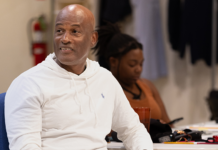
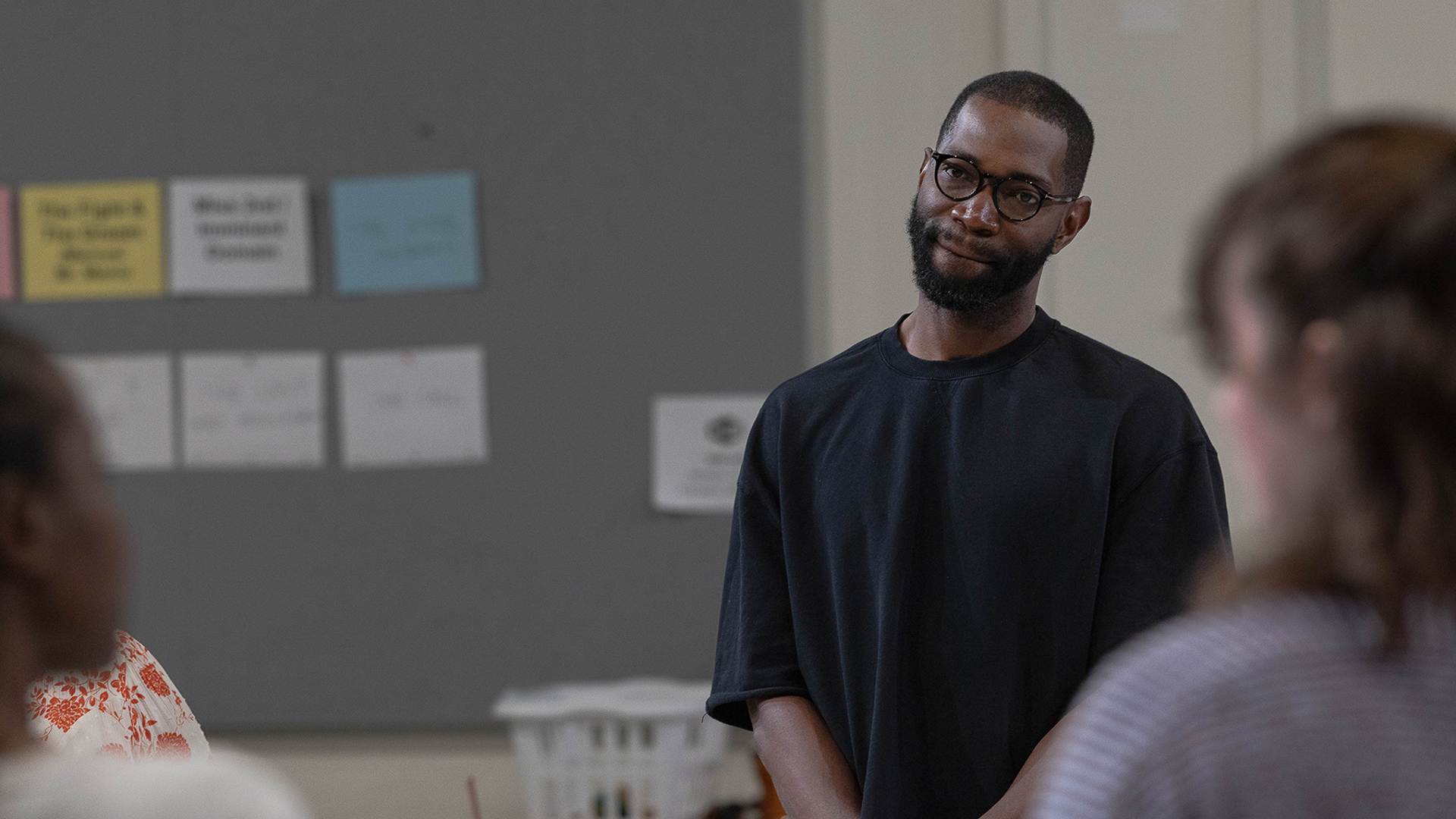
Main Photo: Tarell Alvin McCraney at rehearsals for Windfall (Photo by Jeremy Williams/Courtesy Steppenwolf Theatre Company)
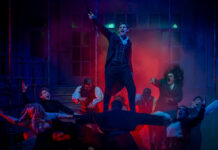
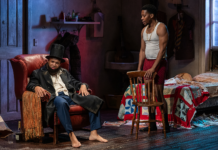
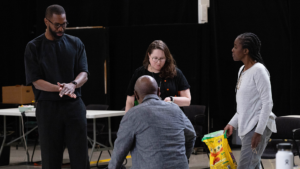
Clips from Windfall courtesy Steppenwolf Theatre Company