


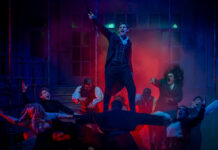
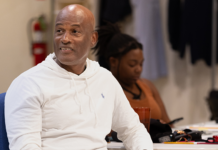
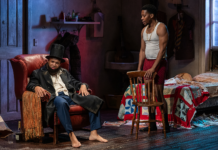





Titanique has not followed the traditional Broadway path. Created by Tye Blue, Marla Mindelle and Constantine Rousouli, the musical began as a collision of James Cameron’s Titanic and the music of Celine Dion before growing from a basement production into an international sensation. Now, after years of rewrites, reinvention and word of mouth momentum, the show has arrived on Broadway with four Tony Award nominations, including two for Blue as co writer and producer.
Could Titanique join other underdog musicals like Fun Home and Avenue Q and be the iceberg that sinks bigger shows on June 7th at the Tony Awards?
Speaking just days after the nominations were announced, Blue reflected on imposter syndrome, queer storytelling, the long road to Broadway and why following instinct mattered more than following the rules.
Q: Two days after the Tony Award nominations came out, how are you feeling and has it truly sunk in that the little show that could is now competing for Best Musical?
Tye Blue: I guess it hasn’t truly sunk in yet. I think once we’re at the awards ceremony or we start going to events for it, I think that’s probably when it will set in. It still feels a bit nebulous to my spirit, but at the same time, it’s a great honor. And I’m trying to hold space for that and hope that we meet the moment.
What do you think it is about “Titanique” that could start in the basement of a grocery store and end up with productions around the world?
Well, the thing that we didn’t realize when we started writing it was that combining the world of Titanic fandom and the world of Celine Dion fandom with comedy and a modern queer lens, we didn’t realize that we had landed on a magical formula from a marketing perspective. But I think beyond that, it was always my goal to make this show something that really delivered and exceeded expectations. You see, oh, they’re doing a parody of this thing in a basement. You think it’s going to be very thin, very flimsy, very one note. And I didn’t want that. I’ve done those shows. I know those shows. And I wanted this to be something that was musically complex, something that honored Celine and her catalog and her incredible gift and her songwriters and her producers.
And I also wanted it to, yes, be silly and fun and unhinged, but also honor this incredible film that really touched multiple generations and kind of was the beacon for what a love story should look and feel like. So for me, I always wanted the show to reach people through all of those avenues. And I think making sure it did that is what allowed us to grow up out of that basement and go all over.
It is interesting that you talk about the eternal appeal of James Cameron’s film because the love stories that tend to endure are often the ones where the couple does not end up together. So how do you take that emotional framework and merge it with topical humor and a kind of improvisational chaos?
So much of it just came out of organic collaborative conversations of ways that we could combine these two worlds. It’s been a very interesting journey. We’ve probably done 40 drafts of this show at this point. Every time we would do a reading of it or a one off concert, we would get together and really go through and find truth about what worked and what didn’t. Is this too much movie? Do we need more of a departure here? Do we need to come up with something totally new to really set us apart from the film? Every iteration has been a whole new experiment.
What is the process of continually refreshing the show so that the audience feels like it is happening in the moment?
I think first of all, people think there’s more improv in the show than there is. There’s the one chunk where Celine improvises what happened down in steerage. But the tone of the show feels improvisational. Much of that is pulled from the rehearsal process.
What I will say is taking the show to all of these different locations and markets and literally hemispheres, much of the pop culture references that are in the script here in the States did not translate to Australia. Much of it did not translate to England. A lot of it doesn’t translate to Canada. So what was exciting about doing those companies was sitting down with that cast and marketing team, doing a read through on day one and saying, get your highlighters out. I want you to highlight anything that does not make sense to you, anything that’s a reference you’ve never heard of.
Then we would talk through all of those question marks. I’d explain the bit, explain what the funny is, and then take pitches from them about what a local equivalent might be. Getting to customize each production to make it feel localized and curated to their culture and their pop culture there, that was really exciting. That kept it alive for me in a lot of ways.
You worked with Stafford Arima for years and Christopher Gattelli, who also has Tony nominations this season. When you find yourself among artists whose Broadway careers have perhaps been more visible for longer, do you feel like you have arrived where you always wanted to be?
Here’s the thing. I have always felt like an outsider. Like someone who didn’t go to a big school, didn’t have any connections in New York. Unlike many people who go into this business and are kind of darlings who get shot to the top fast. So on the one hand, I will always have that small town Texas kid outsider feeling about myself, that imposter syndrome thing about myself.
But on the other hand, Christopher Gattelli and Michael Arden and other people nominated this year are dear old friends of mine who I know we have the same skill set because we’ve worked together. I just hadn’t been given the opportunity to do this yet. I had to make it happen for myself.
What I know for sure is that I’ve paid my dues. I’ve been in the trenches. I know how to speak the language of every department on my show because of what I’ve had to do to get where I am. So without sounding egotistical, I have earned it and I feel great about that. But there’s always going to be that little voice in the back of my mind that’s like, you’re a nobody. You’re a kid from a small town who used to play in the middle of a cotton field. You didn’t go to Yale. Who do you think you are? So it’s about managing all of that.
You spoke in another interview about battling the inner saboteur. Do you feel like success allows you to exhale a little more now?
It does. I will tell you that when you are scraping by and trying to get there, you have to say yes to a lot of things. You have to subjugate yourself to a lot of situations. You have to take work that you don’t want to do that you think is going to serve you. But I think in hindsight, now that I’ve got a bit of footing and now that I’ve got a track record of creating a show out of thin air that can be an international success commercially, I can hold that. I know what it takes to get here now.
And now that that has happened, there are people coming to me looking for help, looking to involve me in things. So I can say that I’m feeling much more confident.
This show opened for a limited Broadway run and has now extended. What are the possibilities that Titanique keeps going?
Some people have pondered that. I am fairly certain that the powers that be have ideas for other things they want to do in there next year maybe. It’s an in demand theater. It is potentially one of the best theaters on Broadway. So I don’t want to be pessimistic, but I think we would have to win all four of these Tony Awards and sales would have to skyrocket for us to really go for a long time.
You have to remember, we ran for three years Off Broadway. So many people in the Tri State area have already seen the show. It’s a complicated set of equations. But I can’t imagine there aren’t a couple of other big shows that really want in that theater.
Well, I think closing on New Year’s Eve would be perfect.
Honestly, that’s my personal goal. If we can get through this year, then to me that is like we’ve won a gold medal at the Olympics. That would be amazing.
Is there any fantasy scenario in which Celine Dion introduces the show’s Tony Awards performance?
It would mean more to me than winning a Tony. She is such a beacon for us. Even to have her come to the Tonys. Everyone on her team has seen the show. Her orbit knows about the show. But she’s the only one who hasn’t been yet. We would be blown away if she would.
But she’s very busy now. She’s got her health back on track. She’s doing great. She’s got these sold out concerts in Paris. What I have been told by her team is that she’s busy. The likelihood of her being able to come is probably slim, but I hope she knows how much we love her. It’s my fantasy for her to be at the Tonys. I wish she could be my plus one for the Tonys. I’d probably explode into a ball of glitter if that happened. But respectfully, I think the lady is booked.
Going back to the earlier days of Titanique, there was a moment where you lost three songs very late in the process. What did you and your collaborators learn about yourselves from having to respond so quickly?
I think we learned a lot about each other in that moment. Marla was very strict with her wants for the show and what she thought it needed. She lost her mind and cried and didn’t want to deal with it. Connie and I were just like, we’ve got to figure this out. She has a million songs. Let’s go dig.
It was an interesting moment for our dynamic. How do we keep this thing alive? As we found in looking through her catalog, it was actually quite easy to move things around, reconceptualize, repurpose and choose different pieces of different songs to function in different ways.
I do miss the dramatic theatrical fanfare of “It’s All Coming Back to Me Now” and the conceit of that setting up our whole concept. But by the same token, what we’re doing with “I’m Alive” as the opening feels more like a Celine Dion concert opening number. It’s much more expository and joyful and brings the audience in in a way the other did not. So I ultimately think those changes maybe made the show better. And it allowed us to partner with the songwriters who wanted to support the show and understood what we were trying to do.
Early on, you wanted to do the show at a venue in Los Angeles where you had already found success, but they were not interested.
I think I’m specifically talking about Rockwell in Los Angeles, where we were all working and literally just the room where we were drinking and had the idea after one of our shows there to do this. I thought, this is genius. This will be our next show here. But the person who was running the venue at the time did not want to do it.
In hindsight, I now see it as the universe saying, if you want to do it, do it. Take the reins. Make it happen. And I’m glad I did because if she had said yes, we probably would not be where we are now. I do wonder if that person remembers saying no. I wonder if they watch and think, well, could have said yes to that. Could have been a part of that. But I’m proud that we took it into our own hands and let it grow organically over the years.
Given the political climate right now and the way the queer community is often being targeted, what do you think the success of a show like Titanique says culturally?
It’s interesting to be on Broadway right now with Oh, Mary! and Cats: The Jellicle Ball across the street from us and Rocky Horror down the street. I do think that art is the way. Art is the result. Queer people have had to fight to be taken seriously our whole lives.
This journey of putting on a show that is innately queer, I will say we didn’t come at it with that mission. We came at it with our authenticity and with what we thought was good and funny. And now here we are being viewed as this very queer expression for our community. I think there’s something to it being organic like that that helps it work this well. If you try to manufacture it too much, it doesn’t seem to work as well in my experience.
But queer people are survivors. We have to be. That’s what we always felt making this show. No Broadway producer was going to take a meeting with us, these musical theater expats waiting tables in Los Angeles. We had to make it ourselves, for us. And I think that’s the message. If you have a voice, you have to build what you can with what you have.
I hope queer theater people and creatives in general see what has happened with Titanique and feel empowered and know that you can be a little nobody doing an odd job and write your passion project and take it all the way to the top.
So what’s next?
There are a couple new musicals in London that we’re trying to get homes for to develop and premiere. I directed a play called Joan about the life of Joan Rivers and her daughter Melissa that went pretty well, so we’re hoping that can have another bigger life. And there are a couple of musicals that I am co writer and director of that are brewing. Hopefully in the coming year there are some big announcements coming.
Let me finish with one of Celine Dion’s best known quotes: “If you follow your dreams, it means you follow your heart.” How much does that resonate with you now?
It means everything. This whole show exists because a knowing washed over me. One specific moment that I will never forget. It was like spirit moved through my body and said, this is what you need to do. This show is the one that needs your focus. Build the resources to make it happen. Lead it. Shepherd it. This is your baby that is worth all your time. Stop spreading yourself thin. Focus everything you have on this. And I did that and here we are.
So she couldn’t be more right. It never felt like work. It was always the thing that I wanted to sit down and look at. The thing I wanted to revise artwork for or look at a contract for. It was always the thing I was excited to do. So she’s absolutely right. If you’re following your heart and that little voice in your head that says there’s something here, then you won’t go wrong.
Titanique is now playing at the St. James Theatre in New York through September 20th.
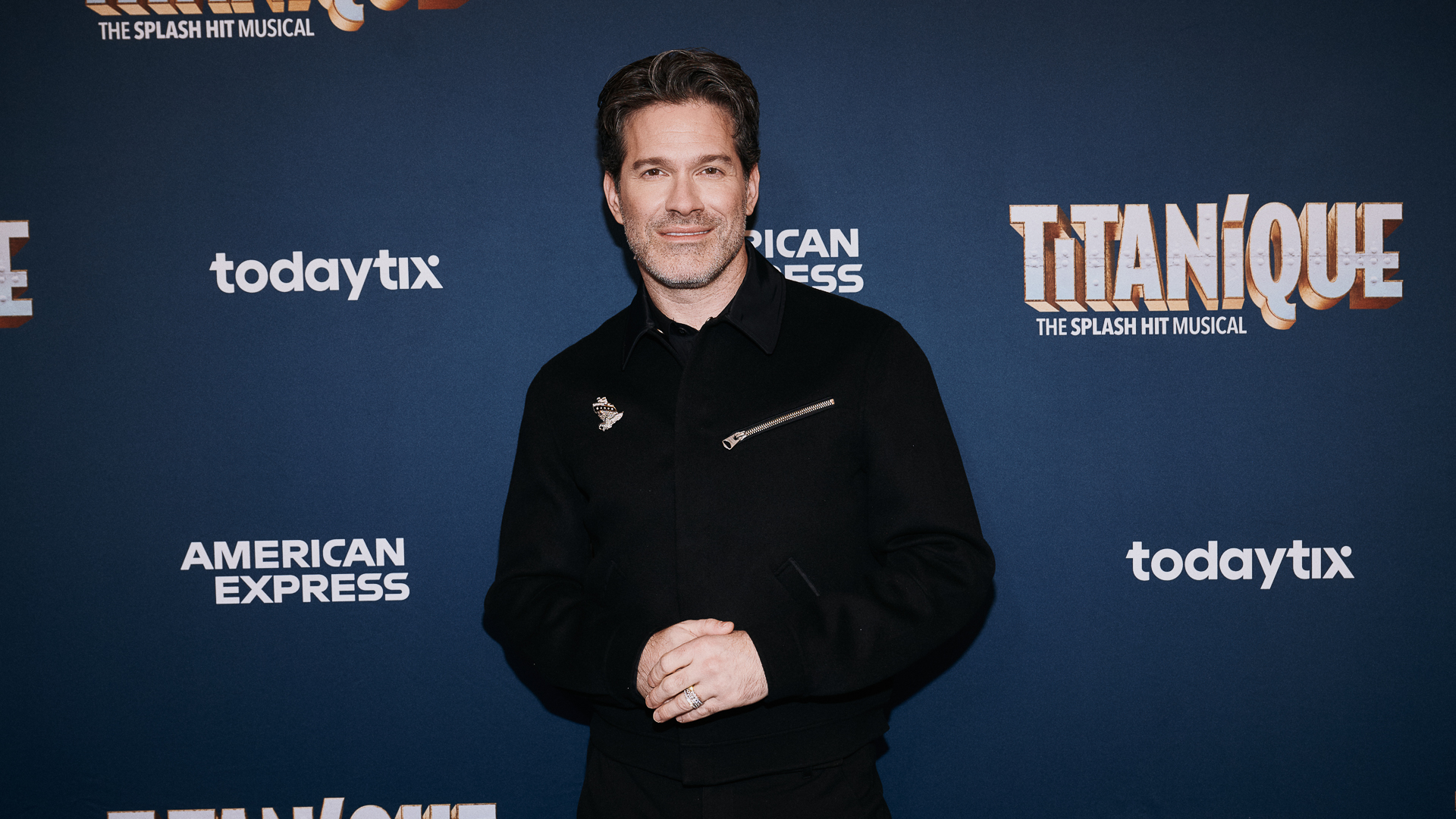
Main Photo: Tye Blue at the opening night of Titanique on Broadway (Photo by Valerie Terranova/Courtesy the Production)