










“Oh no, Alan, that’s inhuman.”
Those were the words Samuel Beckett spoke to actor Alan Mandell during a rehearsal of Endgame. Mandell was playing Nagg, a character who spends much of the play confined to an ashcan. Having finished a lengthy speech, Mandell remained inside, preparing to spend the rest of the performance there. Beckett lifted the lid and informed him that he could come out.
Mandell protested. He needed to get accustomed to remaining in the ashcan until the play ended. Beckett disagreed. They would cut out the back of the container so he could escape after his scene.
“I had done it in San Francisco and stayed in the ashcan the whole play,” Mandell recalled when I interviewed him in April 2016. “I had to get in there before because there was no curtain, so I had to get in there before the audience arrived. What a joy! It wasn’t a long run, thank heavens.”
We were sitting in Mandell’s home near UCLA, surrounded by beautiful paintings, sculptures and other works of art. His late wife had been a gallerist. Mandell was extraordinarily polite, something I would discover was not limited to our afternoon together.
He was 88 and preparing to direct and star in a production of Endgame at the Kirk Douglas Theatre in Culver City. He would play Hamm opposite Barry McGovern’s Clov, returning to a play and a playwright who had been central to his artistic life for decades.
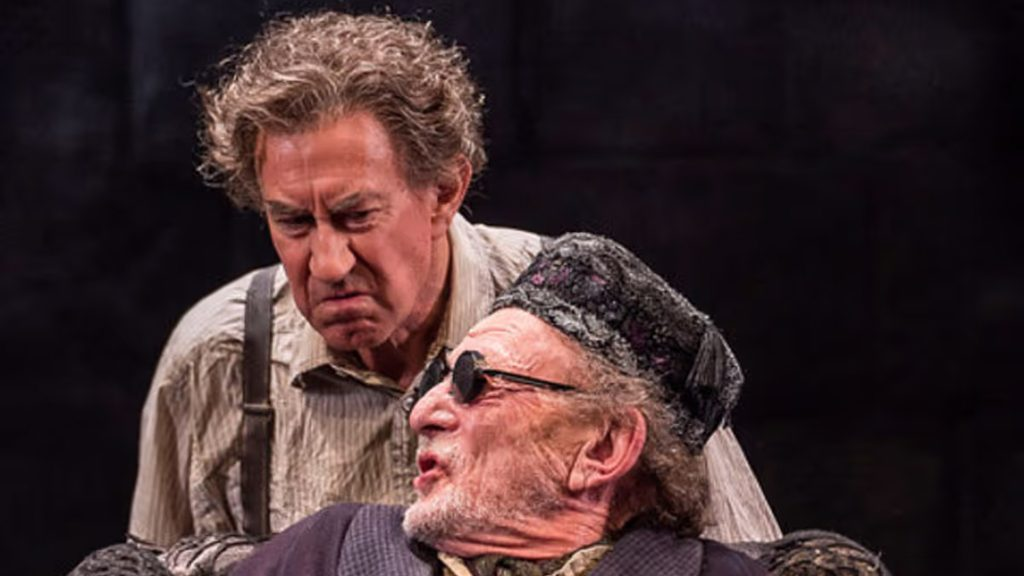
Mandell died on October 13th at the age of 98. His career encompassed theater, film and television, with screen appearances including A Serious Man and Hedwig and the Angry Inch. But it was the theater, and particularly the work of Samuel Beckett, that occupied such an important place in his life.
Mandell’s association with Beckett began through the San Francisco Actor’s Workshop and the San Quentin Drama Workshop, which he co-founded with Rick Cluchey. Over the years, he became one of the playwright’s most distinguished interpreters, performing Waiting for Godot and Endgame and developing a friendship with the man whose work he understood so deeply.
When we spoke, Mandell was candid about the challenges of returning to the stage at his age.
“It’s hard work,” he told me. “I’ve told someone who asked me about learning lines, it was easier when I was 85. It really gets harder after that.”
He kept the script beside his bed, sometimes waking in the middle of the night trying to remember a particular line. John Sloan, his assistant director and, as Mandell described him, really his co-director, was coming over to help drill him on the text.
Yet when our conversation turned to Beckett, his recollections were vivid and often very funny.
He remembered rehearsing Endgame when the actress playing Nell had not yet arrived. Beckett suggested that they rehearse the scenes between Nell and Nagg anyway.
“Why don’t we pull up two chairs? I’ll do Nell and you do Nagg,” Beckett proposed.
“Talk about being on the spot,” Mandell recalled. They performed the entire scene together. At the end, Beckett patted him and said, “You are going to be very good.”
“It doesn’t get any better than that,” Mandell said.
Their relationship extended well beyond the rehearsal room. Mandell recalled that whenever his work brought him to Europe, he would try to stop in Paris to visit Beckett.
“Every time I came to Paris, I was doing his work in Barcelona or wherever, I would stop by in Paris. He always knew where I was.”
Mandell remembered arriving at his hotel and receiving a telephone call from Beckett almost immediately.
“They’ll take care of your bags. I’ll see you in ten,” the playwright would tell him.
Mandell would leave his luggage behind and go to Beckett’s home in Montparnasse, where they would share coffee and conversation. Mandell would have a croissant. Beckett, he recalled, almost never ate.
“He was the most generous, kind, loving, tormented individual I ever knew,” Mandell told me. “I felt so privileged knowing him.”
Mandell was particularly eager to dispel the notion that Beckett’s plays were inaccessible or impossible for ordinary audiences to understand.
He recalled performing Waiting for Godot at San Quentin in 1957, where the prison authorities had warned the actors that the inmates would make their displeasure known if they disliked the production.
According to Mandell, some 1,500 prisoners watched the performance.
“They knew what the play was about; they knew what waiting was. They had no trouble understanding this play.”
Mandell also remembered Beckett’s generosity toward fellow artists. He told me about a touring company associated with Sean O’Casey’s daughter, Shivaun, that had been stranded in the American Midwest after its producers abandoned the production.
Beckett, Mandell said, quietly paid the expenses necessary to get the company back to Europe.
“He paid for everything. Never asked for anything. He did all these things that people never knew about.”
He was equally fascinated by Beckett’s relentless pursuit of precision. The playwright was forever revising, eliminating words and adjusting rhythms. Mandell showed me a script containing Beckett’s handwritten changes.
“He was always making notes. He was forever correcting and eliminating.”
During performances of Endgame in Rome, Mandell recalled audience members following the play with printed scripts. Afterward, some complained that passages had been omitted.
Mandell explained that Beckett himself had made the cuts. The news astonished them.
The playwright had described Endgame as a chamber piece in eight movements, even marking those movements in Mandell’s script. He had also cautioned that a performance lasting longer than 90 minutes meant something was wrong.
For Mandell, the lesson was clear. The words mattered, but so did the silences, the timing and the musical structure beneath them.
“As long as you keep the rhythm and poetry of the piece there, that’s fine.”
Although Beckett dominated much of our conversation, Mandell’s own sense of humor was never far away. He delighted in pointing out the ages of his fellow performers in the 2016 production. James Greene, playing Nagg, was 89. Charlotte Rae, one of the actresses playing Nell, was turning 90.
“That must be one of the oldest casts in America,” he said.
He also spoke about the possibility that Endgame would be his final stage appearance in Los Angeles. The demands of performing had become considerable, and he was beginning to contemplate other pleasures.
“There are other things I want to do,” he said. “I’m at that time of my life when I look at my so-called bucket list and there are places I want to go, and I better travel while I’m able to do it.”
Then he mentioned something that seemed entirely in keeping with his spirit.
“Then I’ll go back to my tap class. I take tap class, which I love.”
Over the next five or six years, I occasionally encountered Mandell at theatrical openings around Los Angeles. He was frequently accompanied by Phyllis Moberly, the publicist who had arranged our original interview. Most of our conversations were brief, though on one occasion we sat together and talked for nearly ten minutes. He remained as gracious as I remembered him from our first meeting and continued to be an avid theatergoer.
During our 2016 conversation, Mandell had told me something I did not include in the original interview. He thought Endgame would be his final appearance on a Los Angeles stage, but he had another production in mind before retiring from the theater altogether.
He told me privately that he hoped his last stage appearance would be in The King’s Speech. He asked me not to reveal that plan, and I honored his request.
Three years later, in 2019, Mandell played the Archbishop of Canterbury in The King’s Speech at Chicago Shakespeare Theater. It would indeed be his final stage role.
The final curtain has come down on Alan Mandell. But for those of us fortunate enough to have experienced his work, the ghost light will always be burning.
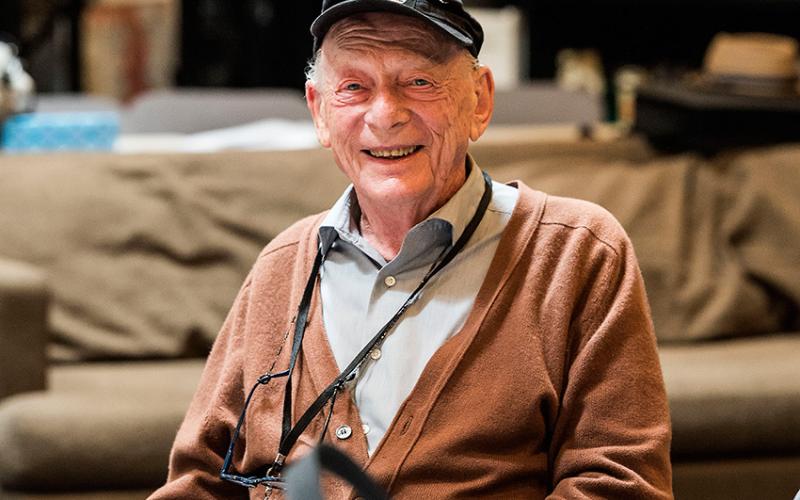
Main Photo: Alan Mandell (Courtesy Center Theatre Group)