



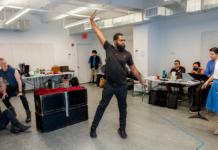
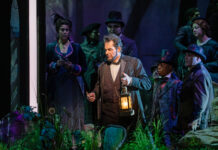





In Tarell Alvin McCraney’s play Head of Passes; currently playing at the Mark Taper Forum, Kyle Beltran plays “Crier,” a young man clearly in love with Cookie, a troubled woman he can’t have. They are part of the characters that surround Shelah, the matriarch of Cookie’s family facing a devastating storm. Phylicia Rashad gives a towering, career-defining performance as Shelah.
Beltran has seen McCraney’s play evolve from early readings to its present production. I recently spoke with him about the journey of the play and his personal journey with it.
You have been with the play for over four years. How did it change over that time?
I did the first reading in the fall of 2012 with Steppenwolf. Tarell and I met when I did the early readings of Choir Boy in New York. I had worked with [director] Tina Landau separately on a workshop of a musical at Yale Rep. They invited me out to Steppenwolf and it was very different. There was an angel character within the play that existed as a quiet otherworldly presence. I think over the years Tarell decided to remove the angel so Shelah was left to wrestle with the questions with less obvious safety. Then as it moved to LA from NY he did quite a bit of cutting and trimming to try and give the play even more of a launch from start to finish. The soul of the thing has always been the same. Tarell is a constant re-writer.
And how has your journey changed over those years?
It’s such a beautiful and complicated thing to keep revisiting this character as I get older. It does deepen in so many ways and changes based on where you are in your personal life. It’s also challenging to keep things fresh and new and challenge yourself to go further when you think you’ve gone as far as you can.
In the Steppenwolf production Cheryl Lynn Bruce played Shelah. In New York and here it’s Phylicia Rashad. How has the role been different in these hands of these two actresses?
Cheryl is amazing. She’s a wonderful actor and so kind and compassionate and lovely to work with. So it’s a real gift to actually see these two terrific actors tackle this massive undertaking. Tarell has written something for the canon of women of color as they age. Phylicia and I have so much history. Her daughter and I grew up together and did theatre together. It has been one of the greatest thrills of y life to have earned a place beside Phylicia and watch her work. Even though it’s clear the play is built around her, she’s adamant about maintaining that ensemble feeling. Her performance is so full of the entire scope of human emotion and it’s such a feat or theatrical skill. It blows my mind every day.
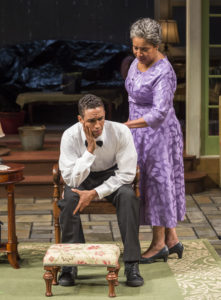
In the play Shelah questions and challenges God after tragic events in her life. You lost your mother 13 years ago. How did that shape your view of grief and God?
Losing a parent that young, and I’m an only child, it’s a massive earth-shattering personal loss that completely turns your life upside down. Your whole understanding of being alive changes. Your relationship with your mother is probably the most central relationship in a person’s life because that’s the way you come into the world. Her absence doesn’t end that relationship; it only makes it infinitely more complicated. My mother was petty religious. To do this play every night with this woman who knew my mom and in so many ways has been my surrogate mom, is surreal. There are moments when I hold her in my arms and it’s just impossible not to feel the present of my mother in those moments. I have worked so much on my own grief and loss that what you hope to do as an artist is to take all your pain and joy and grief and loss and hope and try to make something of it that means something to someone else.
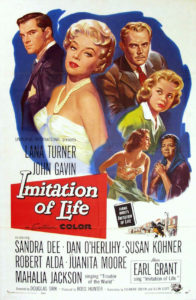
You said in a previous interview that Imitation of Life (1959) was important to you because it was your mother’s favorite. Clearly you still feel a strong connection with her.
I talk about it so infrequently. It’s a convergence of so much it feels like too much to express to anybody. That article that you are mentioning, when I got to LA and opened this play Tarell had added, just by complete coincidence, that song that Mahalia Jackson sings in Imitation of Life. [Trouble of the World] That’s the song Crier hums at the beginning of the play. He had no idea.
Your original career aspiration was to be in musicals. [Beltran played Usnavi in the national tour of In the Heights before doing the role on Broadway.] But mostly you’ve been in plays by writers like Annie Baker and Branden Jacobs-Jenkins along with McCraney. Did something shift?
At one point musical theater was going to be the thing. As I’ve gotten older that has fallen away. It’s not that I don’t still love to sing; I just really want to be the greatest storyteller that I can be. I just want to do work that means something to me and that I feel inspired by. It’s been a total embarrassment of riches in the play department. I’m very open to what comes. I’m curious. I feel like I sound pretentious, but I try to follow my bliss and it went downtown where all these people are doing all this unbelievable writing. I’m so fortunate that they’ve had in me in their work. It’s where I’m happy.
Head of Passes continues at the Mark Taper Forum through October 22nd.
Photo Credits: Craig Schwartz