







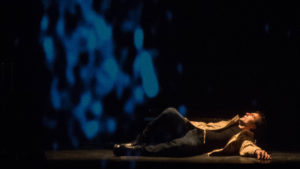
If you attended one of the performances of Dog Days, a post-apocalyptic opera that LA Opera presented at REDCAT in 2015, you know that composer David T. Little creates powerful and demanding operas. Soldier Songs, a work that had its world premiere in 2008, is being performed on Saturday at the Ford Theatre as part of LA Opera’s Off-Grand program. Beth Morrison Projects is presenting Soldier Songs. David Adam Moore, who was part of the work’s premiere at Le Pouisson Rouge in New York ten years ago, returns as the soldier.
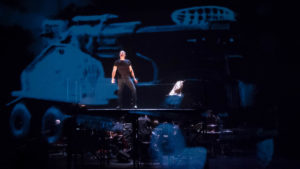
For Soldier Songs, Little interviewed veterans of multiple wars to put together the libretto for this multimedia work that looks at the lives of soldiers through three phases of life: Youth, Warrior and Elder, all offering perspectives on war and the experience of being in war.
I recently spoke with Little about the people with whom he spoke, how he responded to their stories and about his views on the military and the arts.
One of the things that intrigued me about the promo movie was your comment about veterans saying it was the first time they had spoken about their service. Did that surprise you?
I asked veterans who were family members or people I had grown up with or one person I met later. Perhaps it is that people are not asking. There is an anxiety because you don’t want to ask the wrong thing or be insensitive. So people can sometimes not engage. One of the friends I interviewed, and the story he tells in the piece, his mother heard for the first time at the premiere of Soldier Songs.
How much could you relate to the stories they told you?
There’s something about these experiences from what these men and women told me, it’s almost like you can’t understand it if you haven’t experienced it. My perspective has shifted over the years. Initially I thought I could understand it, now I have accepted that I can’t. But I want to get as close as I can through empathy and listening. The piece over the years has been able to facilitate that in certain ways. It can serve as a bridge between a veteran’s experience and the absence of the experience for the civilian.
Were the people with whom you spoke all from one war or conflict or was there a range?
They were from all different time periods. The only guiding principle was I needed to know them personally. I talked to my grandfather who is now 98 and was in World War II. I talked to my stepfather who was in Air Force Intelligence in Vietnam. Two uncles who were in Vietnam/Laos/Cambodia at the time. And people in Iraq and Afghanistan. My grandfather in WWII, with a clear objective, varied greatly from my uncle’s experience in Vietnam. Despite that there were threads through them. That’s what the piece explores is that thread.
War is war and war is hard and not all wars are the same?
I don’t want to split hairs over which war was worse or better. Of course there is a reason that “War Is Hell” is a common phrase. Because there is absolute truth to it. I wonder about the nature of clear objectives. Especially thinking about Vietnam. The sense that I got from the people I spoke to is there was a moment in Vietnam where our feelings about the government and whether that government had the best interest of the solider in mind became more complicated. For that generation that is something that has been very difficult and that is different than what my grandfather experienced.
Does having made these stories the foundation of Solder Songs leave you feeling an overwhelming sense of responsibility for making these intimate experiences public?
The act of talking brought up things they’d rather not have brought out. On one hand it feels like a continued sacrifice. Not just their service, but being willing to talk about that service to help others grapple with whatever they are grappling with. To the extent that I caused any emotional difficulty for them, I would have rather that had not been the case. This piece, and as the piece gets performed year after year, it gets a little harder for me to attend because I know all these people.
I know from your Twitter feed that you are not apolitical. Is there a political point-of-view to Soldier Songs?
I tried to not make it a political piece. This felt like something bigger than politics. It certainly intersects with politics in a way because it is about an experience that is impacted by politics: combat, war, where they are sent and why. Beyond that I didn’t want to write a piece to make a point about Iraq or any particular conflict. There are certain moments in the piece that show evolving attitudes about the government in general and where a soldier is sent and why. I wanted to approach it from the perspective that individuals experienced, not some grand political statement.
In the divisive world we live, where, depending on to whom you are speaking, spending on the military is deemed more important than funding culture, what are your views on our priorities as it relates to both?
That’s a huge question. I’m not even sure where to start with that. I wish that we funded the arts more. That’s the simple answer. There are all kinds of different ways that communities benefit from strong arts programs and the presence of really great art.
I don’t think I could, thinking about my friends who served and knowing what kind of technology they need, I would not want to suggest that that should be funded less when you consider that someone’s life is on the line. I wouldn’t look at them as a seesaw where one gets more and one gets less.
Maybe I can just say culture benefits from the arts and we should fund the arts more. The military question is extremely complicated in terms of…I have this work, Agency (2013) which is sort of about the process of accepting that there are things you will never know about your government and coming to a kind of peace with that almost. Not that you shouldn’t try to learn at all, but maybe you’ll actually get there. This questions falls into that category for me.
Photo of David T. Little by Merri Cyr.