







Inspiration can come from the most unlikely of places. For writer/director Ain Gordon it was while spending time at the Pennsylvania Historical Society that he came upon the archives of one Dr. John E. Fryer. He was the psychiatrist who, in 1972, disguised himself and read a statement declaring that he was homosexual. His comments lead the American Psychiatric Association, one year later, to remove homosexuality from its list of mental disorders.
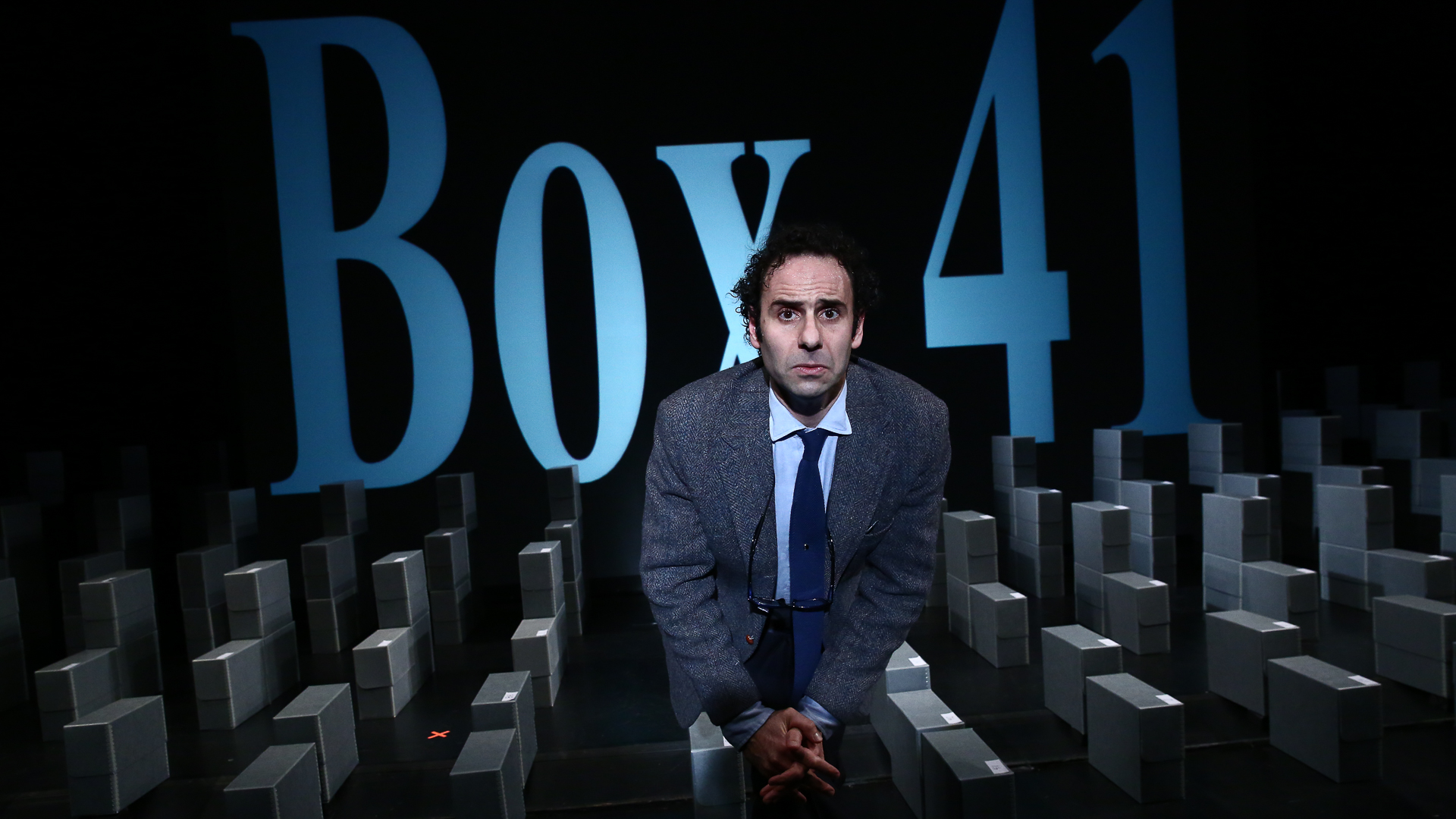
Digging through these archives, Gordon gradually discovered a story he wanted to tell. The result of his efforts is 217 Boxes of Dr. Henry Anonymous which has performances this weekend at the Freud Playhouse at UCLA.
Last week I spoke by phone with Gordon about how this play came to be, why Fryer isn’t better known and how far we have or have not gone since his speech in 1972.
Was there any one thing amongst these documents that inspired the structure of 217 Boxes?
I knew nothing about him before I completely accidentally happened on his archive. I had never heard of him. That was interesting to me. I have a lot of historical information in my head and I’m not ignorant of queer history. That was the first anchor – my own lack of knowledge.
Second was the notion of this famous image that forever obscures him. That was tantalizing for me. Lastly, I went to the 50th anniversary of Reminder Day in Philadelphia and there was a person doing introductory remarks who was well-informed and knew a lot about gay and queer history and he bought up this history, but never said Fryer’s name.Â

You have described your works as seeking out marginalized and forgotten histories of lives that have left enough trace to tantalize. Given the incredible risks Dr. Fryer took, why do you think his story has been all-but-forgotten?
Ironically, which I think is very telling, and a good metaphor for queer history, the mask has become more famous than the man in it. And the pseudonym and not the real name behind it. He had a big ego. He was not a selfless man. But for various reasons I can only imagine, he never sought recognition for the moment. Also he becomes not the ideal for the way the movement changes as it moves towards marriage and equality and more heternormalization. He wasn’t interested in monagomy or marriage. He didn’t think that was the crux of gay history. He’s not convenient.
Fryer wrote in 1985 that “I lost a job because I was gay.” Though the timing of your performances here are linked the Stonewall Riots anniversary, what are your thoughts on the Supreme Court taking up the week your show is performed in Los Angeles the issue of whether the Civil Rights Act protects gay and transgender people from being fired just for being gay?
John’s actions and what the APA decided as a result is part of a domino falling. But sometimes they get right back up. Right now we’re watching the pendulum swing back and forth on women’s rights, gay rights and more.
One of the last lines in his speech is “This is the greatest loss, our honest humanity, and that loss leads all those around us to lose that little bit of their humanity as well.” Though things have gotten better for the LGBTQ community, do you think full parity will happen in our lifetime?
Unfortunately what will happen is they will happen and then unhappen and happen and unhappen. That’s the cruelty of our notion of progress. It’s supposed to be a straight line, but it keeps turning. I think we will take the step in the right direction again and all those who feel it is in the wrong direction will turn back. It’s our job to be vigilant because the work is never done.
Fryer himself is not depicted in 217 Boxes of Dr. Henry Anonymous. However his father, who never acknowledged his son’s homosexuality reads his speech in your play. What was the inspiration for that choice?
The speech had to be in the piece because there wouldn’t be a purpose without it. The speech is a much more traditional and academic message. It doesn’t carry the sense of the risk that prompted it. I was trying to figure out how I could make the audience experience the danger of making that speech.
It came to me it would need to be somebody who would be taking a different risk. I thought the mother would be in the play. Then I realized she had hundreds of letters, so she was too present and frankly too Southern Gothic and I didn’t want that overtone in the play. The father wrote nine letters all signed, “Love, Daddy.” That seemed big. If the father has to make peace with what he never managed to do in life, that would be the ultimate risk for him. He has to say “homosexual” ten times. He has to acknowledge his son. That will be the risk that will enlighten him.
If in 45 years someone chooses to do a play inspired by your life, they will, of course, have their own perspective on what is important to include and exclude. But if you could offer a bit of advice, what would you tell that future writer?
I have always maintained that absolute truth is not available in the historical retrospective glance. As soon as you are looking back you have a somewhat fictive lens you will use. Since not everything is available you’ll only see what has survived and what is available.
I would say to anyone treating me through that lens, I would hope they would do what I do. Try to be empathetic. Try to figure out why you want to use this person for your own means. You should be honest with yourself and admit some part of this is always about you. What part of you are you trying to show while doing this?
Main photo:  Derek Lucci in 217 Boxes of Dr. Henry Anonymous by Paula Court/Courtesy of CAP UCLA
Image of Dr. Fryer courtesy of New York Public Library Manuscripts and Archives Division