









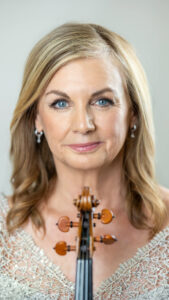
The absence of thoughts like what am I going to do tomorrow, oh my gosh the kids are sick and my dog needs to go the vet are amongst the things violinist and Los Angeles Chamber Orchestra concertmaster Margaret Batjer missed most during the absence of live performances.
“The most amazing artistic moments of my life,” she said last week during a Zoom interview, “have happened in a live performance where you feel the silence, the absence of noise. I mean all of those everyday things that we all carry around every single day of our lives. They go away in the concert hall because it is so magical when that silence meets the music and people connect in a very deep way.”
That silence will return for Batjer and the Los Angeles Chamber Orchestra when they take to the Royce Hall stage at UCLA on Saturday for the first concert in the 2021-2022 season. Joining conductor and Music Director Jaime Martín is LACO’s former music director Jeffrey Kahane. The latter will be at the piano for a performance of Mozart’s Piano Concerto No. 22 in E-flat Major. Also on the program is Beethoven’s Symphony No. 3 in E-flat major also known as the Eroica.
Sitting downstage and to the left of Martín will be Batjer who has served as Concertmaster since 1998. She couldn’t be happier about the program that reunites the musicians with their audience.
“You want it to be warm and fuzzy. I’m in need of warm and fuzzy,” she revealed. “I don’t want to come back into the concert venue and be shocked. I want to enjoy the music. I think picking Mozart and Beethoven was really smart of [Jamie] to welcome our patrons back who’ve waited so long for that experience.”
Kahane’s return Saturday to play Mozart speaks to Batjer about life pre-pandemic and what life will be like post-pandemic.
“I experienced those twenty-plus Mozart concertos with Jeffrey over that 18-month period so long ago. We always look forward to playing Mozart with Jeff. Through COVID the combination of the past and present became really important. It’s almost like it erases what happened between before COVID and post-COVID. Now we put [Jeff and Jaime] together and it reminds us of the past, but it’s a real look into the future. I’m excited to see them on the stage together.”
During our conversation Batjer remarked that after all these years playing music by the masters it has never become boring for her.
“Mozart, Beethoven, Bach – these kinds of major geniuses, even at my age, continue to be astonishing to me how fresh their music is.”
It was a lesson she learned from pianist Rudolf Serkin who was considered one of the foremost interpreters of Beethoven in the last century. She recounts an encounter she had with him at Tanglewood in Massachusetts.
“I saw him in the morning and he was so nervous. He was always kind of a little nervous anyway, but he was especially nervous. I said to him, ‘Mr. Serkin, you seem a little nervous. How could you be nervous tonight? You must have played this Beethoven concerto a thousand times in your life.’ And he said, ‘My dear, the day you stop being nervous is the day you need to stop being a musician.’ That taught me that there’s always something new.”
In addition to her role as concertmaster, Batjer is curating the December 4th Baroque Chamber Music concert LACO members will give at The Huntington. She is also leading the January 8th Strings for the Ages concert at The Broad Stage.
Batjer was able to continue teaching during the last 18 months. As part of her teaching philosophy at the USC Thornton School of Music she says, “My goal as a teacher is to pass along all that I have had the privilege to learn throughout my life as a musician.”
As she sees it, there’s still time for more learning and, by extension, more teaching.
“I feel like I learn every day that I teach. I learn from my students. When you teach it forces you to be able to articulate your beliefs about music. That’s something that a lot of performers do instinctively, but they don’t have to intellectualize it. They don’t have to be able to articulate it in words.”
Nor are there necessarily absolutes in how Batjer approaches music and teaching.
“Every time a student comes to me with a Bach sonata my students laugh at me because I’ll say, ‘How could you do that? You have to do this. You have to do this articulation or this dynamic.’ They say, ‘Last week you told me the opposite.’ I did because last week I felt that way and this week I feel this way. I’m constantly questioning and growing and trying to figure it out. I think that’s why I love being a musician – because I don’t know it all. I’m still growing. I’m never satisfied.”
At this point in our conversation Batjer expressed confidence as she looks forward to the rest of her career.
“I hope for the rest of my performing life that I continue to grow as a musician by being curious. The most important quality of being a musician is to be curious and to never feel like we have it. I understand Mozart. I understand Beethoven. We don’t. There’s always more to learn.”
Photo of Margaret Batjer courtesy Margaret Batjer and Los Angeles Chamber Orchestra