




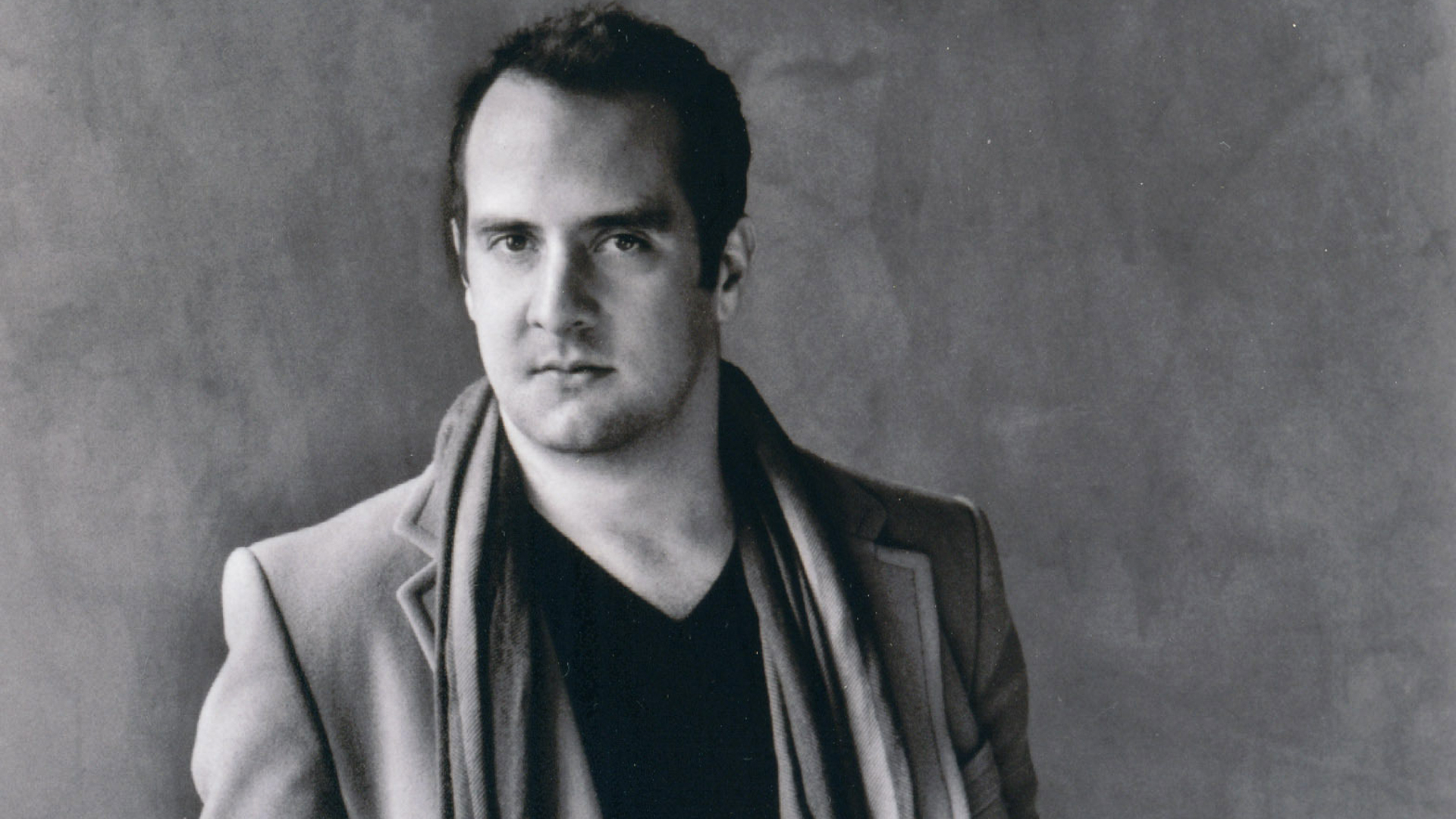

Choral fanfare. Two words not commonly found together. The composer John Rutter wrote a piece called A Choral Fanfare, but beyond that you’d be hard-pressed to find other references to such a hybrid. Unless you happen to look at this Saturday’s concert by the Pacific Chorale in Costa Mesa. Opening the concert is The Quickening which is described in press materials as a choral fanfare. This is a world premiere by composer Tarik O’Regan with text by Marcus Omari.
London-born O’Regan was a composer-in-residence with the Pacific Chorale and The Quickening is his third commission from the ensemble. He’s currently serving as composer-in-residence for Philharmonia Baroque Orchestra. Earlier this year he was named by The Washington Post as one of the 22 classical composers and performers to watch in 2022.
Two weeks ago I spoke via Zoom with O’Regan about The Quickening and its themes, the ambitious project he’s doing with Philharmonia Baroque Orchestra and we bookended our conversation with a discussion of British composer Ralph Vaughan Williams whose Dona Nobis Pacem anchors Saturday’s concert. What follows are excerpts from our conversation that have been edited for length and clarity.
If you want to see and hear the complete interview with Tarik O’Regan, please go here.
I want to talk to you about Ralph Vaughan Williams because you’re sharing the program at Pacific Chorale with his music. It also happens to be the 150th anniversary of his birth. I’m wondering what thoughts you have about Vaughan Williams music and if he, as a composer, has influenced you in any way?
I think over the years I’ve had a reckoning, I suppose. I used to hate his music. I thought it was interminable. Over the years I’ve come to actually see his trajectory as a composer very differently. I think what’s interesting about Vaughan Williams is he develops over time, and I think he’s created the one thing in a way, it’s always the easiest thing to dismiss. Which is he creates an identifiable sound and you can always tell a Vaughan Williams work through his orchestration and the way that he handles these modal harmonies.
But I think part of the reckoning in my mind is about what it means to be a composer with a unique voice. How do you create a sort of sound identified with your own heritage in the nation in which you live, that is somehow different to the dominant Eurocentric movements of that time, namely out of Germany. It’s a very strong romantic tradition and you just have to give him credit.
The Quickening is described as a choral fanfare which is not a term that I was accustomed to seeing. Is that an apt description and is that exactly what you intended to write?
It’s what we intended to write and it was there right at the very beginning. Thinking about this came about at the height of the pandemic when it was at its worst. It was always really about bringing the full forces of the Pacific Chorale and the Pacific Symphony together after this two year hiatus. So right from the beginning it was meant to be a celebratory opening; the largest forces being together on stage and making music again. It is for a large chorus and it’s for a large orchestra more or less matching the the Vaughan Williams.
The fanfare aspect of it is a welcoming, I suppose, both to the performers, but also to the audience in the community. We wanted to make a sort of slightly nuanced take on what a fanfare is. The context of it coming out of this very, very difficult period for so many people. There’s certainly a nuance to it that I think Marcus definitely gets and has created in the poem that there is not just light, but some darkness in both the poem and the piece.
Was this a poem that Marcus Omari had already written or was this written exclusively for this? And if so, what made him the person that was going to give language to what you wanted to address in this acknowledgment of the past two years?

It was a collaboration with Marcus right from the beginning. We definitely wanted someone that was in the Orange County community and who worked not just, I guess, as a poet, but also as an activist and an animator and a thinker. And that is Marcus. He, I felt, was just a really good person to talk to about how you try and create something truthful. As he puts it, how do we think about these huge topics which are of lasting significance. Yet how do you make the piece not so tied to any one issue that it speaks narrowly. So it’s not just about looking over the last two years. It’s really about looking forward to this idea of lasting significance not bound to one incident – which are Marcus’s words, by the way.
The Washington Post referenced a new opera. Knowing that Joseph Conrad’s Heart of Darkness was an inspiration for one of your operas, what other light, happy-go-lucky, easy-reading fare have you’ve chosen for this next opera?
Oh, I wish I could tell you. I’m not allowed to tell you anything about it. What can I say is it’s based on a novel by a very well-known living author. And it’s just for period instruments, so it’s going to be for Philharmonia Baroque Orchestra. It’s about taking a contemporary novel and placing it in the context of these historically-informed instruments and performance and creating an interesting space for new work. It is part of a much bigger scheme of my role there as composer-in-residence to commission much more work for historically-informed instruments and singers. My plan is hopefully next year we’ll be announcing the commissioning scheme to just start getting lots of exciting new pieces by exciting composers written for these instruments and players.
Ending where we began, I’m going to ask you to respond to a quote by Ralph Vaughan Williams. He said “The art of music, above all other arts, is the expression of the soul of a nation.” Do you agree with him and what would you like your music to say about the soul of perhaps not just one nation, but ultimately all of us as humans?
I get where he’s coming from with that quote. Do I fundamentally agree with that? No, I don’t. I don’t think music embodies the soul of a nation. This legacy is certainly a sort of 19th century legacy of music being the art of all art. I think that it has been potentially quite damaging over the years. The idea of the composer being, you know, a sort of genius figure and untouchable in a way. So I feel I feel very different to that and I feel I partly feel different to that because I feel something rather nice that’s happened to composing, which is it’s got it’s gone back to being a craft.
The great thing about being about a craft is that is that linked much further back to sort of earlier music. I think Bach very much a crafts person linking in improvisation with performing, with composing and composing being brought much more in line with greater music making and communication.
So for me? The thing that I find most powerful about music and what I enjoy as a composer is that something magical happens between the page and the air. That is mostly to do, but not entirely to do, with the people performing the work. That’s why it’s so important to have two or three performances, because nothing changes on the page with the second performance or the third performance or the fourth performance, but something is changing in the ether. Something is changing in the performances.
A composer is, in a way, a bit like being an architect. I suppose all I can do is create the blueprints for this living art form that is temporary. It takes time to breathe and I’m relying on these wonderful performers to build the work from the blueprints. I feel like all I can do is like light the touch paper. There’s a lot of magic in music that I am not in control of, but that I love being a part of. Maybe just triggering it and then sitting back and watching and listening.
Main photo: Tarik O’Regan (Photo by Marion Ettlinger/Courtesy Tarik O’Regan)