









Chamber music ensemble Salastina’s own description of themselves on their website reads like narration from a trailer for an superhero movie. “By day, we’re world-class performers and studio musicians who’ve played on your favorite films. By night, we’re on a mission to broaden the definition of what classical music was, is, and can be.” Okay, not a Marvel or DC superhero necessarily, but it’s a heroic mission nonetheless. One Executive Director and Co-Artistic Director Maia Jasper White takes very seriously and brings intense joy and passion to the mission.
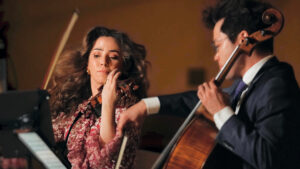
This weekend Salastina concludes their season with a performance of Mahler’s Das Lied von der Erde (The Song of the Earth) on Sunday, June 11th at The Huntington Library and Art Museum’s Rothenberg Hall. They are performing Arnold Schoenberg’s arrangement which will feature tenor Thomas Cooley and soprano Clara Osowski. White, along with Co-Artistic Director Kevin Kumar play violin. (I guess that makes them the dynamic duo!)
I recently spoke with White about this particular work, Mahler and the things he said, the ever-shifting ground that classical music finds itself on and the role of identity, both personal and institutional, in their thinking. What follows are excerpts from our conversation that have been edited for length and clarity. To see the full interview with Maia Jasper White, please go to our YouTube channel.
Israeli author, Amos Oz, said about his book, The Same Sea, which came out in 1999, “I wrote The Same Sea not as a political allegory about Israelis and Palestinians. I wrote it about something much more gutsy and immediate. I wrote it as a piece of chamber music.” In your mind, what is it about chamber music that perhaps inspired him to consider it as both a form to emulate and something that could allow him to be more gutsy and immediate?
There’s that famous Nietzsche quote about chamber music being like watching a conversation between highly intelligent people. But I think that’s a really kind of frou frou undersell and a sort of oversimplification of what’s actually happening. For me, chamber music is like when you have a conversation with a friend that you’re very, very close with and you are inspired to think differently because of the presence of your friend and the reception that you get from them and the ideas that they are throwing at you. So that kind of feeling of not necessarily even knowing how you feel or what you think until you articulate it to someone that you trust. I feel like that’s the better allegory for what happens in a properly functioning chamber music context.
Chamber music, by definition, is that there is no one leader. Everybody’s unique part is has its own integrity and is not doubled by any other person. So in that sense, it’s a really great metaphor for the individuality of human beings. Kevin likes to say that chamber music is like where the best parts of being a musician and a human being meet.
I suppose that this author was speaking about is the multi-way communication that you have with close others in a kind of trusting and encouraging space. How that leads you to feel inspired to do things and to articulate yourself in a way that you otherwise might not, and the sense that you are an important part of a bigger picture.
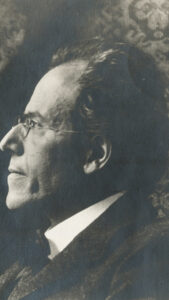
You are finishing the season with Das Lied von der Erde. The last song includes the line “I seek peace for my lonely heart.” Does the selection of this piece as the closing work you’ll perform for this season offer some kind of commentary about the world that we’re living in and who we are as people in very troubled times?
Yes, certainly. I think that we’re always trying to be sensitive about reading the room of the current moment; what’s in the zeitgeist. How are we feeling about life and the universe and everything? The idea of taking tremendous hardship and sublimating it into something beautiful is very, very front of mind for us and was certainly a driver of the selection of this piece.
If you’re trying to stay in touch with the zeitgeist at the moment, it seems like it changes on almost a daily basis. How do you get to the point where you’re able to just lock in and say, you know what, this is going to be our statement regardless of how things change?
We try to take our own temperature about what are we really longing to play and share and why is that? Sort of trusting that instinct and, of course, trying our best to market it well and using that kind of language to try to connect with the audience. Are you feeling kind of how we are right now? If you are, you might enjoy this concert. So at a certain point, you do have to leave things up to fate.
What’s at stake for you emotionally when you’re playing a piece like this? If you’re translating these beautiful notes on a page to this emotional experience that the audience is going to have, I can’t imagine that it’s without emotion for you.
That applies across the board for any piece when you’re putting yourself out there and your interpretation out there. It’s a little bit personal. If you’re asking about what are the stakes for me, it is this kind of fear of doing artistic harm by not adequately releasing the beauty of this piece. Certainly when the piece has as much gravitas as the Mahler does, that gets dialed up in some senses.
It has words for starters. It’s not to say that I feel the relief of being able to hide behind text, but perhaps a little more confident that the overall meaning and the gravitas is going to come through and that I am just a vessel at that point. So in some sense, there is a release for me in a piece like this compared to a Beethoven violin sonata or something like that.
I recently spoke to the choreographer Alonzo King who has said to his dancers over the years, “I don’t want to see you thinking, I want to see you dancing.” Is it possible to just play and not think while you’re playing?
Yes and no. I like to compare focus and attention to an image of drawing a circle around a four-year-old and telling the four-year-old to stay there. So the four-year-old is likely to leave, and that’s okay. You just have to keep bringing it back. For me, that’s what focus and attention is. And improving that muscle is just bringing your focus back faster and faster and recognizing when you have left the circle.
I think that sometimes non-performers may idealize what that looks like because it appears so effortless and transcendent and hypnotic and all of those things. But as far as the inner experience of a performer, I think the more accurate description is like that. It’s sort of constantly roping yourself back and building that muscle so that you can do so with more and more agility.
In your mission statement you address changing perception or definition of what classical music is. How much does that definition change from season to season, or more broadly, say, in five or ten year increments?
Even eight years ago I felt that we were still a bit more in rejection of tonality land. It was just starting, but not necessarily being taken as seriously. One thing I would add, too, is that the inclusion of non-Western classical music has also sort of exploded.
When I get applications for our Sounds Promising Young Artist program, it’s almost as if every single composer is leading with their identity, their ethnic background, their gender, all of these things. What we thought maybe eight years ago was very fresh and new has already become quite ingrained in the new music culture. So it does change a lot.
Right now we’re thinking what does that look like now? What’s that next frontier for modern music? If anything, it feels to me a bit like maybe not leaning so heavily on one’s unique identity. Maybe that’s the beta version of the post-World War Two, “I’m going to invent my own musical language because I’m me and I’m godlike and everyone should care.” So who knows where that’s going to go? But I’m smelling maybe a bit of fatigue with the contemporary classical composers identity capital “I” being the be-all end-all basis for their compositions. Maybe that’s not so interesting and universal to the audiences.
Mahler is quoted as having said, “It should be one’s sole endeavor to see everything afresh and created anew.” What are the challenges you face as a musician and as a leader to perform and present works that have been performed time and time again and make them not just new for the audience, but new for you as well?
I think one thing that musicians need to caution against is wanting to perform a traditional work because of the feeling that it’s my turn. I don’t think that’s enough. I think that what needs to come first is reading the room and combining that and letting that inform your own desire to play a certain piece and to analyze one’s desire to play a certain piece. Why is it that I want to play this piece and share this piece? What is it about this piece that is worth communicating to others? Why would anybody want to hear this piece right now the way that we are going to do it? How are we going to do it? Really being inquisitive in all those different directions, I think, is really a joy and a struggle, too.
One thing I’d also like to mention. If we’re talking Mahler quotes, “A tradition is not the worship of ashes, but the preservation of fire.” That’s a Mahler quote that I love. I think that that also informs the spirit of our approach towards the classical repertoire as well. Preserving fire also means supporting contemporary music. Something from which I derive a lot of personal glee and chuckles sometimes is when I read reviews every now and then about Salastina to see how others describe us as either an organization that mostly focuses on the classics or a organization that focuses heavily on contemporary music. There doesn’t seem to be agreement there. I love it. I’m okay with it. People can’t peg us, so much the better. That means we’re doing Mahler’s quote justice.
To see the full interview with Maia Jasper White, please go here.
Main Photo: Maia Jasper White and Kevin Kumar of Salastina (Courtesy Salastina)