




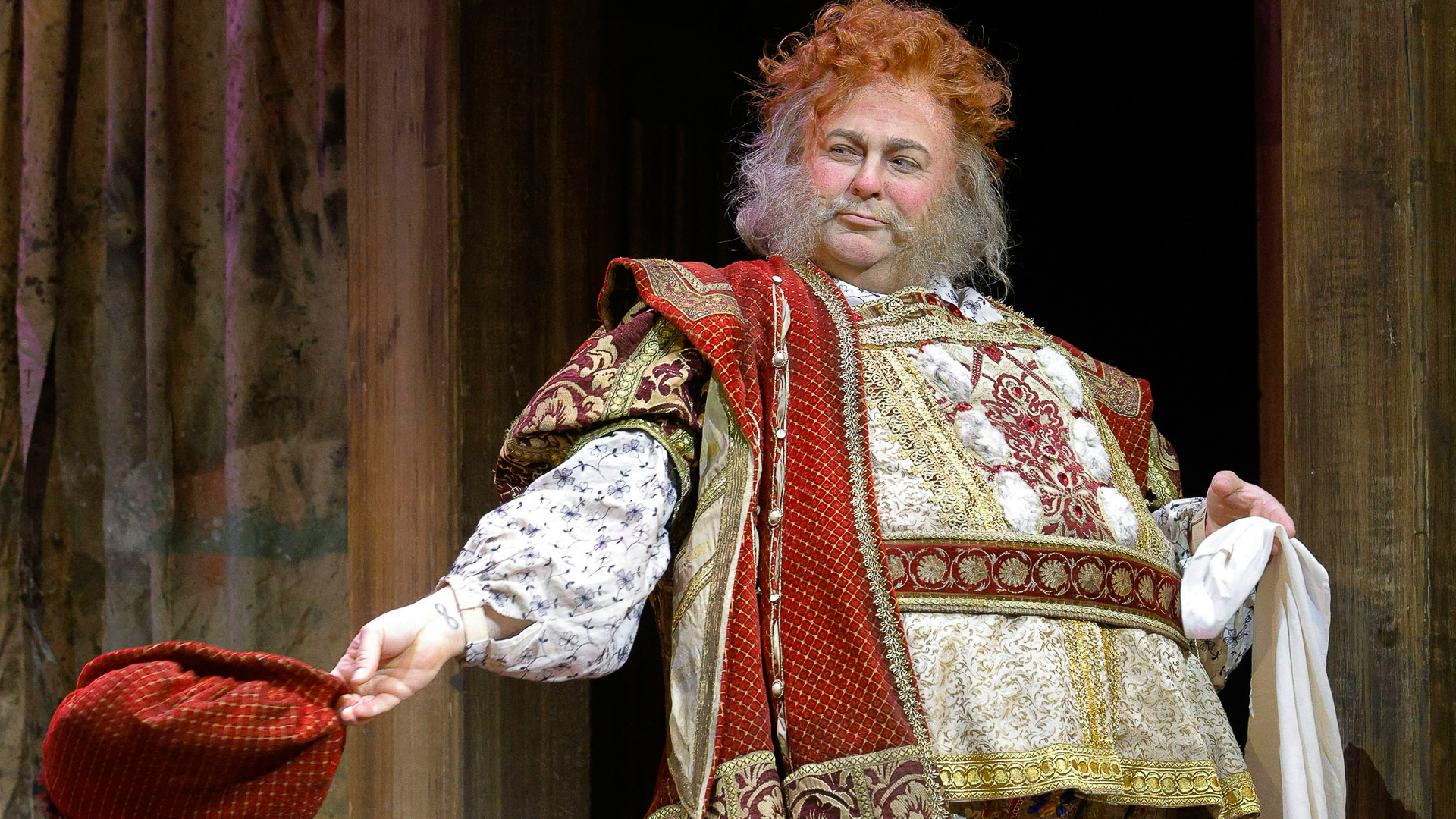

Verdi’s final opera is supposed to be a comedy. But Falstaff begins with a man already in decline. He’s outpaced by youth, mocked for his body, and staring down the limits of his own vitality.
What makes the work extraordinary is not that it laughs, but that it refuses despair.
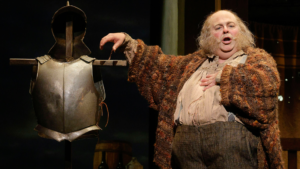
For bass-baritone Craig Colclough, who performs the title role at LA Opera through May 10th, Falstaff is less about mischief than survival: a portrait of a man confronting decay.
Yet he chooses, against all evidence, to insist on joy.
Q: You’re in the title role of Falstaff with LA Opera, and I want to start with something the singer who originated the role, Victor Maurel, once said. He described the lyric actor’s profession as a kind of sport, requiring the endurance and elasticity of an athlete. You’ve been living with this role for a while now. Do you feel that?
I do—and I feel it more now than I used to. I’ve lost count of how many times I’ve said during this run, “Oh… I’m not in my 30s anymore.” You really feel it. If you sing any part of Falstaff in isolation during rehearsal, you think, “Oh yeah, I’ve got this.” But then you put on the suit, you’re running around, you’re throwing your minions around, you’re doing the acting—and suddenly it hits you.
By the end of that first scene, I’m sweating and hanging on for dear life. And then there’s the forest scene, where I’m crawling, rolling, getting beaten up. I want it to be as hilarious and physical as my body can handle, so I go for it. It’s always the next day, about twenty hours later, when everything aches and you realize just how much you pushed.
Oddly enough, the role gets easier as the evening goes on. You’re riding adrenaline, but recovery becomes part of the job. So yes, I appreciate that quote deeply.
Does that mean you have to build in real recovery time, even at the start of a run?
Absolutely. This time around they were very kind. A day on, day off, spacing out rehearsals. But even then, by opening night, you’re thinking, “I wish I had one more day.” And then right after opening, I’m back in rehearsals for Maestro Conlon’s farewell concert. It’s less athletic, thankfully, but there isn’t much downtime
When I’ve spoken with Maestro Conlon about Verdi, he’s emphasized Verdi’s ability to express humanity in all its complexity. What does Verdi reveal about humanity in a comic opera like Falstaff?
That’s what puts this piece on a different level than most comedies. Yes, there are shenanigans, certainly. But the real plot is Falstaff confronting decay, his own mortality. He says, “Everything is in decay,” and that’s that old man’s parallel: as we age and lose our youth, we start to project that outward, to see the world itself as declining.
There’s a moment after he’s dumped in the river where he could give in to despair. He admits he’s too old, too out of shape, that he’s losing his physical abilities. He’s at a dangerous point in his life, and he knows it.
And what Verdi does, very clearly, is say: no. Through will, through spirit, you do not succumb. Yes, he uses the vessel of Shakespeare’s monologue on sack, on alcohol, but what he’s really saying is that he insists on joy. He insists on vitality.
That message, that insistence on the human spirit, I can’t imagine anything more optimistic. And the fact that Verdi is writing this at the end of his life, staring death in the face, and chooses that? That’s extraordinary.
So it may be a comedy, but he never stops imparting deep emotional wisdom. You have to read what’s on the page. You have to look at the arc. The choices are intentional.
And that requires not allowing it to exist as just a comedy. There’s pathos at its core.
Exactly. That’s one of the beautiful things about storytelling. You can weave those elements together. The comedy opens you up, and then suddenly you’re startled by depth you weren’t expecting.
Verdi once told Maurel to focus on the libretto and the character, not the music. That if those are right, the music will take care of itself. Is that insight, overconfidence, or both?
I think there’s a difference between ego that covers insecurity and a confidence that comes from understanding what you’ve created. This feels like the latter.
As a singer, you have to develop that same honesty. You have to be able to look at another artist and say, “They do this better than I do,” and also, “I do this better than they do.” That’s how you grow.
With Falstaff, every phrase is written in character. There are so few arias because he wasn’t interested in writing something detachable. He wanted everything to come from the text, from intention.
So if you get the character right, if you understand what you’re saying, then yes, the music does carry you. You get into the river of what he wrote, and it moves you along. So I hear that not as arrogance, but as precision.
What has Falstaff taught you, as both an artist and a person?
One of my personal tenets is insisting on keeping my inner child healthy; keeping access to the full range of emotions. That I can go from deep pain to fear to tenderness with sincerity. That takes maintenance. It also means resisting the callousness that can come with aging. Insisting on playfulness.
That aligns perfectly with Falstaff’s worldview—his insistence on gratitude, on enjoying every flavor of life, on keeping his spirit buoyant. So playing him feels good on a very personal level.
I come out of performances and rehearsals feeling refreshed and healthier, even if my body is tired. It’s genuinely uplifting. And I’ve been lucky that my instrument aligns with him, because I want to carry that with me.
I first did the role at 30, which can be dangerous. You have to do a lot of emotional homework to understand where he is in life. But it forced me to think ahead, to empathize with stages I hadn’t yet lived. Now, that understanding has deepened.
In what ways has that understanding changed as you’ve gotten older?
It’s become more personal. The physical difficulty is one thing, but there are other layers like weight. This role is so physically demanding that it actually affects how I manage my body. I burn through immediate energy, so my diet shifts, and then I have to recalibrate afterward.
But beyond that, there’s the societal aspect. People in the show say very nasty things about Falstaff’s weight, and sometimes audiences misunderstand that. They think there’s mockery built into it. For me, it’s the opposite. Falstaff loves himself. He refuses to internalize that negativity. He is the anti–fat-shaming figure.
There’s a complexity there: the way society treats people versus how you see yourself that I didn’t fully grasp when I was younger. Now, it feels much more immediate.
You’ve said elsewhere that comedy is actually harder than drama. Why is that?
Because comedy is precise. It’s heightened. It’s not naturalistic behavior. It’s structured, exacting.
I always think of someone like Bryan Cranston. People were shocked he could do Breaking Bad after Malcolm in the Middle, but great comedy requires such control that it naturally extends into drama.
Drama is just comedy that never turns the corner back. There’s always that pivot point. In Don Pasquale, if he stays down after being slapped, the piece becomes tragic. It’s only because he gets back up that it remains comedy. Managing that turn is everything. You can make a character irredeemable if you don’t handle it correctly.
In Sweeney Todd, after “Epiphany,” he’s at total collapse. Then there’s that shift, that idea, and suddenly the piece lifts again. It’s still dark, but it becomes something else.
So comedy isn’t lighter. If anything, it’s more demanding.
You’ve had major opportunities come with very little notice—your Met debut in Macbeth, for instance. How do you handle those moments?
The story sounds more dramatic than the reality sometimes. In Chicago, I had a full rehearsal process. At the Met, I had been covering the role, so I’d done the staging, worked through the scenes.
The truly intense one was Munich. Three days’ notice, flying from California, one rehearsal, one orchestra run, then performing a production I’d never seen, with jet lag. That was pure focus. Lock in and trust your preparation.
Even when something feels sudden, it’s built on groundwork. You don’t get those opportunities without having already done the work.
I came across your Instagram video, “What a Liberal Wants,” which was thoughtful and provocative. Comments were disabled. What kind of response did you get?
The comments were off by design. When I’ve engaged online before, the negativity and what people feel free to say anonymously, doesn’t align with how I want to live.
The point of that video was that so much of our online discourse is based on imaginary versions of each other. People aren’t speaking to real individuals, they’re reacting to caricatures.
I’ve had people I haven’t spoken to in years come to me and tell me what I believe, who I am, based on something they’ve been fed. They’re having a conversation with an imaginary person and asking me to occupy that role.
So I didn’t want to extend that dynamic into the comments. I wanted people to sit with the idea. In person, the response was overwhelmingly positive. People said it articulated something they hadn’t quite found the words for. That meant a lot.
Verdi believed that an artist knows what suits them better than anyone else. What roles still feel like they’re waiting for you?
I’ve been very fortunate already. But I’d love to do more Nick Shadow in The Rake’s Progress. He’s not a caricature. He’s an intellectual adversary, and I have a very specific take on him that feels personal.
I’m also interested in Iago. Again, that intellectualization of evil. And I’d like to revisit Kurwenal in Tristan und Isolde, particularly in German, to really explore the text.
But I don’t tend to chase roles aggressively. Most of the best things in my career have come from people with great ears saying, “You should do this.” Falstaff was one of those. It wasn’t even on my radar.
So I try to stay open. The right things tend to arrive when they’re meant to.
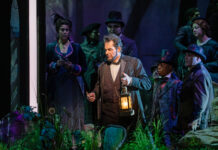
Main Photo: Craig Colclough in Falstaff (Photo by Cory Weaver/Courtesy LA Opera)