









When tenor Miles Mykkanen steps onto the stage at Ravinia Festival for concert performances of Mozart’s The Abduction from the Seraglio on July 16 and 18, he’ll be returning to a role he first sang in 2017. But in the years between, his career has accelerated dramatically. This past season alone included opening the Metropolitan Opera season in Mason Bates’ The Amazing Adventures of Kavalier & Clay and returning to Kaija Saariaho’s Innocence for its New York premiere – also at the Met.
Despite those milestones, our conversation continually returned to Mozart.
Again and again, Mykkanen described the composer not simply as a musical genius, but as a teacher. Whether discussing Maestro James Conlon‘s rehearsals, the discipline required to sing Mozart or the humanity at the heart of the composer’s operas, he kept returning to the same idea: every time he comes back to Mozart, he learns something new.
Q: We’re going to talk about your return to Belmonte in The Abduction from the Seraglio, but I’d like to begin with Mozart himself. He once said, “All I insist on, and nothing else, is that you should show the whole world that you are not afraid. Be silent if you choose, but when it is necessary, speak. And speak in such a way that people will remember.” How does opera allow you to speak?
Wow. Leave it to Mozart to give us some of the best quotes. I hadn’t heard that one before, so thank you. That was beautiful.
I think opera is, especially in this world of technology, still the most fundamental way of communication because it is about the human voice, the human spirit carrying a message out into the ether and into these large theaters wherever we’re singing.
Mozart also is a reminder to all of us of the decency in humanity and those lessons that are in all of his operas. There are still lessons for us in 2026. His operas still teach me things every time I return to them. As you get older, you learn more and more, and Mozart somehow, in his twenties and thirties, was able to put his finger on something that still baffles most of us in our everyday lives.
What strikes me most now is just the glorious music. Of course the arias, but also the ensembles, that quartet and the duet toward the end of the show. Some of my favorite Mozart writing is in this opera. You have to stay on your toes. It isn’t technically easy, but it is so musically fulfilling.
How we arrived at that understanding has changed. The first time I sang Belmonte, the late Michael Cavanagh imagined him as a kind of James Bond figure, which was tremendous fun. This production is a concert version with light staging, so it brings the focus back to Mozart himself.
Q: You’ve had the unusual opportunity of moving almost directly from The Magic Flute at LA Opera into The Abduction from the Seraglio while working with James Conlon who conducts both. How has that shaped this return to Mozart?
It was very special because my season was largely twenty first century repertoire, and then suddenly in May and June I entered what I’ve been calling my Mozart era.
I’ll be doing a lot more Mozart over the next several seasons, and to have somebody like James Conlon leading you through these scores is extraordinary.
This is his fourth or fifth Abduction, and he still has notes in his score from productions he conducted in Europe in the early eighties. That’s one of my favorite parts of being an opera singer, tapping into that legacy and history. Right now I can’t imagine anyone better to help us do that than James Conlon.
What impressed me most is that he is truly a man of languages. He speaks beautiful Italian. He speaks beautiful German. It’s always a relief to have somebody on the podium who finds the music through the text, because Mozart was writing for German ears. The language informs the music.
I had finished the final performance of Innocence in New York, took the red eye and was in rehearsal for The Magic Flute the next afternoon. I was coming straight out of Kaija Saariaho’s world into Mozart’s, and James was there saying, “Miles, you’re not singing twenty first century music anymore. Your larynx can relax. Come back to basics.” That’s a gift.
Mozart is challenging because everything is exposed. Everything is transparent. James knew exactly where I needed space, where I needed support, when I wanted to linger and when I wanted to move forward. Over the course of The Magic Flute we built this rapport, so stepping into The Abduction from the Seraglio together now feels like a completely natural continuation of that relationship.
Q: This is a concert performance rather than a fully staged production. What does that allow you to discover in the score?
The challenges are simply different. I don’t have to think about costumes or complicated staging, but I will be standing on stage with members of the Chicago Symphony Orchestra and Maestro Conlon. That allows you to give yourself over completely to the music.
At Ravinia we’re also in a more intimate space than many of the opera houses where I’ve been singing recently. In those larger houses you use your technique differently. When you come into a theater like this, you can explore more colors, more nuance and more possibilities in your phrasing.
With a score like The Abduction from the Seraglio, it’s a chance to let Mozart speak before anyone else does. His music directs the evening. I spent a great deal of time studying chamber music at Marlboro and Juilliard, and those lessons come back immediately in a concert performance. You’re listening differently. You’re hearing the orchestra differently because they’re beside you instead of beneath you. You’re responding to your colleagues in a much more immediate way.
Concert performances remind me that before I’m anything else, I’m a musician. I love acting, but sometimes it’s wonderful simply to be the singer and the musician and focus on this glorious music
Q: You referenced earlier that you’re ready to step into your Mozart era. What does Mozart offer you as a singer and as a man that is unique to what other composers offer you?
The human part is that beautiful purity, the humanity of these characters. They have their flaws, but almost all of Mozart’s characters are searching for something better. They’re searching for beauty or purity in their lives and in their stories.
That’s always a touchstone for me when I reopen Così fan tutte, Don Giovanni, The Magic Flute or The Abduction from the Seraglio. La clemenza di Tito is another opera I’m working on now. With Mozart, and with the wonderful librettists he worked with, the score itself becomes a guidebook. Every time I come back to it, I learn something new.
As a singer, I understand something now that I didn’t when I was younger. I’d hear older singers talk about how you have to be completely lined up technically to sing Mozart, and I remember thinking, “Well, shouldn’t you always be lined up?” But as you get older and begin singing different repertoire, you realize what they meant.
Every decision you make throughout the evening matters. You have to be incredibly conscious of how every phrase begins. You have to be consistent. If you make two or three poor choices, you’re going to feel it because Mozart leaves you nowhere to hide. You’re one of the solo instruments. If your technique isn’t completely free, it becomes a very fast downhill slide. It’s a wonderful challenge because it brings you back to the fundamentals of healthy singing.
He’s the best teacher. He really is.
Q: James Conlon wrote that one of the central ideas in The Abduction from the Seraglio is “the rejection of vengeance and the power of forgiveness.” More than 240 years after Mozart wrote the opera, why do you think that message still feels so relevant?
That’s another beautiful quote.
The rejection of vengeance. The power of forgiveness. I’m going to pause there for a second and let everyone fill in the blanks for themselves.
I think we’re living through a period of reckoning, not just here but everywhere I travel. At the same time, I’m beginning to see people searching for our fundamentals again.
That’s why Mozart continues to live on our stages. He’s one of the greatest teachers we’ve ever had because he reminds us what it means to move beyond all the noise and simply be a good person.
I think about the end of The Marriage of Figaro, when the Count and Countess are finally able to look at one another simply as two human beings. Or the final duet in The Abduction from the Seraglio, when Belmonte and Konstanze believe they’re saying goodbye forever.
These operas continue to remind performers and audiences alike about the importance of decency, compassion and forgiveness. Those lessons don’t become less important with time. If anything, they become more important.
Q: I do want to talk about this remarkable season because opening the Metropolitan Opera season in The Amazing Adventures of Kavalier & Clay and then returning for Innocence in its New York premiere is extraordinary. Have you had time to process what this season has meant?
Honestly, no. I was talking with a very dear friend the other night, and she asked me almost the same question. I realized I’m not quite ready yet because I’m still coming off the season.
I have a little time off later this year, and I think that’s when I’ll finally be able to decompress and understand everything that’s happened.
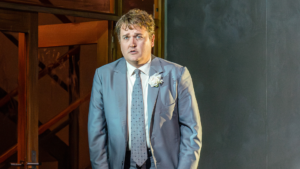
You really can’t plan for a season like this. Innocence had actually been booked before Kavalier & Clay, so none of us knew those two productions would end up together. What strikes me now is how naturally those two characters fit me. Sam Clay and the Bridegroom are very different people, but I understood both of them. Then suddenly one opens the Metropolitan Opera season and the other becomes the New York premiere of one of the great contemporary operas.
Nobody could have planned that. I’m simply grateful.
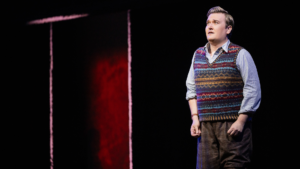
I’m certainly not saying goodbye to Sam Clay. I look forward to singing him again because he’s become very special to me. Anyone who has read Michael Chabon’s novel understands what makes him such a remarkable character. Amid war, fascism and families being torn apart, Sam still believes in goodness.
Near the end of the opera I stand center stage at the Metropolitan Opera, put on my hat and walk into the final image of the production. After performances, people would tell me they simply wanted to hug Sam.
That wasn’t about me. That was the character. That’s Mason Bates’ music, Gene Scheer’s libretto and Bartlett Sher’s production. To be part of a work that offers hope in the middle of darkness is a gift in any career. The fact that I was able to experience it this early in mine is something I’ll always be grateful for.
Q: You also realize that, for as long as this opera is performed, you’ll be remembered as the artist who created Sam Clay.
History still scares me a little.
But when I first received the score, I remember sitting at the piano, playing through it and having to stop because I was crying. What hit me wasn’t that I was creating the role.
It was that someday colleges would be performing this opera. Young singers would discover Sam Clay for themselves. I really believe that’s going to happen.
What a privilege it is to be the first person to bring that character into the world. I hope I sing him many more times, but I also look forward to watching future generations make him their own because I think the message of The Amazing Adventures of Kavalier & Clay deserves to be heard for a very long time.
Q: I’d like to end with something Enrico Caruso once said. He wrote, “I suffer so much in this life. That is what they, the audience, are feeling when I sing. That’s why they cry. People who have felt nothing in this life cannot sing.” Do you agree? And how, at this point in your life, do you translate what you’ve experienced into your singing?
I do agree with him. Of course our job is to sing beautifully, to know our languages and to be good musicians. But what makes singers different from instrumentalists, and even from other performers, is that the human voice becomes the messenger of the singer’s soul.
My voice teacher at Juilliard, Cynthia Hoffman, always described it this way. She would say to imagine that the singer is a lighthouse. The light is already there. The teacher’s job isn’t to create the light. The teacher’s job is simply to keep the glass as clean and clear as possible so that the light can shine as brightly and as far as it possibly can. I think that’s a little of what Caruso was talking about.
Whatever you’ve experienced in life, grief, joy, loss, hope, if you can bring those experiences into your performances and into your voice, that’s what audiences are really responding to. That’s what they’re coming to experience.
At the end of the day, that’s why we stand on an opera stage. This art form allows the light inside each artist to reach someone else. It consoles us, but it also teaches us without feeling like it’s teaching us. It opens us up.
I think that’s one of the reasons we need the arts more than ever. They give us something that nothing else really can. You sit in the audience and suddenly you have goosebumps, or your eyes fill with tears, or you find yourself completely connected to your emotions. It’s almost like going to church. It’s something deeply spiritual because it’s so much more than simply making music.
Q: Listening to you describe Cynthia Hoffman’s lighthouse, it strikes me that when it works, singers become teachers. They clean the glass for the rest of us.
Oh my God. Well, that’s the goal. We don’t always get there. Sometimes there’s a pretty big storm out there.
But thank you. You’re right. That’s always my mission. To forget about the technique. Forget about my own worries. Forget whether I had the perfect warmup. Just walk onto the stage and give the audience a good show.
Main Photo: Miles Mykkanen (Photo by Katja Hentschel/Courtesy Miles Mykkanen)