

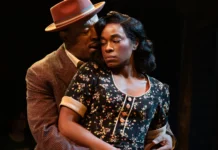
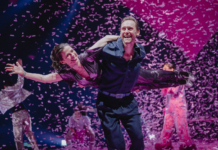


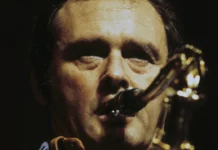




When I first interviewed Aaron Lazar in 2017, he was about to perform his cabaret show in Los Angeles. I had seen him on Broadway in The Light in the Piazza, A Little Night Music and The Last Ship.
We spoke again in January of 2025 when Lazar was a Grammy nominee for his album Impossible Dream. By then he had gone public with his diagnosis of amyotrophic lateral sclerosis (ALS), a progressive neurodegenerative disease for which there is currently no cure. During that conversation he told me, “It’s when you change, your life will change.”
With Thanksgiving approaching, I wanted to talk to Lazar about gratitude. On Monday we discussed what gratitude means to him today, the role music continues to play in his life and what he’s learned about himself in the nine years since our first conversation.
What follows are excerpts from our conversation that have been edited for length and clarity.
Q: We last spoke in January of 2025. You told me at that time, “It’s when you change, your life will change.” Your life has changed in so many ways since we spoke 22 months ago. How different are you today?
Oh man, I am so different. My life is so different. My kids would support me in this because we have this digital picture frame in the house with photos of years and years. They look at photos from before ALS. My body is physically fit and strong. They just say, “Dad, we don’t even recognize you. Not because of your body. Because you’re not happy in those photos. You’re so much happier and healthier even though you’re dealing with such difficult challenges physically.”
Did their recognizing that surprise you? A lot of people would think that in some of those photographs you’re at the peak moments of your career.
Yeah. Of course, in the photos, I remember being very happy. When the going was good, I was happy. But now, even with the going being incredibly difficult at times, I’m still pretty much a happy guy. And that’s the difference.
Are there things you know about yourself today that are new since we last spoke?
For sure. I’ve learned that I was much more of an empath and a sensitive soul than I knew back then. And so I played the leading man character at that time in my life and I thought that’s who I was. I played it as if my life depended on it. My livelihood, as far as I thought, certainly did.
I’ve learned over the last five and a half years living with ALS how to be myself, who I really am, and stripped away the artifice of the character I was playing to really get to know my soul. My life, the people in it, are all now a reflection of that. And so it’s been profound.
I can only imagine that has strengthened your family bonds in ways you could never have imagined.
One hundred percent. I think there’s a quote attributed to the Oracle of Delphi of “Know thyself.” I really do believe it’s why we’re all here, but it’s the hardest work sometimes to do. And ALS forced me to do it. It gave me an opportunity, and do it or die was really the choice.
That aligns with this philosophy that things don’t happen to us, they happen for us. I’m assuming that you’re thinking that things are happening for you as opposed to to you.
One hundred percent. Because if they’re happening to you, you can feel like a victim. Victim energy for me — I won’t speak for anybody else, but I know it to be true for myself — is low energy. It opens the door to negativity like fear, anger, sadness, worry, doubt, impatience.
When I say I’ve changed, the change is driven by a key question: What do I need to change about myself to access more healing, more joy, more positivity, more recovery?
Gratitude is front and center in your social media posts. Your GoFundMe page exceeded its goal. There was the Extraordinary: Broadway Sings for Aaron Lazar concert. There’s been so much outpouring of love. How is gratitude a fundamental part of your thinking today?
I used to, like most people, try to be grateful. I would keep a journal. I would write about it. But writing about being grateful and feeling grateful are two different things.
The journey for me of reconnecting with my body is a journey of focus, energy, feeling and connected movement. So the feeling of gratitude is way more important. I can’t write in a journal right now, but feeling grateful leads to a focus of what you have instead of what you don’t.
My partner, Sarah, and my kids, to my family, friends, to the Broadway community, to the world, what I have in the way of love and support is truly extraordinary. I don’t take that for granted ever anymore. Ever.
Given that outpouring of love that you’ve received, particularly for somebody who gave so much of himself in performance, how has the lesson of being able to receive impacted you?
That’s a beautiful question. It was very hard at first as an alpha male, blah, blah. I never wanted help. I had a real chip on my shoulder, especially with my career, that I was going to prove to my parents and the world that I could do what I set out to achieve. And I did it a lot alone. It was very isolating, very hard. I made it much harder than it needed to be.
With ALS, I knew from the beginning I would need help. Every step along the way that God has asked me to receive help, to receive love, I have surrendered to that and accepted it. And I’m so grateful that I have, grateful for the guidance and grateful for the help, because I’ve learned that it’s a balance.
You can’t just give everything. You’ll empty yourself and drain yourself. If you receive everything, you’re not balanced either. So it’s about a balance and I’m grateful for all of the love in my life.
Were you surprised by it?
I want to say both yes and no. No, because my self-worth has changed dramatically over the last five and a half years and I’ve learned to feel, believe, and accept that I’m worthy of the dreams that I am setting out to live — making this recovery. And so I couldn’t do it without the help. In that respect, I am not surprised because God and the world have supported my dream from the beginning here.
The other side of the coin is I’m very surprised because it is totally overwhelming. I tried for years to not do [a GoFundMe]. I didn’t want anybody’s help. I worked my ass off to keep making a living while my body started to make that more and more difficult.
The amount of support is still overwhelming. The amount of not just donations, but comments and emails and social media posts. I’m just being me, doing my best and so grateful for all the love and support.
You gave a lot of people a lot of joy onstage. I think this is just people being reciprocal to you.
It’s hard to imagine that I could ever pay back all of this love and support. But my goal is me recovering means other people have a chance. And it’s long overdue that ALS be cured. We’ve got to crack the code.
You maintain such a positive outlook publicly. When you have moments of anger or sadness or frustration, how do you find your way back to gratitude?
It’s work. People go out every day and do their jobs. That’s part of my job because I am completely dedicated to my purpose to recover. The darker, tougher moments are very hard.
Just last week, it was a really hard week. I was dealing with some kind of virus on top of ALS. You know it’s bad when the virus goes away and you’re like, “Yay, now I only have ALS.”
My energy’s back. My voice came back. My breathing improved and I was able to post on Instagram for the first time in two and a half months. So you’ve got to be persistent. You can never give up. Gratitude is a sure way to reconnect me to what is real.
Because I associate you so closely with musicals and with music, I’m wondering what role music plays in terms of your personal well-being at this point.
Another beautiful question. It’s been very hard to lose the ability to sing and do voices and even speak in not so monotone of a pitch. I really, really miss that. But I still sing whatever I can. It might be more croaking than singing, but I do it.
I listen to music every day. I was listening with my caregiver to Kelli O’Hara, my friend, the other day. She happened to be at a Carnegie Hall concert and texted me right when we were listening to her. And so music was connecting us. I really do believe it is such a part of my soul. It will always be a part of my healing process.
I was at Kelli O’Hara’s LA Opera concert where we were very pleasantly surprised to see you join her onstage.
Oh, I love that. That was so special.
You did get a Grammy nomination for Impossible Dream. How has your definition of an impossible dream changed since we last spoke? Or has it?
I think two years ago I had just started the real hard couple of years of ALS. It got real hard, real fast. And at the same time, I met the love of my life exactly two years ago. Sort of the balance of the best of times, the worst of times.
An impossible dream for me that was a little more abstract, a little more pie in the sky, now it is very much grounded in my reality. I’m living it. I’m doing it. I’m making the impossible possible. And I never imagined how many people would connect with that, to support that and inspire themselves.
When you first went public about your ALS diagnosis, you did an interview with Playbill and you talked about writing a thank-you note directly to ALS. You said, “Thank you for all these things. Now you can go.” If you were to write one of those thank-you notes today to ALS, what do you think you would say first?
It’s a great reminder and a great idea. And for Thanksgiving, I think I’m going to do that. So thank you for the inspiration.
If ALS had gone when I first wrote it, I would not be who I am right now. I would not have learned all of the invaluable lessons that I’ve learned. I would quickly follow that up with saying, “Now you can really go. Now it’s time. I don’t need you anymore to learn those lessons. Life is full of them without you.” And I’m excited to learn the lessons in a healthy body, in this body recovered.
So it’ll be a thank-you and an eviction notice at the same time.
Love it. Yes, please.
What do you anticipate being most grateful for when you gather with your family on Thursday?
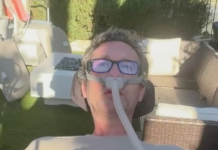
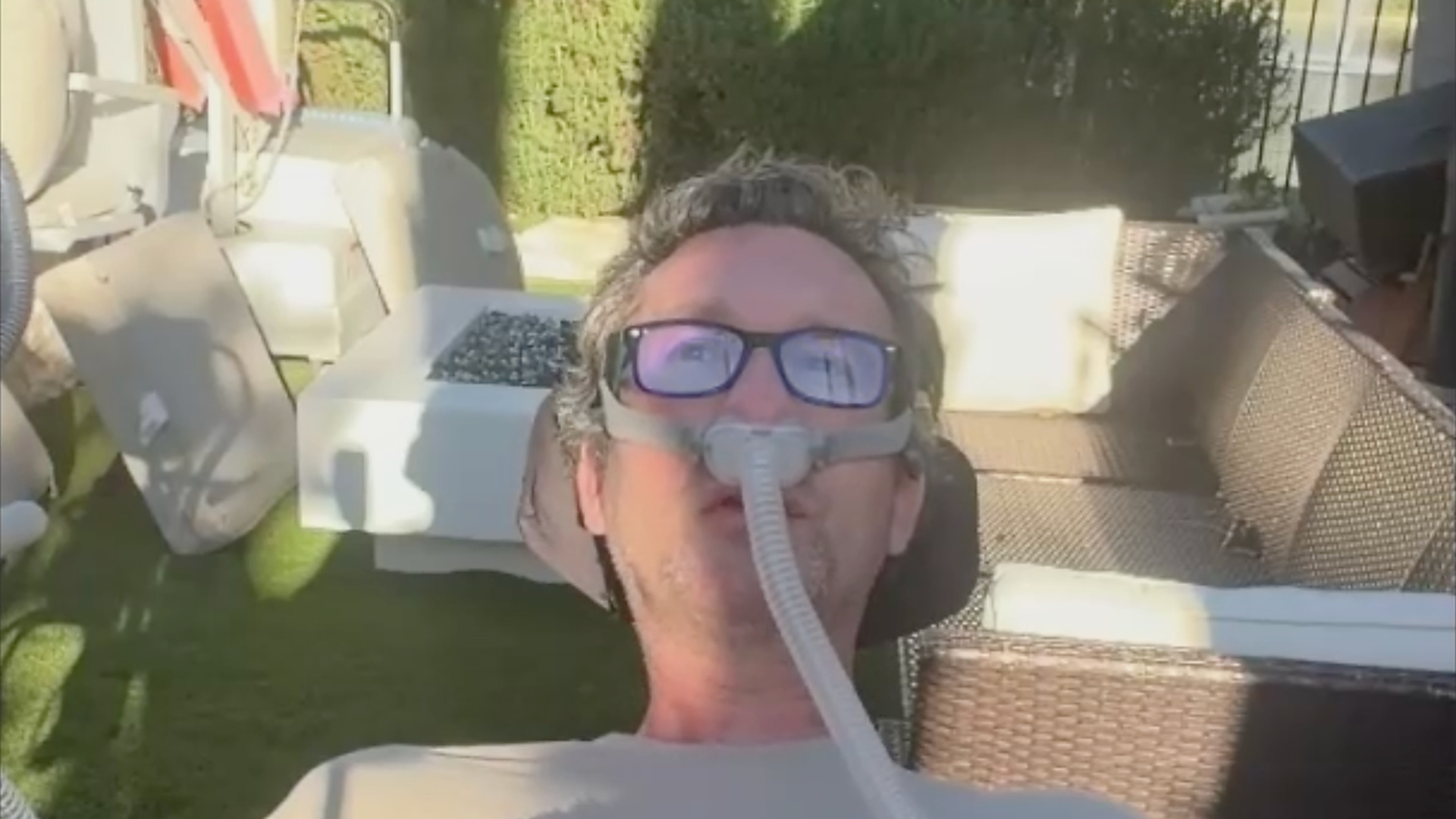
I’m most grateful that despite how this looks — the machines, the caregivers, the extreme adaptations that I have had to make and my family has had to make — I’m most grateful that we still are so close. We’re closer. We’re definitely closer.
I am grateful that my kids live incredibly normal lives and healthy lives and are happy. Grateful that I’m able to gather the people that I love under one roof and I’m still able to eat and swallow. I don’t need to use the G-tube.
I’m so grateful to be connected to the holidays, the fall, fresh air, to have the sun on my face and have another chance every moment to make it better, as good as it can be. I’m grateful for all of it.
I will be first in line for your next cabaret show when you start with I’m Still Here from Follies.
Hell yeah, dude. I was lucky enough to work with Elaine Stritch, as you know.* I would never have touched that song until now.
When we spoke for the first time in 2017, you told me, “The faster you can get in touch with your authenticity and share that, the happier you are going to be as an artist.” More than nine years later, what does being in touch with your authenticity mean to your happiness today?
It’s everything. I can no longer lie to myself about who I am and what I need. I have much healthier boundaries in my life that allow me to be my authentic self without sacrificing it for anybody.
It does not mean it’s easy, but it does mean a healthier life in so many ways than I ever had before. And so for that and so many other reasons, I’m grateful for the opportunity — not ALS per se, but the opportunity that ALS has given me to make the choices that I’ve made and continue to make in order to be my authentic self and help people to be theirs.
* Lazar and Stritch appeared together on Broadway in A Little Night Music.