


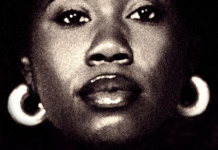






Playwright Lynn Nottage is a two-time Pulitzer Prize winner for her plays Ruined and Sweat. Her work isn’t restricted to plays. She is the book writer for MJ The Musical. She is also wrote the libretto for composer Ricky Ian Gordon’s opera based on her play, Intimate Apparel. This was Nottage’s first foray into opera. That opera premiered in 2020.
Her second opera, This House, has its world premiere on Saturday, May 31st at Opera Theatre of St. Louis. Once again she collaborated with Gordon. She’s also brought along a young playwright, Ruby Aiyo Gerber, whose play of the same name serves as the inspiration for this opera. Gerber is also Nottage’s daughter.
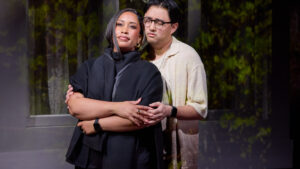
This House tells the story of a young woman, Zoe (Briana Hunter), who returns to her family home in hopes of convincing her mother, Ida (Adrienne Danrich), and her brother Lindon (Justin Austin), that it is time to remodel the property. Both are reluctant to agree to her request. The memories that their home contains are too significant to risk losing them in the process. The weight of those memories reveal themselves gradually over the course of the opera.
Yesterday I spoke with Nottage about collaborating again with Gordon, what she learned from their previous collaboration about the requirements of opera and the goal she has of creating community with her work. What follows are excerpts from our conversation that have been edited for length and clarity. To see the full interview with Nottage, please go to our YouTube channel. (You can also find an interview with Ricky Ian Gordon from 2022 there as well.)
Q: You told a great story at Works and Processes earlier this year about writing the libretto for Intimate Apparel and how Ricky told you that you had basically rewritten your play twice. That he needed you to trust his work as a composer to bring his creative voice and music to the storytelling in the opera. How did that experience inform this second collaboration with Ricky?
The first time I wrote the libretto for Intimate Apparel I had never written a libretto before. I didn’t understand the economy of storytelling and so I was hell bent on trying to rewrite my play and to fix the things that I thought weren’t working rather than focusing on writing a new libretto. With the help of Ricky, I really came understand the beauty of the form. That in a libretto less is more. You have to really trust that your composer is going to do a lot of the expansive and emotional storytelling.
So when we were sitting down to write This House, that was definitely at the back of my mind; this economy of storytelling. Allow Ricky to do a lot the heavy emotional lifting with his music. One of [Ricky’s] real skills is that he is an excellent dramaturg and he’s able, within an aria, to give you the full emotional arc.
You’re working with Ruby’s play and this is her first time working on an adaptation of something she had written for a different form. How much did you pass on what you learned from Intimate Apparel to this creative process with her?
I definitely really early on passed on the wisdom from my experience with Intimate Apparel because I certainly wouldn’t have to go down the same long laborious road to discover what the libretto is. One of the things that I think was really lovely about this process is, not only that I was collaborating with Ruby, that we were also collaborating with Ricky from the beginning. It is a new piece and so his input was really important. He could say when he looked at the first drafts of the libretto I think i need more language here or I think they need less language here because I think I can fill this moment out with musical textures.
I read an interview that you did with The Interval in New York in 2016, where you said, “I have much more control of my craft. I don’t have to rewrite as much because I’m able to incorporate that rewriting into my initial writing.” Ruby is at a different stage in her writing career. So how did your experience and her relative inexperience come together?
I think we have very different skill sets. One of the things that I have spent a lot of time on is just structure and the architecture of a piece. And I understand how to do that. Ruby is a poet. And she has a real facility with language and is able to lean into metaphor in ways that I find quite beautiful. So when we’re building this I could bring my expertise as a playwright to the structure of the piece and she could bring the free-form expertise that she has as a poet and a wordsmith to the process. It was a really happy collaboration in that way.
But that said, I’m much more comfortable wielding an eraser than she is. Because I know from experience that sometimes you have to kill your darlings. Sometimes the beautiful language is only to get you someplace and you may have to sacrifice it in service of the overall narrative.
There’s the whole idea of write what you know. Ruby grew up in the same house that you grew up in. How much do you think, or know, that her original play is at least inspired in some measure by her own experience growing up in a house that has a long family history?
I’ve heard Ruby speak about it, so I won’t try to put words in her mouth. But one of the things she talked about is the play was inspired by finding herself in isolation during COVID and having some distance from the house that she grew up in. Having to sort of nest in a space that was foreign and missing that multi-generational home which she grew up in and which I live.

We had three generations. It was myself, my father, Ruby, my son, Melkamu and my husband. What was really beautiful about it is that we had this intergenerational conversation that was constantly going on and was just very fluid and natural and beautiful. My father’s a great raconteur and he loves to tell stories. I think that Ruby’s love for storytelling and, in part, my love for story telling, probably came from some of those wonderful, rich stories he told about growing up in Harlem. So I think that the roots for Ruby’s stories really lie in what she heard in our home.
That same Works and Processes evening, you talked about how when Ricky first reached out to you about would you be interested in doing an opera, and you immediately said yes. That it was something that you had long been considering. How long had that desire in you been festering, and what made Intimate Apparel, your own play, the right first opera for you?
I can’t tell you exactly how long the thought had been festering. But it certainly was one of those things in the back of my head that I was very interested in. I was interested in the form. I was thinking about this actually today. About this moment which I would call my opera moment and what it was that drew me to this particular medium. Why I had this kind of restlessness to tell stories in a different kind of way than I’d been doing it for the last 25 years.
I began my creative life as a musician. I went to the High School of Music and Art. I was a pianist. I did some composing. Not very well, but it was something that intrigued me. I think that moving into opera is sort of reconciling my love for musical storytelling and my desire to stretch and grow as an artist and to continue to challenge myself in new ways. Thinking of how I can tell stories that really force me to go outside of my comfort zone. I have to say that’s one of the other things that drew me to opera is that there is slightly more freedom to indulge yourself in opera than there is in other forms. It doesn’t always have to be naturalistic and you can bring fairies and magical beings onto the stage.
In This House Zoe sings about “the heaviness of time.” I put the libretto down and thought about that for 10 or 15 minutes. What concept do you have of time and the weight that time has?
I wish that Ruby were here because she actually explains this in a very beautiful way. She talks about Black temporality and how, because of the weight of our history, that we’re not only living in this moment but we’re constantly living in the past as well. Because we’re still processing everything that happened in the way in which we negotiate this present. So we’re forced to live in two times as opposed to just being in the present. And there’s beauty in that, but there’s also burden in that.
By the end of the opera, what Zoe does is embrace the beauty of that. She begins with rejecting that heaviness of time, and then ultimately embracing all of that. What that heaviness means to her own being.
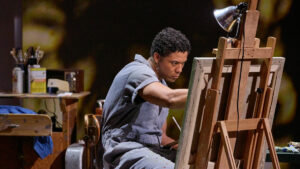
The other line that stood out to me is something that Lindon sings. He says, “I used to be afraid of voices. Then I learned to listen with my brush.” Sounds like a great expression of what it means to be an artist.
I think that that’s true, and I think that we talk about the different way in which Zoe’s haunted versus the way Lindon is haunted. He’s really reconciling with all of those ghosts that are in the space and figuring out how to process them through his art and tell their story.
In this opera the house is a character. How did the three of you come to the concept of the house as a character and the best way for that to be represented, whether with a combination of music and words or no words?
I think that from the very beginning when we sat down, we wanted the house to be personified and to be embodied because it is the central character of the piece. We wanted to figure out how do you bring that to life so it doesn’t just feel like bricks and mortar, but it actually feels like this sentient breathing organism that’s shaping the outcome of what’s happening on stage.
We’re in a pretty tumultuous time. The arts are being threatened by this administration with the horrendous cuts to NEA grants and things like that that have already taken place. Is it a good time to be an artist or a scary time to an artist?
I think it’s both things. I teach at Columbia and I had this conversation with my students about what is our role right now. I have a friend and she said this phrase that I really embrace and I love. She said, “Our role is to be second responders.” We are there to sort of process and interpret and reflect and do a lot of that really difficult work that scares the administration. Which is why they want to silence us, because we are truth-tellers.
You need your truth-tellers in society. Particularly now when there’s such an assault on the truth. When newspapers are being silenced and you have newspaper owners who are just rolling over and deciding to censor their own papers. We have to be the truth-tellers in this moment. Sometimes that truth can be difficult and sometimes that truth can come in a form that allows us release laughter and joy. But I do think we have to carve out space to tell our stories, particularly with this assault on DEI. They don’t want us to tell stories. So the onus on us now is to really lean into telling those stories by any means necessary.
I spoke to Ricky about his opera The Garden of the Finzi-Continis. He had recently completed an interview with Playbill where he was asked to finish the sentence, “I never understood why…” His response was, “there was so much hatred in the world.” Given the themes that run through your plays and operas, I’ll ask you what I asked him. What role would you like you and your work to have in we, as a people, becoming a more compassionate species?
I think, and this has always been part of my mission as a storyteller, it’s to ensure that there’s a diversity of really complicated voices available to people who come to the theater. And I hope that when people come, they have more empathy and love and understanding of folks who they may not necessarily be in proximity to. That’s the beauty of the performing arts is that we’re forced, not only to see stories that may challenge us or inspire us on the stage, but we’re also forced to be in proximity with people who we don’t know. There’s a built-in intimacy and community to theatergoing that I think is particularly important right now. We need to be able to look to our right and look to the left and see people who are different and understand that we’re all part of the same community. So if there’s anything that I wanna do through my art, it’s build community.
To watch the full interview with Lynn Nottage, please go HERE. To watch the full interview with Ricky Ian Gordon, please go HERE.
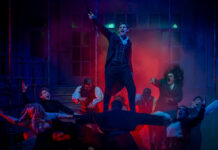
Main Photo: Briana Hunter and Brad Bickhardt in This House (Photo by Eric Woolsey/Courtesy Opera Theatre of St. Louis)