








For 50 years Robert Westenberg has been performing in plays and musicals. I first encountered him in the original production of Sunday in the Park With George. I later saw him in the original production of Into the Woods.
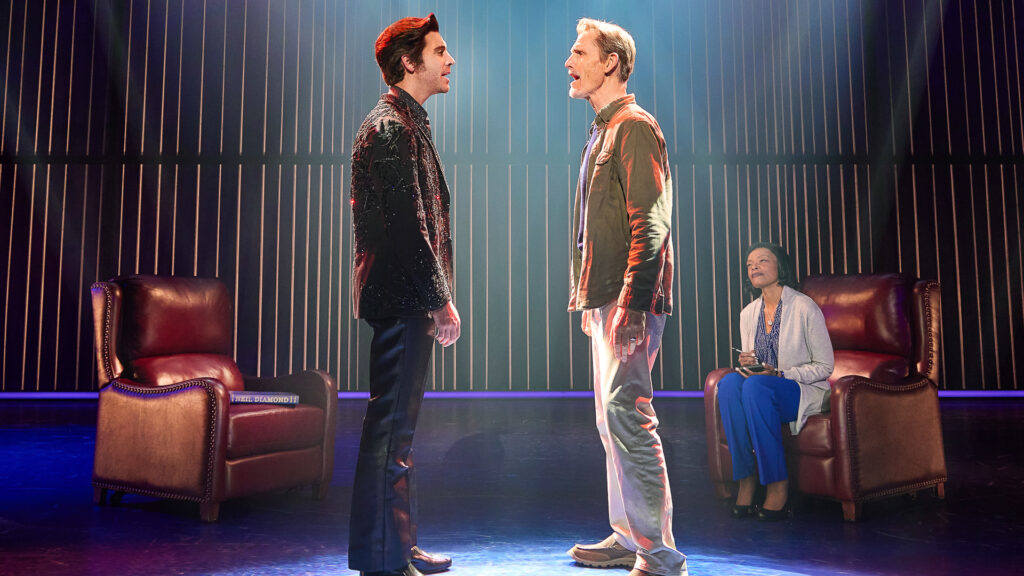
Today audiences around the country can see him as Neil Diamond (Now) in the touring company of the musical A Beautiful Noise. Nick Fradiani plays Neil Diamond (Then). The show is currently playing at the Hollywood Pantages through Sunday, July 27th. On Tuesday, July 29th, it opens at the Segerstrom Center in Costa Mesa through August 10th. A Beautiful Noise will be on tour through July of 2026 and Westenberg will be with the show for the full tour.
Last week I spoke via Zoom with Westenberg about his return to the stage (his last show was in 2009), his experiences working with Stephen Sondheim and about his recent encounter with the man he’s playing on stage – a man whose music he has loved for years. What follows are excerpts from our conversation that have been edited for length and clarity. To see the full interview, please go to our YouTube channel.

Q: Tell me about Saturday afternoon, June 12th, at the Hollywood Pantages.
It was a pretty special day. We had a special guest appearance by none other than Neil Diamond, whom I had not yet met. At the end of the show, when we normally sing a reprise of Sweet Caroline as a cast and as the audience joins in with us, Nick went straight down stage and he said, “Ladies and gentlemen, Neil Diamond.” The audience didn’t really know that he was in the house because he was snuck in and snuck out.
He started singing and he can still sing and it sounds like Neil Diamond. People started going nuts. I mean, nuts. And then people were crying and then the cast started weeping and he sang the crap out of it. Then we finished the show and it was a raucous celebratory moment. Afterwards, Neil came back to my dressing room and that’s when I first got to meet him in person. We chatted and had a great talk. He was incredibly sweet and generous. It was amazing.
It appears as though your last stage role prior to joining A Beautiful Noise was as Mr. Darling and Captain Hook in Peter Pan with Cathy Rigby in 2009. What made A Beautiful Noise the right project for your return to the stage?
This was completely out of the blue, asking me if I’d be interested in auditioning for A Beautiful Noise for the Broadway production. I thought, let me talk my wife [Kim Crosby who was also in Into the Woods] about that and so we decided it would be worth trying.
I didn’t know this until later, I got very close, but Mark Jacoby, an old friend of mine, got the role, and he was amazing. They called me right after that, and they said, “Bob, it’s not gonna work out this time, but we wanna keep you in mind for the future.” Then they offered me the tour. So, again, long conversation with my wife, because it’s a pretty big commitment away from home and children and grandchildren. And decided that I would probably be beating myself up if I didn’t do it. Not to mention the fact that it’s an incredibly wonderful show, a wonderful role. How many roles for people my age come along at this time of life, right? We decided as a group that it would be a good idea to take it. So that’s how I ended up here.
The structure of the show is the later in life Neil Diamond is talking to a therapist about his work at the suggestion of his wife. He’s recounting his life through his songs. Knowing that you were familiar with the songs, how familiar were you with his own personal journey or even his professional journey through the career that you’ve come to admire?
Not very, to be honest. And it was only until I got the role that I started digging in to do my research. But I had a lot of time between being cast and actually starting rehearsals. So I did a lot of YouTubing and a lot of reading and found out the sensational arc of his career and the ups and the downs.
The book contextualizes that music and allows you to see, not only what part of Neil’s life that song emerged from, but also what were the emotional situational influences that created that piece of work, how that piece of music emerged from that particular crucible of his life at particular time. It’s fun to see all the pieces of the puzzle come together in the play.
When you’re taking on the role of somebody who is so beloved and so well-known and has a unique singing style, how important is it for you to emulate what later Neil Diamond sounds like and how much room is there for you to bring you to that?
I think all of that depends on the actor that you cast, the director who’s directing the play, their vision of it and what the expectations of that particular piece create. I’m not an impersonator. I have a little bit of mimicry skills, but that’s not what this play is about at all. So I was just personally interested in capturing the essence of what the book is about, what the scene is about within it, what the internal conflict is about and the emotional journey that this particular character has to take. When I say particular character, of course I’m referring to Neil, but I’m also referring to the character that I embody in the play. I have to bring me to that role. When I did the audition, I didn’t do any Neil Diamond impersonations. I didn’t try to sound like Neil. I was just Bob and they cast me in the role.
When I got into rehearsal, Nick Fradiani, who’s playing Neil (Then), he’d been doing it on Broadway for a long time. So I thought it was wise for me to watch Nick and to see his bearing and see his demeanor, his sensibilities, vocal timbre. It just gently coaxes myself into that world so that there would be a believable thread between this young man and this old guy. Fortunately, Nick and I are almost exactly the same height. We have the same physicality. So that was extremely helpful in terms of helping me believe that that could happen.
The first show I saw you in was Sunday in the Park with George. The older I get, the more impactful that show becomes. Do you have any theory as to why, as we get older, that shows becomes more meaningful?
I did a lot of projects with Sondheim. He was a genius, for goodness sake. With that particular project, I took over the role of George when Mandy [Patinkin] left. [He was Soldier and Alex when the show first opened.] When I had to do the put-in rehearsals, Steve and [director/book writer] James Lapine, would come to the rehearsals. Steve and I would go back to my dressing room after the rehearsal and talk for about 45 minutes. I had about four of these sessions with Steve. I wish I could have recorded them. I had a good relationship with Steve, we became friends. He taught me a lot.
One of the things that he said, we’re talking about a particular moment, he was talking about the absolute critical need for the specificity and how when he writes, he always writes from the specific. It’s always about the small details of a character or a scene, the textures, whatever it is that make it visceral for him and allows him to find the fertile ground that he needs to create. Then he said, “It’s from the specific that we get to the universal. Not the other way around.” Because he’s so specific about everything he writes, every line, every image, every note, because he paid attention to the details, that’s where I think it’s a portal into the universal.
That kind of specificity is in Steve’s work and I think that’s in Sunday in the Park with George. That’s why I think as you get older, it continues to speak to us. That the universal is so present in that play that it’s talking about things so much larger than itself, so much larger than art. It’s talking aging and death and infinity and legacy. There’s so many things that touch all of us that become more important as we grow older and more aware of as we go older. I think that’s why that play resonates more deeply as you age.
Did you have a sense when you were doing Into the Woods that it would become Sondheim’s most produced and most popular show?
No, it was just another show. It was just an other show that we’re doing on Broadway that we thought is as ephemeral as anything else that we’ve ever done. And once we finish it, it will be forgotten or it’ll be remembered by a bunch of theater geeks who will hold onto the original LP and have a signed copy. But it was recorded by PBS. That’s important because that became a touchstone for a while. Several generations could research the show to get familiar with the original production. It’s a perfect show for high schools. It was his most successful show and one of the reasons is that high schools can do it.
It deals with myths. It deals, again, with archetypes. It deals with universals. It deals with things that resonate. The whole essence of fairy tales is just something that’s in the core of our being that every culture in the world has their own version of that, you know? They’re very Jungian, they speak to our subconscious, our collective subconscious. I think that play hits people on a level they don’t even realize when they’re watching it and that the realization of how deep it’s hitting them increases as they get older in terms of how deep that pool really is.
You got to have a front row seat to see how Sondheim and Lapine worked on trying to improve their shows and make things work to the best that they possibly can. What was that like?
What was so cool for me as a young actor when I did Sunday in the Park, was watching Steve and Jim throw things away. You have to remember, too, we were getting ready for the Broadway opening of Sunday in the Park with George and there were songs that hadn’t been written yet. So we had bookmark scenes that were written by Lapine and said song inserted here. We had this little connective tissue that got us from A to B to C to D, which represented what the essence of the song was going to be. Here we were in previews in New York and four songs have not been written for Act Two. People were walking out of the theater before we finished our curtain call. They’re streaming out. We would have a meeting after Steve would say, “Don’t worry. It’s gonna be okay. I’ve been through this before.”
He knew that he worked really well under pressure. That’s when he created some of his best stuff. When we were in Into the Woods the same thing was happening. We delayed the opening, and I may be wrong on this, by something like four weeks, a huge amount of time. We were in the six week range of previews before I think the New York Times finally said, “No. We’re coming in. I don’t care what you say. We’re going to review it.” But the reason for that was that he was still workshopping it. And finally, we got that what is, quote, unquote, the final form. Working with them, it was delightful and scary, but you just had to trust them.
Since A Beautiful Noise is a memory play, I want to try a little memory play about you. When you were playing Conrad in Bye Bye Birdie, or Zeppo in Minnie’s Boys, or Billy Bigelow in Carousel at Good Company Players in Fresno, what expectations did you have for your career?
I was sort of a rambling idiot. I didn’t know what I was gonna do. I had no idea. The idea of making a living at it, I don’t know if it actually crossed my mind. I did it because I was having fun. I sort of ended up backing into theater and I liked it. I enjoyed it and it was a great. It was a great way to meet girls. Then slowly but surely I started having more theater credits than English credits. I was an English major. After a while, I was like, well, if I want to graduate before eight years are up, I have to make a decision here. And so I thought well, I’ll go with theater because I’m having a gas. Literally, I had no idea.
Now that you’re 50 years into your career, as an actor and also as a director, what thoughts do you have looking back on those 50 years and what do you want at least the next five to 10 years to be like?
I’m not particularly reflective in that sense. I don’t dwell on the past very much. I don’t have a lot of memorabilia in my house. I didn’t want my children growing up with that. Once the past is past, it’s past. I try to build on it and learn from it, but I don’t dwell on it. The present is more important to me and the future is important too, but present most important. Especially in terms of acting. That’s the hardest thing to do in acting is to be present. I think that that’s an art form and a skill that takes decades to develop.
I’ll say that this particular show has been incredibly rewarding because of the responses that we get. How moving it was to them and thanking us for the collective effort that happened and how surprised they were and how moved they were. And I thought, well, that’s why we go to the theater, isn’t it? We go theater to feel human again. We go to theater to feel again. We go there to feel that communion of spirit that makes us all human. And I think this play does that. It’s a jukebox musical, for God’s sake. Yet it goes to a very rich, fertile, dark, joyful place. I just feel like the luckiest guy around to be able to be 71 and to still be able to do it. I know a lot of people my age are not even ambulatory. So I’ve got that to be grateful for. And the fact that I get to dress up every night, put a wig on and a microphone and go out and pretend to be somebody else and have it be contributing to this beautiful group effort with this unbelievably gifted cast. It’s a genuine privilege.
To watch the full interview with Robert Westenberg, please go HERE.
To see all the tour dates for A Beautiful Noise, please go HERE.
Main Photo: Robert Westenberg in A Beautiful Noise (Photo by Jeremy Daniel/Courtesy Segestrom Center)