


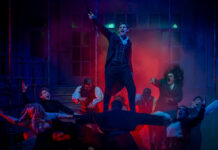







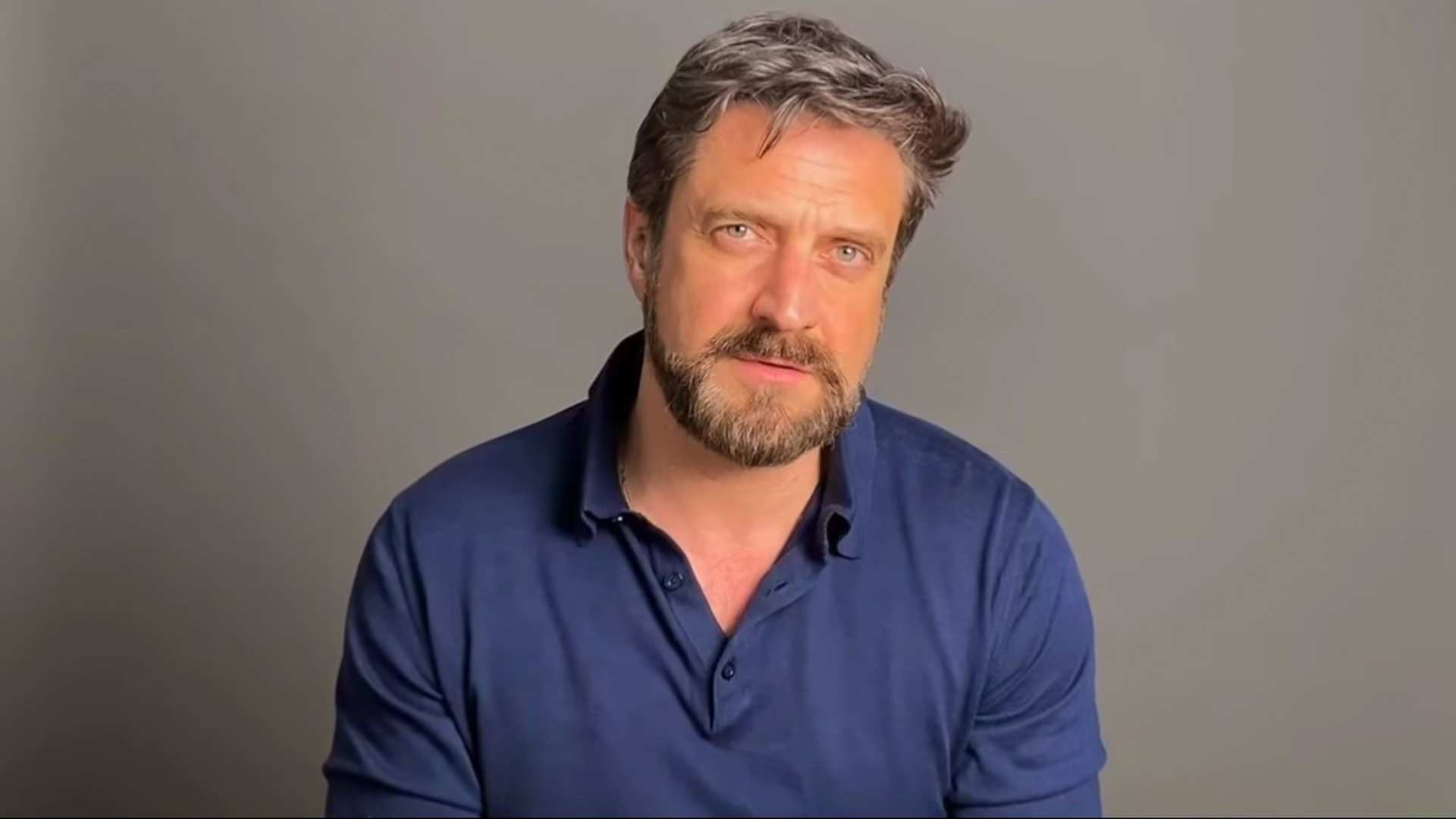

Four-time Tony Award nominee Raúl Esparza has appeared on Broadway as the emcee in Cabaret, as Riff-Raff in Rocky Horror Show, as Bobby in Company, as Philip Sallon in Taboo and in plays by David Mamet, Harold Pinter and Tom Stoppard. He’s only toured in one show, Evita as Che.

Evita was, of course, written by Andrew Lloyd Webber and Tim Rice. This weekend, at the Hollywood Bowl in Los Angeles, Esparza will appear in their musical Jesus Christ Superstar as Pontius Pilate. Nothing like playing the man who ordered the execution of Jesus.
The performances, nearly sold out, feature Cynthia Erivo as Jesus Christ, Adam Lambert as Judas, Phillipa Soo as Mary Magdalene and Milo Manheim as Peter.
Last week I spoke with Esparza about playing one of the most hated men in history, how Jesus Christ Superstar will be received in 2025 and about several of his major shows on Broadway.
What follows are excerpts from our conversation that have been edited for length and clarity. You can hear the full interview (and there are a lot of things that don’t make this print version) on our YouTube channel.
Q: Ted Neeley, who sang the role of Jesus Christ on Broadway and in the film, said in an interview that the part he would most want to do apart from Jesus Christ was Pontius Pilate because “He’s the only character that has a beginning, middle and end.” Do you agree with him and what appeals to you most about Pilate’s arc in this musical?
I do agree with him. That’s actually a very perceptive key. They are the only roles that have a dialog in terms of question and answers. What do you want? Why do you it? Well, I want this, or I don’t say this, or we need you to do this. It’s why the scene is so compelling. It’s very perceptive. It begins with him afraid of what might come. And then he tries to avoid it, and then he does it. And it’s divided into three little perfect sequences. Part of the reason I was drawn to doing this one is for the fun of it. And two, every time I’ve seen Superstar, the Pilate scene is a scene I always remember. I remember the people who played it. I remember either how they did it or what I heard. It’s a standout, fun, rock and roll moment. It’s also just really cool to visit this music and do it – particularly with this cast.
You said that it’s fun to do. But these Hollywood Bowl weekend musicals that they have most summers are notoriously challenged by time and resources. What is the joy to be found in so short a rehearsal process?
I’m glad you’re asking that because I can’t speak about the Bowl. I’ve never performed there. That’s also one of the reasons that I wanted to do this because I saw things there when I was a kid. I have no sense of what that’s going to be like, but I think there has been a tendency of late, and particularly even in New York, we have this problem where shows get thrown up on their feet in about two weeks in sort of the Encore’s model. Sometimes it’s extraordinary. Sometimes it’s a mess. I don’t think that’s a way to make theater at all. Overall, I don’t think you can create anything with real depth and substance in two weeks. But what is interesting about putting something like this together in these sort of one-off explosive things over a weekend is that you get back to the basics of fun and I mean it.
It is very easy in this career, particularly as you become more and more successful, to lose sight of any enjoyment in what you are actually making. The joy of saying, wow, listen to that band. Wow, look at that actor. Listen to that audience. How thrilling. You don’t have time to second-guess yourself. You don’t time to do anything but follow your first instincts. I also believe that our first instincts are generally the best ones we have. Then it takes us about four or five weeks of rehearsals to get back to them. It can be terrifying, but I really like that tightrope. I like the sense of jumping in without having to plan too much. You’ll never get the sort of nuance that I know you can accomplish with a long and delicious rehearsal period, but you will have a lot of the joy and the fearlessness and the playfulness that brings you back to why you wanted to do this in the first place.
Have you discovered that already in the process of rehearsing?

Well, Cynthia. It’s a pleasure to be in a room with such an extraordinary actor. It’s pleasure to do this with a company that is excited by what I’m doing. That happened yesterday in rehearsals and it was really moving to me. It’s moving to see a whole cast kind of light up because they were liking what she and I were doing. They come and say so. That’s really special. I don’t take it for granted. It means a great deal to me when the company I’m working with appreciates me and what I’m doing. I feel the same way about her.
I love [director/choregrapher] Sergio Trujillo. We worked together years ago [Leap of Faith]. He’s a friend. And then that music. We haven’t heard the orchestra yet, but I can’t wait.
How unique are the challenges of doing a concert performance of a musical? It’s not the first time you’ve done it. You recently played Henry Higgins in My Fair Lady for one night.
Doing My Fair Lady in Aspen was…I never get asked to play parts like that. I get asked do this. I get to ask to do rock or pop. It’s one of my favorite musicals. So the opportunity to do Henry Higgins with a 65-piece orchestra seemed like a lot of fun. Why not? What else was I doing?
I did that for the same reason, for the joy of it. For the opportunity to see what you could find in the Shaw play or the Lerner and Loewe score. Maybe something I’ll do again, maybe it’s something I don’t want to do again but just sort of to live in it for a little bit can be delightful. And I think that that things are not really quite as serious as we tend to make them as actors. And things are not quite as nameable either as we try to be with them. We try to be ferociously articulate about the importance of what we’re doing. Actually, I think some things are just about a feeling and about the jumping into an experience and just seeing where it takes you and having had it for a moment. Better to do that than to not have had it at all.
What is the feeling Superstar is giving you at this point?
It’s really too soon to say. I was raised Catholic and I went to a Jesuit high school. I’ve traveled in Israel and I have always loved Andrew Lloyd Webber and Tim’s work. I did the 20th anniversary tour of Evita that played here at the Pantages when I was like 28 years old. There is a sense of full circle in getting to do their work. There’s a sense of visiting something that is fundamental about how I was raised and who I am and what those things bring up about faith. And about your place in a story that is a huge human story that we keep re-telling and what that face represents to millions of people.
What do you believe or don’t you believe? Those feelings come up. So there’s a sense of gratitude, a sense of circularity, a sense or awe. Then, of course, a sense of panic that I will probably blow it.
How do you approach a character like Pontius Pilate who seems to be defined solely for the act of ordering the execution of Jesus Christ?
You find the opposite thing. You have to look for the side of the character that you can find one quality and then you find the exact opposite of that quality and you just keep doing that like unpeeling an onion of layers and layers of humanity inside someone who is seen as a monster. I’ve always been a big ascriber to Nikos Kazantzaki’s version of The Last Temptation of Christ. The sacrifice is so much more enormous than we can imagine. Even if he was just a man, the sacrifice was just so gigantic that the concept of God is created by man. That we are desperate for these stories that we tell about ourselves to give our lives meaning. Anything that can redeem us, save us, give immortality, and the possibility of immortality to the human soul, is something that we keep exploring for millennia and millennia.
That Pilate is one of the cogs in that story, that there must be a betrayer in Judas, and there must an executioner…Or there is a priest, so to speak, or there is no sacrifice. Whatever you believe. So that all is fascinating and that’s what the story takes care of itself. What is important then to do is to see if you can find any shred of the man inside that kind of myth.
I think that’s why Jesus Christ Superstar works is because it forces you to figure out as an audience member what you believe from what they presented to you.

The Catholic school kid in me knows that my family would be horrified at the thought of my doing Jesus Christ Superstar years ago. But I actually think this show is much more compassionate than people give it credit for. It’s a piece of theater that is both iconoclastic, a little bit revolutionary, quite a lot of fun and a lot dangerous. There’s a reason they became what they became.
I don’t know what they were trying to do. I can’t speak for that. But I know that there was some sense of dragging the musicals screaming into the 1970s and to the culture that they were part of that they wanted to accomplish and they went for it in the most controversial way they could.
This is a musical that has notoriously been castigated by religious organizations and their followers for its depiction of Jesus Christ. Now that we’re living in an America that seems to want to go in reverse and back in time, how do you think this production of Superstar will be greeted and what does it have to say about our world in 2025?
I don’t know how it’ll be greeted. I’ve already seen things about people complaining. The biggest thing that seems to be a problem for everyone is that there is a Black woman playing Jesus. I think this country is on a very bad road in this reactionary climate. Where the one thing that this country was founded on quite strongly, it was never giving the church the power to tell anybody else how to live. And we seem to be backtracking viciously in this climate right now.
I’ve always heard that you can count on a fundamentalist to get the Bible fundamentally wrong. Those stories are not about retribution and they’re not about exclusivity. The story of Jesus was a shatteringly new human ethos that entered the world, which was mercy. Which was inclusion. Which was grace. Which was you may not deserve this, but it doesn’t matter what people think you deserve. You are blessed. You are worth loving. You may not be what everybody thinks of as perfect, but you are worth being adored. And God loves you. That was new, completely new. It’s why the faith is so powerful.
I hope that is something that people hear because we must. It’s a really lousy time for what I think are the fundamental qualities and tenets that this country represents in the world. Not just for us, but for what it means. But the idea of America, asthe son of Cubans, to come to this country and to rebuild their lives and to feel welcome in a place. Like this is essential. I hope that is what the compassion and mercy of what this story is about. It’s something that people will respond to. I hope, too, that in having someone like Cynthia play Jesus, you go back to the basics of seeing Jesus as also an ideal. The unexpected man from Nazareth. The small unexpected thing that showed up and said to simply love each other. Cynthia conveys that because, in her very presence, there is grace. I hope that will be something that people take away.
Let’s talk about some of your previous shows. Do you think Roadshow, vis-á-vis Encore’s 2019 version is going to move the needle on how Roadshow will be perceived since so many of Sondheim’s shows seem to be embraced long after their original productions?
I think Roadshow is a great show. I think he wrote a fantastic classic Sondheim anti-hero in Wilson. I think that those three shows, Pacific Overtures, Assassins and Roadshow are a fascinating trilogy that looks at the American dream and the concept of America in three very different ways. That’s John Weidman’s interest and he and Steve I think are always ahead of their time. Yes, I do feel that about the show. We have talked about whether that production can have a little bit further life. I don’t know that that’ll necessarily happen, but Brandon [Uranowitz] and I have talked about it and we talked about it with John.There has been some conversation, but it’s really not so much about us. Underestimate Stephen Sondheim at your peril because it has been proven over and over and over again that, he knows better than we do.
I saw your evening of Sondheim material at Cal State Northridge in 2012 which I thought was a remarkable show. But I can’t see any record of it having been done anywhere else.
I don’t enjoy doing concerts. I had been asked to do that. It was right after Leap of Faith. I found it very hard to put together. I just started working on television as a respite from the stage work. Leap Of Faith was a real heartbreaker. I needed a break and slowly found my way back into the theater some years later. We did Leap of Faith here at the Ahmanson. We did the out of town down here. The show just kept changing, you know? What we did on Broadway had nothing to do with what we did here. I really needed to step away. My musical director, Mary-Mitchell Campbell, and I have only recently begun to discuss whether it might be fun to revisit that and do some concerts. I just don’t enjoy doing them.
You’ve said that singing Being Alive, a song that is so deeply associated with you, becomes an impossible thing to live up to. I saw the John Doyle production of Company three times because I was so incredibly moved and mostly by your performance of Being Alive. I always sat on the keyboard side of the house. The first time I saw you as Bobby and the trembling of your hands before you started playing that song, like it just resonated so powerfully to me about Bobby’s trepidation, about finally expressing himself and what he wants and what needs. What was the process like of putting that moment together?
Thank you for saying that. That’s both kind and very much appreciated. Perceptive, you’re right on the point that we’re trying to aim for. The process of putting Company together was, or putting that moment together, we discovered that moment in phases. Stephen notoriously said for years that he thought Being Alive was not a good ending for the show. So John and I, in our arrogance, we’re at our very first meeting and we were like, well then we better earn that number. One of the things that I think helped was John’s concept. The actor musician thing in his hands can be fascinating. In particular in Company, it turned out to be really revealing. Because he is accompanied, but cannot accompany himself. He is part of a company, but can not play for himself.
We knew that Bobby is essentially someone who needs to grow up. Needs to walk away from his parents. Needs to any number of metaphors you can impose on it and try to earn what that moment is.It all takes place in his mind. Every minute on that stage isn’t really happening. They are all part of him. They’re in his head. If it’s all from his head you have to earn that song and they play for him, then we knew that he had to learn to play for himself. At first we weren’t sure which piece he should start to play. Maybe it’s Marry Me a Little. We don’t know what we were thinking. Of course it had to be Being Alive.
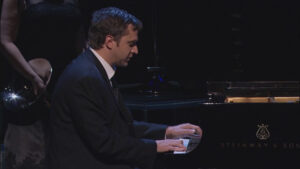
We did not do that song very much. We stayed far away from it. We also needed to earn it as a company. It was not introduced until almost the fifth or sixth week of rehearsals. It’s a very precious thing when something wonderful happens with a song like that because we’ve all heard it a thousand times.
I always say that the reason I can’t [live up to it is] it’s monumental. It’s like standing on the edge of the Grand Canyon. You’re kind of in a sea that also contains you know Dean Jones and Larry Kert and Steve and Hal Prince and Michael Bennett and Barbra Streisand in my case. But also it takes two-and-a-half hours and 14 people to get you there. It’s not a song you do, at least in our production, it wasn’t a song I did alone.
I will always regret never seeing Taboo.
That was such a good one. And then God, they hated us. Then they were like, Oh, we were wrong. That was really good.
That was the toxicity of Rosie O’Donnell at the time, I believe.
It was such a shame because what’s the worst thing she did? She put her money where her mouth was right at the time. She’s one of the most generous people I know. We were in that rehearsal hall and I thought this thing’s gonna be a hit. I mean that is a great score. It’s a show that was way ahead of the curve. It had its diehards, but boy, they hated us.
They’ve just announced that Jack Holden is revising the book with Boy George to take a new look at Taboo. What was your main takeaway, from that experience and is there anything you would like to see them change in the book from what you did on stage?
I’d like to show to go back to what Charles Bush’s original book was. It was outrageously queer. Ferociously queer. We had porn and cocks all over the stage and all of that got cut in rehearsals. I would love that and it was howlingly funny. Also the references to old films. It went so fast and furious and insisted on the audience being smart and made no apologies for its down and dirty cocks and balls otherness. I love that. And she panicked. It just was getting cut left and right.
Also, the Leigh Bowery-ness of it. His extreme outrageousness, which we have seen now copied by Alexander McQueen, an homage by Lady Gaga. These people are riffing on an artist that they appreciate. And it’s everywhere in our culture. That outrageousness. There’s something very exciting about his transgressiveness and ugliness. Unapologetic. That’s why it’s called Taboo. George knows exactly what he’s doing. He wrote a great damn score. And he wrote about some seriously fucked up outsiders who were not apologizing. I would love to see that happen
Andrew Lloyd Webber is quoted as having said, “What strikes me is that there’s a very fine line between success and failure. Just one ingredient can make a difference.” What do you think that one ingredient has been throughout your career that has made the difference in the career you’ve had so far?
One answer is support, as in people have believed in me sometimes when I don’t believe in myself. And help me to continue. So that’s one answer. But I’d say another ingredient is that I just don’t know any better. I have to do this. So I live inside this thing. It can be really fun, but can also be a little bit like flaying your skin off. Maybe part of it is that going inside of things maybe has drawn people to my work. Maybe they see the cost or maybe they see some aspect of themselves in it that I just have tried to dig into whether I’m successful at it or not. That’s an interesting question. I don’t know that I’m the right person to answer it.
I do know that I can love it so much that it can hurt a lot or it can be insanely rewarding. It’s a wonderful way to see the world, to see life. You live so many lives; be that person for a while. You start to wonder what makes something work. What goes from good to great. What goes from great to extraordinary. I couldn’t tell you in a million years. I could tell you all the ways that something is bad. I don’t know that I can tell you the thing that lifts it from good to great. I do know that failure is important. I do that I have learned to let go of feeling like failure is a bad thing. I have learned that the tightrope is intriguing and that mistakes have value. I would never have said that to you 40 years ago.
To listen to the audio of this full interview, please go HERE.
Main Photo: Raúl Esparza (Courtesy RaúlEsparza.com)
Correction: In an earlier version we stated that Ted Neeley had sung the role of Jesus Christ on the concept album. In fact, Ian Gillan of Deep Purple sang the role of Jesus on the concept album. Not Ted Neeley. Cultural Attaché regrets the error.
Ian Gillan of Deep Purple fame was Jesus on the concept album. Not Ted Neeley.
Thank you, Jon. You are correct. I appreciate your comment. We have made a correction in the story.
Terrific interview!
Thank you for reading, Joe!
Raul Esparza is such a talented person!! I would expect that he would write a fantastic play..hopefully we will experience his creation one day. Don’t you agree?
He certainly is talented. Interesting idea about him writing a play. What would Raúl say? Thanks for reading!