


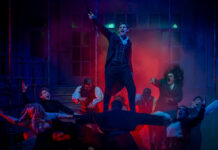



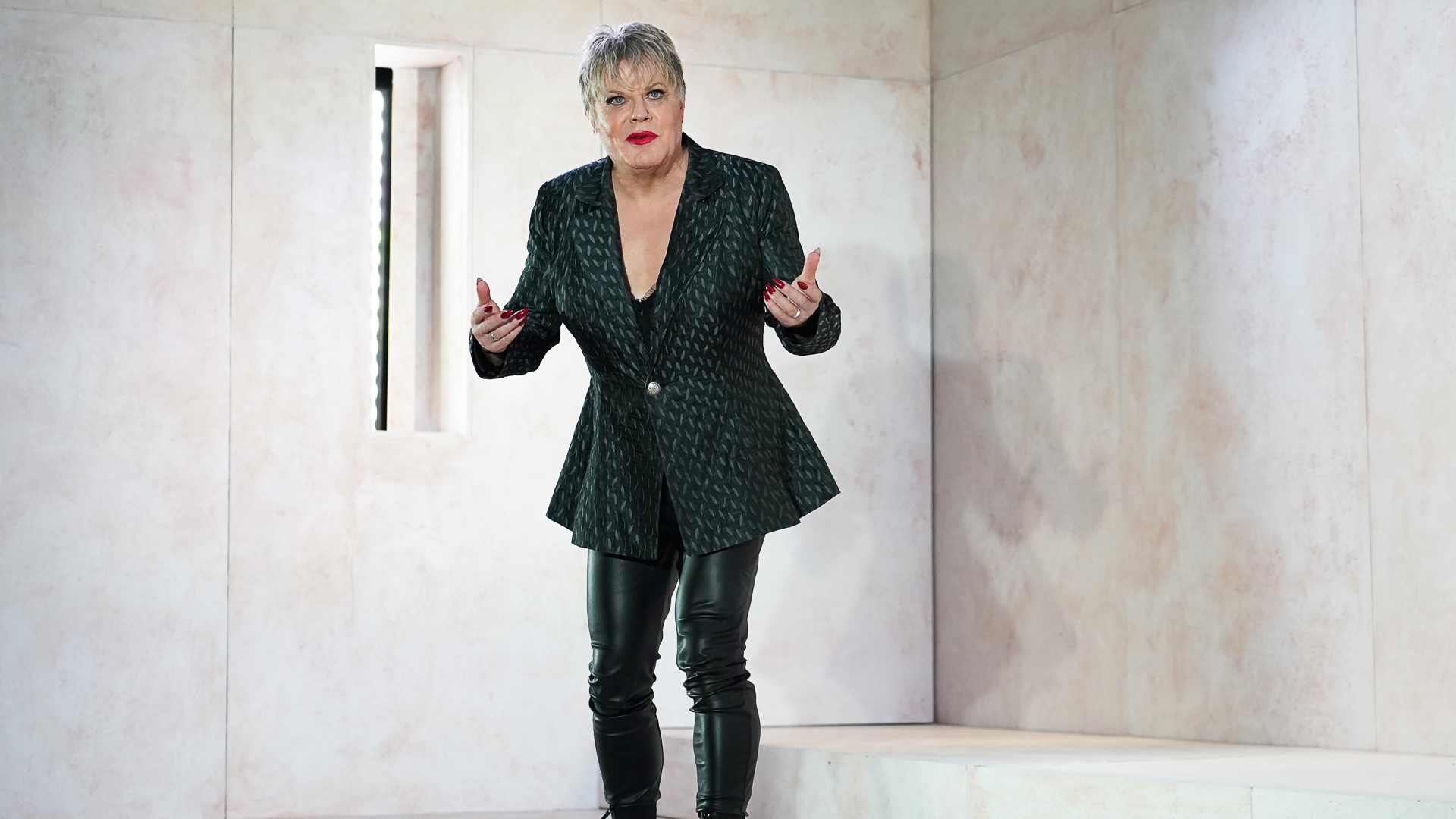

Suzy Eddie Izzard is a British stand-up comedian, actor, and trailblazing performer whose career spans decades of innovative work in film, television, theatre, and live performance. Known for her surreal, ideas-driven comedy and boundary-pushing solo shows, she now tours the world in a bold reinterpretation of Shakespeare’s Hamlet as a one-person theatrical event.
Izzard, who uses she/her pronouns and began publicly identifying by the name Suzy in 2023 while still widely recognized professionally as Eddie, has long embraced challenges that defy expectation and traditional staging, from marathon tours across continents to linguistic feats onstage.
Tonight marks the Los Angeles opening of the third leg of her U.S. Hamlet tour at The Montalbán Theatre in Hollywood (the show will play through January 31st), where she will perform the iconic tragedy—portraying all 23 characters herself—in a production adapted by her brother Mark Izzard and directed by Selina Cadell. The show has already won acclaim in New York, Chicago, San Francisco, and London, including extended engagements and award nominations, and represents a remarkable fusion of Shakespearean drama with Izzard’s singular theatrical energy.
In this conversation with Cultural Attaché, Izzard reflects on determination, solitude, silence, control, and what it means to live inside one of the most demanding roles in the canon.
.
Our conversation took place on Saturday, January 17th before Izzard’s last performance of Hamlet in Chicago. Here are the top ten highlights.
Q: You’re on the third leg of a US tour of Hamlet.
Yes, indeed. It’s the third leg of this Hamlet tour. So, 205 performances under the belt and 50,000 tickets sold. I’m very proud of these numbers because it is a solo one-person show, and I’m just keeping going. You can say, let’s now go here, and then Australia, New Zealand, India, Japan—Japan is really into their Shakespeare—then France and Germany. See if I can do it there, or whether I’ll do the soliloquies in French or German.
I’ve got these crazy plans, which you can do when it’s a solo show. The complications drop away. This is me in my control. I’m running the gate. I don’t have to worry about supporting roles. That’s the unusual thing.
I’m following Shakespeare’s footsteps—going from comedy at the beginning of my career to dramas and tragedies now, in the later part of my career—and I’m loving it.
It’s interesting that you have this career at all, because on your website you’ve said you tried to get into plays at school but couldn’t because they were convinced you were “crap.” With that lack of support growing up, how did you develop the wherewithal to keep going?
That is a very good question. I’m not quite sure. I think I might have determination genetics. I might have a gene in me where I say, “I want to do this.” Oh, you failed. They don’t want you. I’m going to continue.
I do say to young actors, young creative people—determination, determination, determination, with three Ds. That’s the key thing.
I did 12 Edinburgh Festivals over 13 years. The first seven or eight, I was thinking, what have I got to do? I remember being backstage saying, how many tickets have we sold? Ten? Only ten? And then earlier still, six. And I was thinking, okay, six—we can do six, we’ll really give it to those six people.
This time, doing Hamlet in Edinburgh, in a 700-seat theatre, I asked how many tickets were left. Six. There was a resonance there.
I started acting when I was just about to turn eight. My mum had died when I was six. She loved acting, loved singing. I think emotionally I felt that the love the audience gives—you have to earn it. You can’t phone it in. Every night with Hamlet, every night is press night. I want to win people over and take them on an emotional journey.

We all agree Hamlet is a great play, but not all great plays lend themselves to a solo performance. What makes this one work?
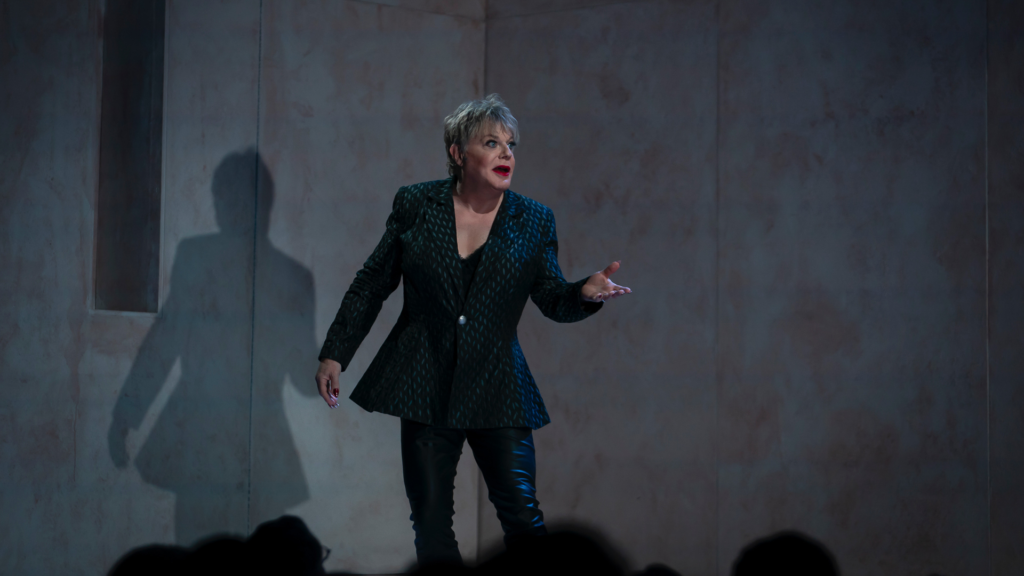
What it does for the audience is make you focus on the words and the characters. I never change costume. You get the purity of what he has written and the beauty of the poetry. It’s a visceral performance. Some people want more costumes, more people, more things. From the actor’s point of view, I know I’ll be giving my all as Ophelia, Gertrude, Polonius, Claudius.
If you have zero imagination, you’ll hate it. But you shouldn’t go to any theatre with zero imagination. About 30% of theatre is your own imagination.
Every night I live it and breathe it. No one is going to be sleeping. I leave everything out there. Every night is press night. This is the third tour of America, so we must be doing something right.
You’re playing 23 characters. Does your relationship to them change over time?
Some characters I’ve always related to more. I felt comfortable with Hamlet early on. You need an ego to create, but you’ve got to be on your A-game.
I really wanted to give Ophelia and Gertrude their due. They’re underwritten female characters, and as a trans person, giving honor to male and female characters feels like a responsibility in this age.
I identify with Hamlet because he over-analyzes. I analyze a hell of a lot. He’s told at the end of Act One to avenge his father and doesn’t do it for four more acts. He keeps asking why he’s not doing anything. That could be Shakespeare himself.
Ophelia’s scenes—when she’s singing and losing it—have become very affecting. Claudius is fascinating: a murderer from minute one. Gertrude is lying to herself. Polonius must be culpable. It’s all power play, regime change. I find it all fascinating.
Your stand-up has always been intelligent and thoughtful. How do those qualities merge into your performance here?
I want intelligence and thought, but not intellectualism. Shakespeare can go very intellectual, but I want visceral.
In stand-up, I fight for the thickness of a laugh. In Hamlet, I fight for the thickness of silence. Silence is the inverse of laughter. I first realized I could get that silence during A Day in the Death of Joe Egg on Broadway [2003].
I do thumbnail sketches of characters in comedy. Here, you have to live them truthfully, in different arcs, jumping between them. It’s very tricky. I’ve worked very hard so the audience can feel it.
What role does silence play in your performance?
You have to earn it. Silence has unusual power. It’s light and shade. I know where those silences are because I can feel them.
Doing Shakespeare has informed everything else I do—articulation, slowing down. I’m severely dyslexic and couldn’t sight-read. That’s why I thought I was crap at school.
Stand-up saved me because I wasn’t reading off pages. I developed fast gabbling talk out of fear of being shouted down. Shakespeare taught me to slow down and articulate clearly. That’s a beautiful place to have driven to.
How has your relationship to this play evolved over the last two years?
It began with intimidation—13,500 words. Lose one brick and the wall crumbles. Now it feels like a cloak I wear.
I run acts in my head in the morning. I rehearse in restaurants, gardens, the Jardin des Tuileries in Paris, hotel breakfast rooms. I look bonkers, but I love it.
It’s gone from trepidation to reverence and warmth. I want to wrap this horrible tale around me. Over 200,000 people have played Hamlet; I’m just one of them. But I want to take it to different places—Australia, New Zealand, India, Japan. It fits now.
How do you protect yourself emotionally living in the tragic world of Hamlet night after night?
I want to get the integrity of their stories out. Ophelia’s pain is the worst. These are tough places, but I want to serve the audience.
I’ve pushed fear barriers back—street performing, stand-up, different languages. I want to do things that are good and difficult. David Bowie said always challenge yourself. Don’t get comfortable and sit there. I don’t want to do that.
Is your comedy background what makes a one-person show less daunting than it might be for someone like Judi Dench who famously said she could never do a solo show?
Judi loves ensemble work. I never wanted to be a solo performer. I wanted to be in groups, like Monty Python.
I went solo out of necessity when my partner went on holiday. I was desperate to move things forward. I tried a solo escapology show and within two weeks I knew—I preferred it this way.
The control came to me. I could work anywhere. I fell in love with solo performance. In comedy I ad-lib; in drama I live in the moment. Forget the audience, forget the cameras. Be in the moment. That’s the key.
What do you think the young boy playing Trebonius in Julius Caesar would have to say about your traveling the world now in a one-person Hamlet?
As a trans woman as well! I think the young boy playing Trebonius would have said, you’ve got some good roles there, you’ve done this—this is not what I saw coming. I don’t think that kid, how old was I, Trebonius, I think I was about twelve, would have thought this was where it was going.
I hadn’t learnt analysis then. That over-analyzing thing which Hamlet does, which I think Shakespeare did, I hadn’t begun to do that. Coming out as trans actually taught me how to analyze, because I thought, why do I feel this, what’s this, what’s that. And I decided I should just come out and be honest, because honesty might be a good idea in the world.
That kid back there would be quite surprised, because a lot of people said, I never thought it would go this far. I did want things to go somewhere. I broke into Pinewood Studios when I was fifteen. I wanted to get into films. I wanted to do things around the world. But I didn’t think it would quite go like this.
Because everything got compressed. I wanted to take off at fifteen, sixteen. As soon as I dropped out of university, I thought, okay, thank you, I’m ready. But no one was interested. Edinburgh Festival—first one, second one, third one, fourth one, fifth one, sixth one—nope, nope, nope. You just keep going.
I was trying to get somewhere as fast as possible. Speed. Get there. But no one gives a damn how fast you do things. It’s how good you get there. My brother kept saying, yeah, you got it on, but it’s not very good. And I realized that’s all that matters—try and make it as good as possible. If you build it good, they will come.
That’s what I started doing on the street. I found people coming to me. I found I had the “it” thing. And now, in Shakespeare, it’s not improvising—it’s something in the gut. There are so many nerve endings in the gut. That’s where confidence comes from.
Street performing broke me and rebuilt me. Accidentally. I didn’t plan it that way. That’s just how it happened.
Eddie Izzard in Hamlet continues across the United States through April 11th. You can find all dates for her tour HERE.
Main Photo: Eddie Izzard in Hamlet (Courtesy Westbeth Entertainment)