



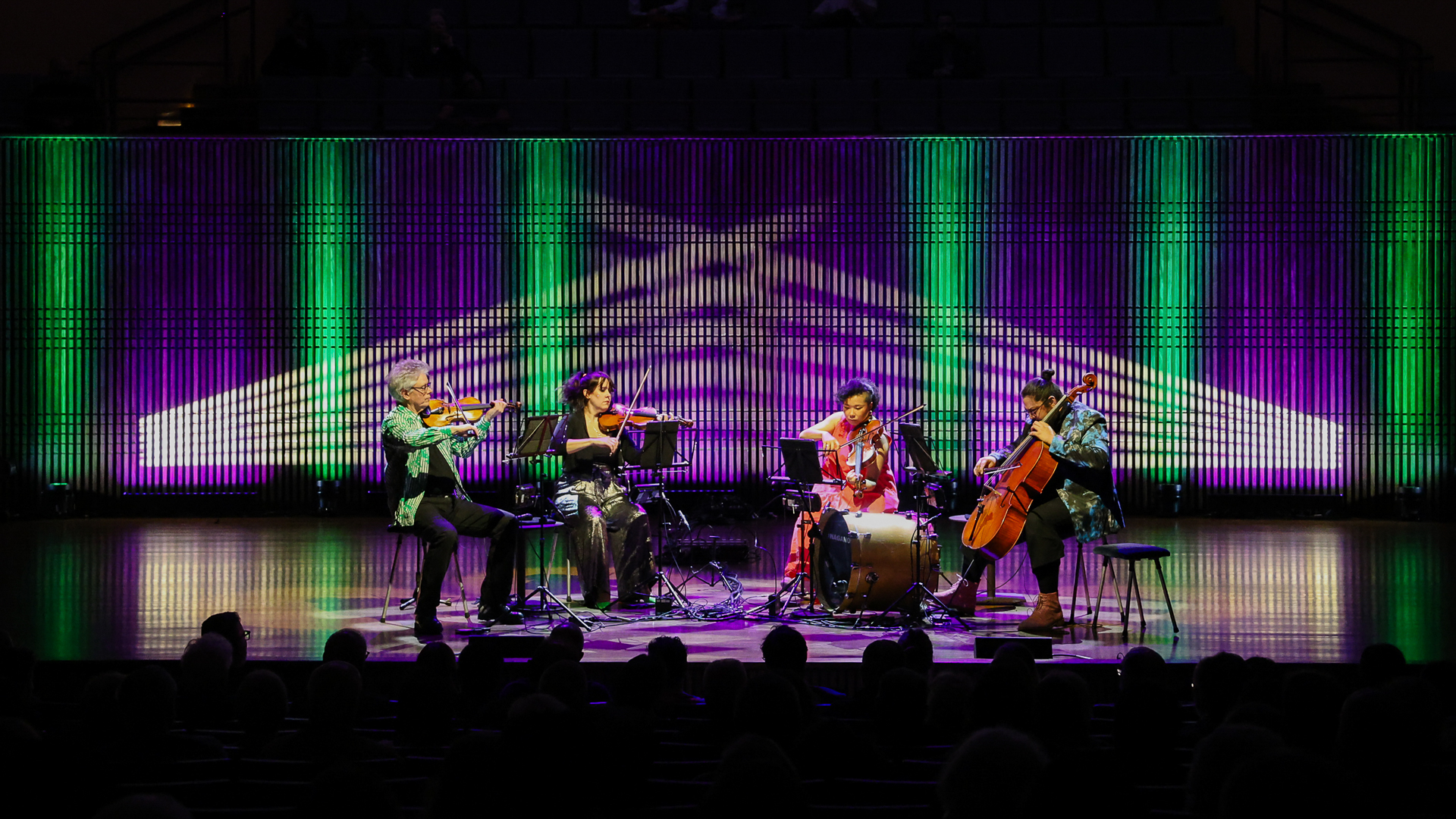

Few ensembles have reshaped the boundaries of contemporary classical music quite like the Kronos Quartet. For more than five decades, founder and artistic director David Harrington has treated the string quartet not as a fixed tradition, but as a living instrument—one that absorbs the sounds, histories, and urgencies of the world around it.
On April 25, at Carnegie Hall, Kronos premieres Three Bones, an ambitious multimedia work created for “United in Sound: America at 250.” Structured as a triptych, the project explores Indigenous, Gullah Geechee, and Chinese American histories through music, archival recordings, and film.
Ours is a conversation about music, but also about history, memory and what we choose to hear.
Q: You were 22 years old when you made a phone call saying you were going to start a group—which became Kronos. What has been the biggest surprise of your journey since you made that call?
David Harrington: There have been many surprises, but one stands out very clearly. Last July 16, in Chicago, we performed for the Nobel laureates assembly for the prevention of nuclear war. It was also the 80th anniversary of the first nuclear detonation.
That context mattered. Not just historically, but emotionally—because it’s something I’ve lived with my entire life, that awareness that everything we care about could disappear in an instant.
We performed music based on Bob Dylan’s “A Hard Rain’s A-Gonna Fall,” and what struck me wasn’t just the audience, but who was in the room—scientists, thinkers, people who spend their lives confronting those realities directly.
And it made me think about what music can do in that space. Not in a grand, declarative way, but in a human way. It felt like something shifted—not dramatically, but directionally. Like maybe we found a slightly different way of being present in the world through what we do.
I’ve always felt Kronos points in many directions. But that day made me want the work to be even more responsive—to acknowledge the fear, yes, but also to offer something that lifts us, even briefly, out of that weight. Because the weight is real. But so is the possibility of connection.
In the last couple of years, you’ve made some changes in membership as people have retired. I know musicianship is clearly the most important factor, but how much does a shared sensibility matter in accomplishing what you were just talking about?
It matters completely. When we were considering new members, the first questions weren’t about playing—they were about how someone thinks, how they listen, what they believe music can do in the world.
That’s different for us. In the past, those conversations came later, after we had already played together. This time, they came first.
And what’s happened as a result is something I feel every day. I’m being lifted up by Gabriela [Díaz], Ayane [Kozasa], and Paul [Wiancko] —not just musically, but in spirit. There’s a kind of openness, a curiosity, a willingness to go further.
It’s subtle, but it’s real. And composers notice it. People we work with mention it. There’s a sense that we’re not just continuing something—we’re becoming something slightly different.
And that feeling feeds directly into a project like Three Bones, which asks a lot of everyone involved—not just technically, but emotionally and intellectually.
Any project of this scale isn’t just a concert, it’s multimedia—there are a lot of moving parts in something like Three Bones.
There are a lot of moving parts, yes—and they’re not just technical elements, they’re human elements. Voices, histories, languages, things that carry meaning far beyond the notes.
Just recently, I received a recording I had been hoping for—a Gullah elder reading the Beatitudes. And when I heard it, I realized immediately that it was something we needed.
When you hear it, you recognize some of the words, but it’s also something else entirely. It’s another language, another way of hearing. It’s a spine-tingling moment. And I don’t want to say too much about it—I want people to experience that for themselves. Because it’s not just the words—it’s the sound of the voice, the rhythm, the way meaning is carried differently.
That’s important. That moment of recognition and not fully understanding at the same time. It creates a kind of listening that’s deeper than translation. And that’s very much what this piece is trying to do—invite people into that kind of listening.
At what point did Carnegie Hall reach out to you to be part of “United in Sound: America at 250”?
About three years ago. They asked what Kronos might imagine doing for the 250th anniversary. And I said, “I’ve been waiting for that question.”
I knew I wanted to create a triptych. Black Angels by George Crumb is a triptych, and Different Trains by Steve Reich is a tryptic. That structure gives you a sense of time—before, during, after—but also a sense of relationship between things.
And very quickly, it became clear that I wanted to focus on Indigenous cultures, Gullah Geechee traditions, and Chinese American history. Because in each case, there are stories—essential stories—that many of us were never taught. And as we worked, that kept happening. Someone would show us something, or tell us something, and the reaction was always the same: How did I not know this?
That question became part of the piece. Not in an accusatory way, but in an opening way. An invitation to reconsider what we think we know about this country, and how we’ve come to understand it.
The title Three Bones—I’m assuming that’s a reference to the three bones in the middle ear, or is there another meaning as well?
That is the meaning. And the title came from the poet Nikky Finney.
After a performance we did together, I told her about the project and said I needed a title. She said, “It’s about listening—why not call it Three Bones?” That was it.
You had the concept, you knew the three panels, and you had the title. What was the process of curating the music that fits into it? Because I know some of these works existed before in different forms—how did you shape the story musically?
That’s something we work on constantly. Even today, I was listening to pre-show music.
What I want is for people, as they enter the hall, to start hearing a collage—sounds from the different panels, without necessarily knowing what they are yet.
And then there are the archival recordings. Those have been part of my thinking for years.
For example, the first Chinese music recorded in America was captured on Edison cylinders in San Francisco. Imagine hearing that for the first time—it must have been as startling as anything in early modernism.
We bring those recordings into the piece alongside contemporary work. It creates a dialogue across time.
There’s also that extraordinary Gullah recording you mentioned earlier.
That recording is at the center of the piece for me. It was recorded in the 1930s by Lorenzo Dow Turner—a song passed down through generations, without anyone knowing its origin.
And then, over time, it was traced back to Sierra Leone. The language is Mende. And as far as we know, it may be the only song that survived the Atlantic passage in its original language.
When you hear it, the connection is undeniable. There’s no interpretation required—you can hear it. And what moves me is that, within that history—within all of that suffering—something was carried forward intact. Something survived.
So yes, there’s pain in that story. But there’s also continuity. And even beauty. I think it’s important to hold both of those things at the same time.
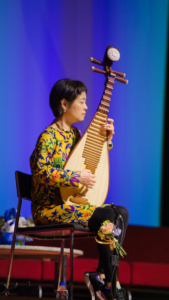
You’ve brought in some incredible collaborators for this project: Laura Ortman, Quentin Baxter and Wu Man.
Each of them brings something that goes far beyond musical virtuosity, although they each have that in abundance. What they bring is knowledge—lived knowledge, cultural knowledge—and a way of understanding the material that we simply wouldn’t have on our own.
With Laura, for example, her work isn’t just about composing a piece. It’s about carrying a perspective that comes from her experience as an Apache violinist, and from the communities and traditions she’s connected to. There’s a sense of place and history in what she does that shapes the entire panel she’s part of.
Quentin brings something equally essential. His understanding of Gullah Geechee traditions isn’t academic—it’s embodied. It’s in the rhythm, in the way music functions within a community.
When he plays, it’s not just performance—it’s continuity.
And Wu Man—she’s someone we’ve worked with for many years, and every time we do, I’m reminded of how expansive her musicianship is. She connects us to a lineage that stretches back centuries, but she’s also completely present in the moment, always exploring, always open.
This isn’t about Kronos presenting these cultures. It’s about working together with artists who carry them. The piece becomes something different because of that—it becomes a collaboration in the truest sense. And I think audiences can feel that. There’s a kind of authenticity, but also a kind of generosity, that comes from that level of shared work. It changes how we listen to each other on stage, and hopefully how the audience listens as well.
I also want to touch on Glorious Mahalia, because it’s such a powerful album. I love the dialogue Kronos is having with Mahalia Jackson through those recordings and interviews. What kind of dialogue are you hoping listeners have when they hear it?
What I hope is that the music continues beyond the listening—that it opens up conversations.
I saw that happen in my own family. My grandson had never heard of Studs Terkel, so we started there. Then we talked about Mahalia Jackson—about what she experienced, about the reality of being celebrated in one moment and denied dignity in the next.
And then we talked about what musicians do. Because in a way, what Clarence Jones described—hearing Martin Luther King Jr.’s voice and writing it down—that’s not so different from what composers do, or what performers do.
We listen. We try to understand what we’re hearing. And then we find a way to share it. If the recording encourages that kind of reflection, that kind of conversation, then it’s doing what I hoped it would do.
I’m borrowing from Mahalia Jackson said encouraging Martin Luther King Jr. when he gave his I Have a Dream Speech when she shouted out “Tell them about the dream, Martin.” What is your dream at this point—for Kronos, for what you can still accomplish, and for what audiences can take away from your work?
I would like music to be much more central to daily life—especially for young people. If someone wants to play an instrument, they should be able to. That feels like a basic idea to me, not an unrealistic one.
Because music is one of the most direct ways we have of understanding other people—and of understanding ourselves. It expands your awareness in ways that are hard to describe but very real. And part of that is being open to what music can be.
Is it silence? Is it frogs? Is it the sound of a violin being pushed beyond what we think it should do? All of that can matter.
So my hope is that Kronos continues to explore that—to keep listening, to keep working with people from different fields, different generations. There’s an incredible amount of creativity in the world right now. Especially among younger people.
And I think our responsibility, as we get older, is to stay open—to listen carefully, and to support what comes next.
Kronos Quartet will perform “Three Bones” at UCSB’s Campbell Hall in Santa Barbara on May 2nd. You can get tickets and more information HERE.
Main Photo: Kronos Quartet in Sao Paulo (Photo by Ali Karakas for TUCCA/Courtesy Kronos Quartet)