







There is an easy way to interview a conductor before the start of a summer music festival. Ask about the repertoire. Ask about the guest artists. Ask why audiences should attend. Jonathon Heyward is far more interesting than that.
As Music and Artistic Director of the Festival Orchestra of Lincoln Center, he is certainly excited about The Beethoven Effect (July 10th and 11th), presenting United States and New York premieres, and introducing audiences to works by some of today’s most compelling composers.
But those programming decisions are part of a much larger philosophy.
For Heyward, the future of classical music depends on creating a concert experience where audiences feel they belong. That means pairing Beethoven with living composers, inviting listeners to shape performances through innovative programs like Symphony of Choice (July 8th), and breaking down barriers that have too often made concert halls feel exclusive rather than welcoming.
By the end of our conversation, we had moved well beyond discussions of repertoire and conducting. Instead, we found ourselves talking about community, accessibility and the extraordinary power of live performance to bring complete strangers together.
Q: Leonard Bernstein once said during his famous 1955 Omnibus lecture on conducting that a conductor must “not only make an orchestra play, but make them want to play. He must make them love the music as much as he loves it.” Looking at this summer’s Festival Orchestra season, is there any music that particularly tests those skills for you?
I don’t think that there is. I love all the programs. That’s the problem. I love everything that’s in this wonderful festival. What is so special about the festival is that it’s compact. There’s so much that we’re able to achieve in the five weeks that we’re playing.
I wouldn’t say it’s a challenge, but one thing that’s perhaps a little more exciting than the average is that we’re doing new commissions and works that have never been played before. We’re doing United States premieres, New York premieres and also a world premiere. Learning how to love that music so much that it connects with our orchestra is a different sort of process than, say, Beethoven’s Fifth Symphony, which I’ll be doing at the very beginning of the season. It’s a challenge, but one that’s filled with excitement and is embedded in the fabric of what I’m trying to achieve with the orchestra.
What are you trying to achieve with the Festival Orchestra?
This marrying of traditional and contemporary voices is something that I’m hugely passionate about because I don’t think they’re all that different. The idea of pairing newer voices with canonical works that we all know and love, or even just canonical composers that we know so well, is a thrilling experience and a huge responsibility when thinking about the thread of an evening.
That’s something I’m very proud of in how we program. The biggest compliment is the idea that someone comes for Beethoven’s Fifth but leaves having discovered Unsuk Chin’s music as one of the biggest revelations of the listening experience. When you can have that duality and win both ways, that’s what we’re trying to achieve throughout the season.
Does that also help encourage younger audiences who may think a program of Beethoven, Haydn or Brahms is simply the music their great grandparents listened to?
Perhaps that’s the case. I’m always fascinated by these barriers to entry that we talk about within the classical music world. For younger audience members that may certainly be part of their experience, but there’s also something important about seeing music written by people close to their age or by people who look like them on stage. That lens of accessibility breaks down a barrier.
When we’re making these programming decisions, we’re asking whose voices are important within the field and making sure we put those voices front and center so people see themselves within the concert hall, within the program and within the evening.
The Festival Orchestra began sixty years ago as the Midsummer Serenades Mozart Festival. Anniversaries are opportunities to celebrate the past while looking toward the future. How does this season allow you to do both?
Again, through our programming decisions we’re always looking forward and backward with these newer voices and older voices. But I also love thinking about the very beginnings of this orchestra. What was so important about its mission at the beginning was accessibility to classical music. Putting Mozart at the forefront was essential during that time. Encouraging people to come into an air conditioned hall was even part of the promotion. Accessibility, accessibility, accessibility.
What we’re doing today is very much a continuation of the birth of this ensemble, now with a slightly different name. Programmatically, everything is aligned with the fabric of what this orchestra has always been. Being able to take stock of that every season is important because you start with your foundation. You start with your roots. As Music and Artistic Director, it’s been thrilling to look back in order to understand how we move forward.
We often talk about what Beethoven does for audiences. What’s the Beethoven effect on the conductor leading Beethoven’s Fifth Symphony?
That’s a great question. I was faced with that recently when I had the opportunity to conduct Jon Batiste in a concert where he presented his own rendition of Beethoven’s Fifth. The opening of this piece is always controversial and difficult. No one knows exactly what Beethoven was thinking, and the interruptive nature of it is still revolutionary.
That’s probably the crux of conducting this piece and all of his symphonies. Everything about conducting Beethoven still feels avant garde. It feels cutting edge. It feels surprising. It feels thrilling. That’s the Beethoven effect. I just found out both performances have already sold out, and I think people still feel that visceral power in his music.
As a conductor, your job is to relay that. Even though I’ve conducted this symphony several times, I always approach the score as something fresh because of how forward thinking Beethoven was.
How important is it that audiences hear the new ideas and nuances you’ve discovered from one performance to the next?
It’s part of the storytelling. Understanding those nuances is part of the drama and part of the story we’re trying to tell within a performance. The details matter. Having meaningful conversations about how we interpret what’s on the page is really important to the impact on the audience.
I especially love doing that with our musicians, who are some of the most curious and open minded orchestral musicians I get to work with.
Do orchestras develop different personalities? Is conducting the Festival Orchestra different from leading the Baltimore Symphony Orchestra?
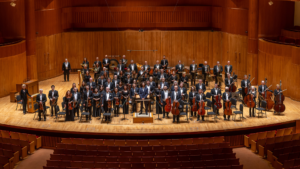
Absolutely. I’m lucky to be Music Director of two brilliant ensembles. One happens to be a chamber orchestra and one a symphony orchestra. The way a chamber orchestra breathes is very different from that of a seventy to eighty five piece symphony orchestra.
There’s a delicacy and sensitivity that naturally comes from a smaller ensemble. You’re trying to achieve that same flexibility within a symphony orchestra, but you have to command it differently because there are more forces that have to align.
My conducting style is lighter in touch with the chamber orchestra than it is with the symphony orchestra, but the way I show breath through my gestures remains the same. That’s something I’m always conscious of when moving back and forth between those two worlds.
Even Beethoven’s Fifth is different in Baltimore than it is here. The halls themselves demand different approaches. Geffen is an incredible hall for a chamber orchestra. In Baltimore we perform in two different halls, and the sound couldn’t be more different, so you have to react and conduct in a very different way.
What draws you most to Jessie Montgomery’s These Righteous Paths, which receives its New York premiere this summer?
What draws me most is the incredible ability of Abel Selaocoe, our cellist and soloist. Without giving away too much, Abel gets to flex not only his cello playing but also his voice. There are sections where he’s singing as well as playing. Jesse really thought about Abel in that way because he’s so incredibly talented as an artist, able to switch back and forth.
I love concertos that truly have an artist in mind. There’s one thing about writing a concerto simply to write one, but to write it specifically for an artist and pull out a skill set that maybe no one else can reveal is really fascinating. That’s what draws me most to this concerto.
When you’re introduced to a new work, what tells you whether it has the potential to stand the test of time?
I probably get a sense of that even before pen goes to paper. I have a great deal of dialogue with composers when I’m commissioning them. There’s a lot of back and forth about structure, narrative, instrumentation and orchestration. I love being part of their world as much as they allow me to be.
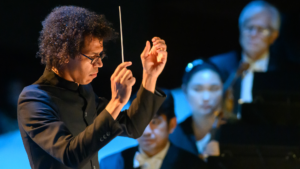
I almost feel I can understand whether a piece will stand the test of time, but my job is to help make sure that it does. When I’m commissioning someone, I already believe in their ability to create something meaningful, powerful, authentic and relatable. Then it becomes my responsibility to make sure the interpretation is focused, relatable and palatable to our audience. That’s why there are so many conversations with composers. I want to understand their world, their past, their present and their future before we ever begin.
Once a new work is premiered, what responsibility do you feel for helping it develop a life beyond that first performance?
I have a huge responsibility as an artistic leader to help follow that through. Last season I had the privilege of conducting Anna Clyne’s saxophone concerto with my good friend Jess Gillam. We performed it nearly eight times together in one season, which is really rare. I believed in Jess as an artist, but I also really believed in the piece.
It was wonderful being able to talk with Anna afterward about what really worked and where the piece continued to evolve. Watching that evolution is such an important part of a composer’s life.
I’m already looking at ways to program works like these again as I finish planning future seasons because I want to be part of that development. As we’re giving this work its New York premiere, I feel genuinely responsible for helping it continue to grow.
One of the most intriguing ideas this season is Symphony of Choice, where audiences help shape the performance, along with the conversations that take place during the concert itself. What have you learned by inviting audiences into the artistic process that directly?
After the pilot year of this crazy idea that I had called Symphony of Choice, I wanted to go straight to the lobby bar to hear what people experienced. The word that kept coming up was ownership. They felt ownership over the evening because they created the symphony they wanted to hear. That sense of ownership gives people a sense of belonging.
Then we break another barrier by bringing our brilliant, charismatic musicians onto the stage for conversations with the audience. Why wouldn’t we? Afterwards we encourage everyone to continue those conversations in the lobby.
To me, that’s what music making is all about. That’s what the performing arts are all about. It’s community building in the most authentic way we can create. Breaking down barriers. Giving people a sense of ownership. Making the art form more relatable and more impactful. I think that’s something we’ve been missing for a little while, but it’s so wanted. It encourages anyone from any demographic to feel that this building might be for them.
A perfect example is my own family. My father’s side of the family is from Harlem, around 145th Street and Edgecombe. The first time they ever came to Lincoln Center was because of me, despite having lived there essentially their entire lives. It’s deeply personal for me to open the doors of Lincoln Center to everyone and make people feel this is their space. Symphony of Choice is one program that hopefully does that in a meaningful and authentic way.
You’ve often spoken about your goal of making classical music accessible to everyone. When Time named you one of its Next Generation Leaders, did that recognition increase your sense of responsibility?
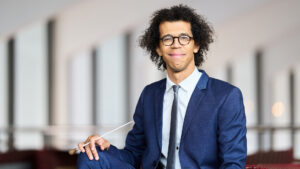
I wouldn’t use the word pressure. My beginnings in classical music are really linked to this mission. In many ways I shouldn’t be here. I didn’t grow up in a family of musicians, certainly not classical musicians. I grew up listening to jazz and rock and roll. I picked up an instrument at ten years old through a public music school program, which many people in this industry would consider late.
I instantly fell in love with the art form. Because I came into classical music without that background or expertise, once those doors opened for me I thought, how could I not be part of this? I realized you don’t need that background. You don’t need that expertise to fall in love with this music. You simply need the opportunity to be there and to feel that you belong there.
That’s what drives this mission. When that announcement came out, I didn’t think about pressure. I hoped it would encourage all of us to think about ways to make this art form truly accessible to everyone.
Does social media help break down those barriers and make classical music feel more approachable?
I think social media can help, absolutely. We see people using it in ways that benefit the art form. But it’s also a double edged sword. If everything exists only on social media, we risk forgetting the beauty of experiencing a symphony orchestra together in a concert hall.
COVID taught me that. We could perform without audiences, but fundamentally that isn’t what this art form is about. It goes back to community and this sense of oneness. Social media can help promote the idea that classical music is for everyone, but the greatest way to do that is still getting people into the hall and making them feel comfortable in that space. That’s one reason I love that our work in Baltimore also goes beyond the concert hall. We go to the audience. Even then, you’re still creating that shared live experience, that sense of oneness that I think we lose when everything happens through a screen.
I’ve always thought one of the greatest things about live performance is that people who might never otherwise spend time together experience the same event. There’s something wonderfully democratic about that.
It’s crucial. During our Schumann symphony cycle we’ve talked about the biological effects that classical music has on us and what actually happens in a concert hall. At certain moments during a performance, heart rates synchronize throughout the audience. What other place do we get that? That true biological oneness that happens all at once is extraordinary.
You don’t get that from a recording, and you don’t get it from a live broadcast either.
It teaches us something about how we connect as a society. Even with the political division we’re experiencing, one of the greatest successes for me is seeing a Democrat sitting next to a Republican in one of my concerts enjoying the very same experience. That’s what this is about.
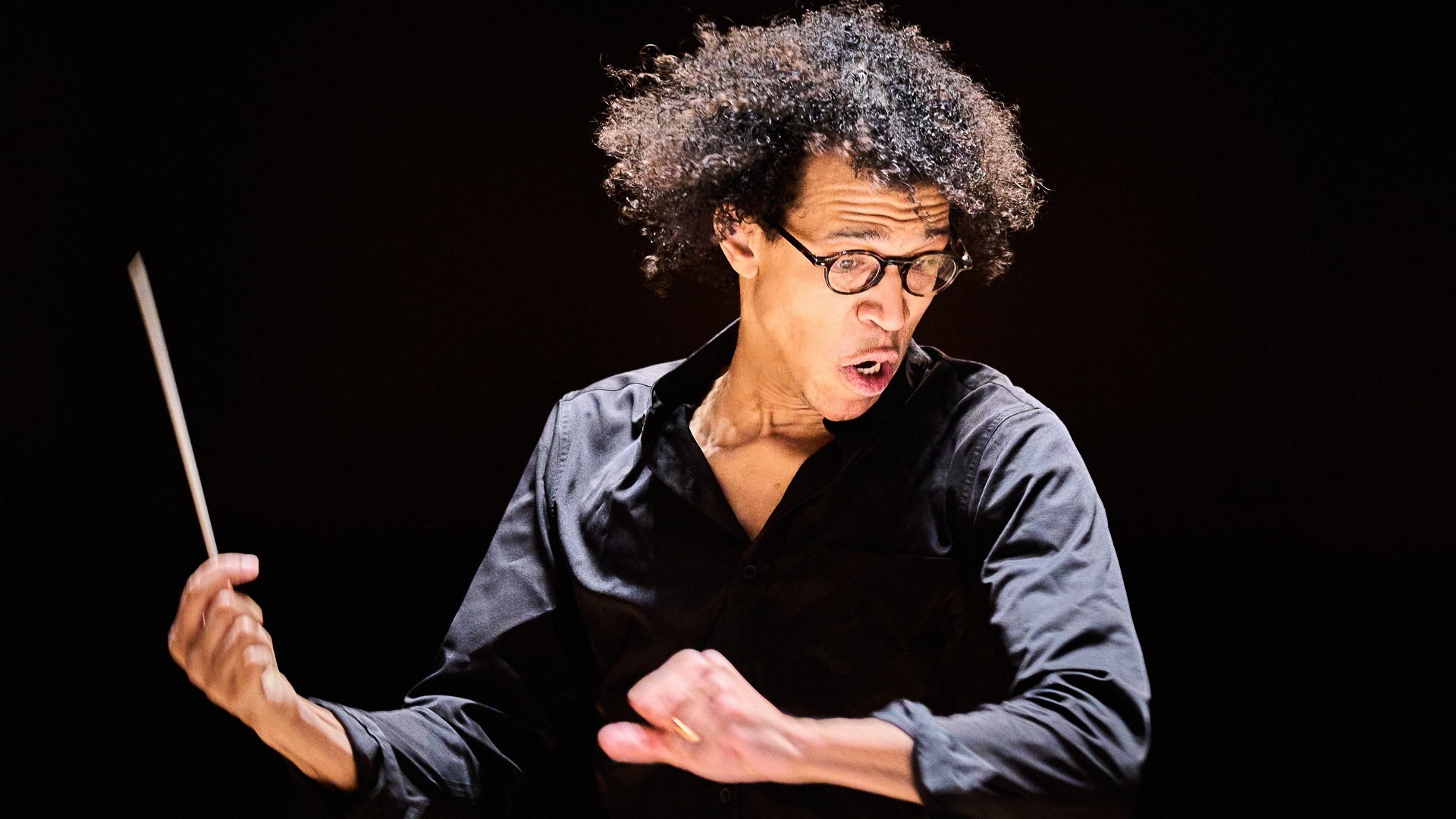
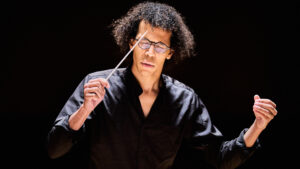
Main Photo: Jonathon Heyward (Photo ©Kaupo Kikkas/Courtesy Jonathon Heyward)