









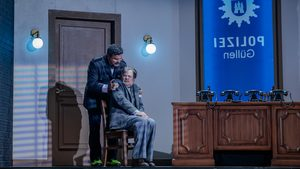
“The world is bad, but not without hope. It is only hopeless when you look at it from an ideal viewpoint.” For Jefferson Mays, who plays Anton Schill in the new Pasadena Playhouse production of Friedrich Dürrenmatt’s The Visit, finding that hope in what he calls a “bleak masterpiece” isn’t easy.
Neither, it turns out, is finding Schill. For an actor who has transformed himself into dozens of characters during the course of a single evening, Schill presents an entirely different challenge.
He is a man around whom events happen, a man whose journey takes him from confidence to fear and ultimately toward acceptance. Days before the production moved into technical rehearsals, Mays readily acknowledged that he was still trying to understand how to make that journey.
That uncertainty provides an intriguing way into both the character and a play written in the aftermath of World War II that Mays believes holds an uncomfortable mirror up to the world we inhabit now.
Q: Dürrenmatt once said, “The world is bad, but not without hope. It is only hopeless when you look at it from an ideal viewpoint.” Does that sound like the same man who wrote The Visit? Because I don’t think The Visit is a hopeful play. Or is it?
That is a question that we’ve all been struggling with, frankly. It is a poisonous little piece. I cannot think of anything more misanthropic. Even Titus Andronicus feels like a light boulevard comedy in comparison. Sometimes it is unremittingly bleak, and it makes so much sense that it was written at the end of the Second World War and certainly reflects that time.
Unfortunately, I think the time in which we inhabit now is an even starker or clearer reflection of the world of Dürrenmatt. He really holds the mirror up to nature then and especially now, unfortunately. But is there a glimmer of hope in it? Where’s the love, one might ask. There’s a longing for love. There’s a longing for redemption. There’s longing for reconciliation, but it does not happen. It is ultimately denied us, I think, in The Visit.
I’m really curious to see how the audience is going to react to it, spending their days in the bilious, dyspeptic news cycle to which we’re all subjected and then coming to the theater at night hoping to be taken out of themselves. Then they’ll be confronted with this masterpiece. But it is a bleak masterpiece, yes.
Let’s talk about Anton, the character you embody in this production. He begins the play as a very popular man, then he becomes prey, then I guess we could say an existential hero. What impact does that journey have on you as an actor as you prepare to do this night after night?
I’ve never done anything like it. It’s probably one of the most reactive or passive roles that I’ve ever encountered. I’m trying to give him a degree of agency, but I feel almost like a character in a medieval morality play. In many ways it feels very fable-like or even medieval. There’s something about us all inhabiting this Brothers Grimm forest where the children are neither happy nor good.
I’ve been having some difficulty inhabiting this character because, as you quite beautifully and succinctly put it, he goes from being a regular stand-up guy to being riddled with paranoia and becomes prey, as you say, and then sort of stoically, philosophically resigns himself to his fate. It’s a very odd journey, and I’m still struggling with it. I don’t know what it’s going to be ultimately.
I find myself delighting in the performances around me, but I don’t feel that sort of driving agency that I have felt in most of my other roles. So it’s good to expand and to be exposed to new things, but it’s not entirely comfortable. This play is certainly a poisonous world that is not comfortable to inhabit, at least from the inside. Maybe people watching it from the outside will have a different response entirely.
Parts of it do feel like tragedy, classical Greek tragedy, especially the last act, that trial scene, which is something out of Aeschylus. I’m kind of lost and at sea because we’re about to go into tech and all the technical elements will be introduced. I just don’t know where I am in the mix right now.
Does that kind of uncertainty represent the best possible challenge you could give yourself as an actor?
I think that’s the most positive way to look at it, yes. I’m trying to embrace it as such.
You’ve talked about how Schill is one of the most passive characters that you’ve played. I found an interview you did with The New York Times in 2003 where you talked about how important stillness was for you: “When you go to the people, I like people to be still so I can hear them.” What role has stillness played so far in your approach to Anton?
That’s really interesting. I guess I’m opening up my old bag of tricks, but I’m trying to make him as still and receptive as possible. In many ways, I think perhaps he is the conduit through which the audience will receive this play.
I find myself looking with honest fascination, often awe, at other people with whom I’m performing. I find myself being very still and watching the play happen around me. As I say, it’s not a terribly comfortable way to be, but it seems to make sense at this point, to be almost in this state of arrest.
The play is happening in and around Schill. If you were to go blazing with emotional guns, there would be no journey.
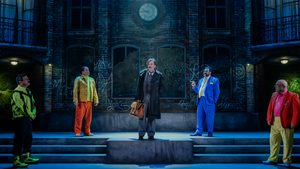
There are no pyrotechnics, and pyrotechnics are red meat to an actor, as you well know. You always want to sink your teeth into something, be it a satisfying, beautifully written aria, monologue, soliloquy. But those don’t exist. The lines are very terse, short, declarative.
I think it’s one of those plays that will have ideally a cumulative effect. It will become greater than the sum of its parts. And I am just one of these parts at the moment.
I remember an interview when you did A Gentleman’s Guide to Love and Murder where you talked about how much easier it was to play multiple characters than it was to be a single character. Where does this role land on that spectrum?
That’s a challenge because I’m just one single character, albeit a character that changes, strangely, from act to act. I think it is more difficult to inhabit one single character throughout the course of an evening because there’s no place to go but in and down and find more and more layers.
In Gentleman’s Guide to Love and Murder, and to some degree I Am My Own Wife, I played 37-odd characters in I Am My Own Wife and about nine, I think, in Gentleman’s Guide. There, you just sort of touch on them lightly. You work fast, deftly, like a caricaturist. You don’t really dwell in any of them. You want them to make an impact and for people to remember them and to serve whatever dramaturgical function. But it was more athleticism than artistry sometimes, I think.
In rereading The Visit, I feel like there are even more modern parallels today than there might have been in the mid-fifties. Do you think there are different parallels today, not just more, than there were when The Visit premiered?
I think Dürrenmatt was responding to a different world in some ways. He was Swiss. Switzerland had a very problematic role during World War II. They were selling arms to the Nazis. They were taking Jewish goods and money. They did all sorts of things to earn a mark, to earn a buck, and they were able to normalize their behavior.
That’s something I’ve been thinking a great deal about. It’s a miraculous human strength and it’s a human horror, our ability to normalize events just to simply get on. And the shifting of the Overton window, as they say, moving ever so slightly. I think that’s what the play is about too, how a society convinces itself, deludes itself, permits itself to do an unspeakable thing for the sake of worldly gain.
What is the theater’s responsibility in making it okay for audiences to look at themselves in the mirror that a play represents?
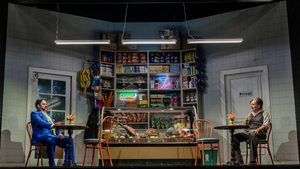
Shakespeare put it best, to hold the mirror up to nature. That’s what we do. I think that’s why theater has a responsibility to show us in all our chops and changes, at our most absurd and our most horrific and at our most wonderful, joyful and triumphant. The Visit doesn’t do the last thing by any means.
But somehow this play avoids being purely didactic. I don’t think it’s telling us a lesson, or it is, but in an engaging way. I’ve never been in a play like it. Parts of it are pure absurdism. Parts of it are German expressionism. Parts of it are hyper-realism. Parts of it are, as I said, sort of a medieval mystery play or morality play. It’s all of these styles packed together in this one event, and yet it does have its own strange cohesiveness and coherence and stylistic integrity.
Is the hope that at the end of this play the audience doesn’t do what Schill does, which is just accept his fate?
Yes. I think that’s a wonderful hope to cling to.
There’s also a very interesting play here in the Me Too era, isn’t there? This is a woman who suffered horrible insults and abuse at the hands of her town and is coming back seeking revenge.
I remember when Jane Alexander was talking about the role. She said, “I’m playing the most evil woman in the world,” and I just think that’s not true. That’s not true at all. In Melinda Page Hamilton’s performance, it’s through with such humanity and a deep sense of right.
Dürrenmatt also wrote, “Our inhuman world has become more humane, but how?” What responsibility does theater have in helping the world become more humane?
I think theater has a responsibility. I’m always afraid of preaching to the choir. Pasadena has a very diverse audience. I’m curious how the conservative Republican subscribers will respond to it. Will they see themselves? Will they feel a slap on the wrist?
Melinda said if people don’t hate it and walk out, maybe we’re not doing our job. I have to ponder that.
Come back Thursday for an interview with director Darko Tresnjak about “The Visit”
The Visit runs through October 4th at the Pasadena Playhouse.
All photos by Jeff Lorch.
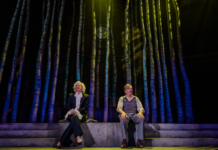
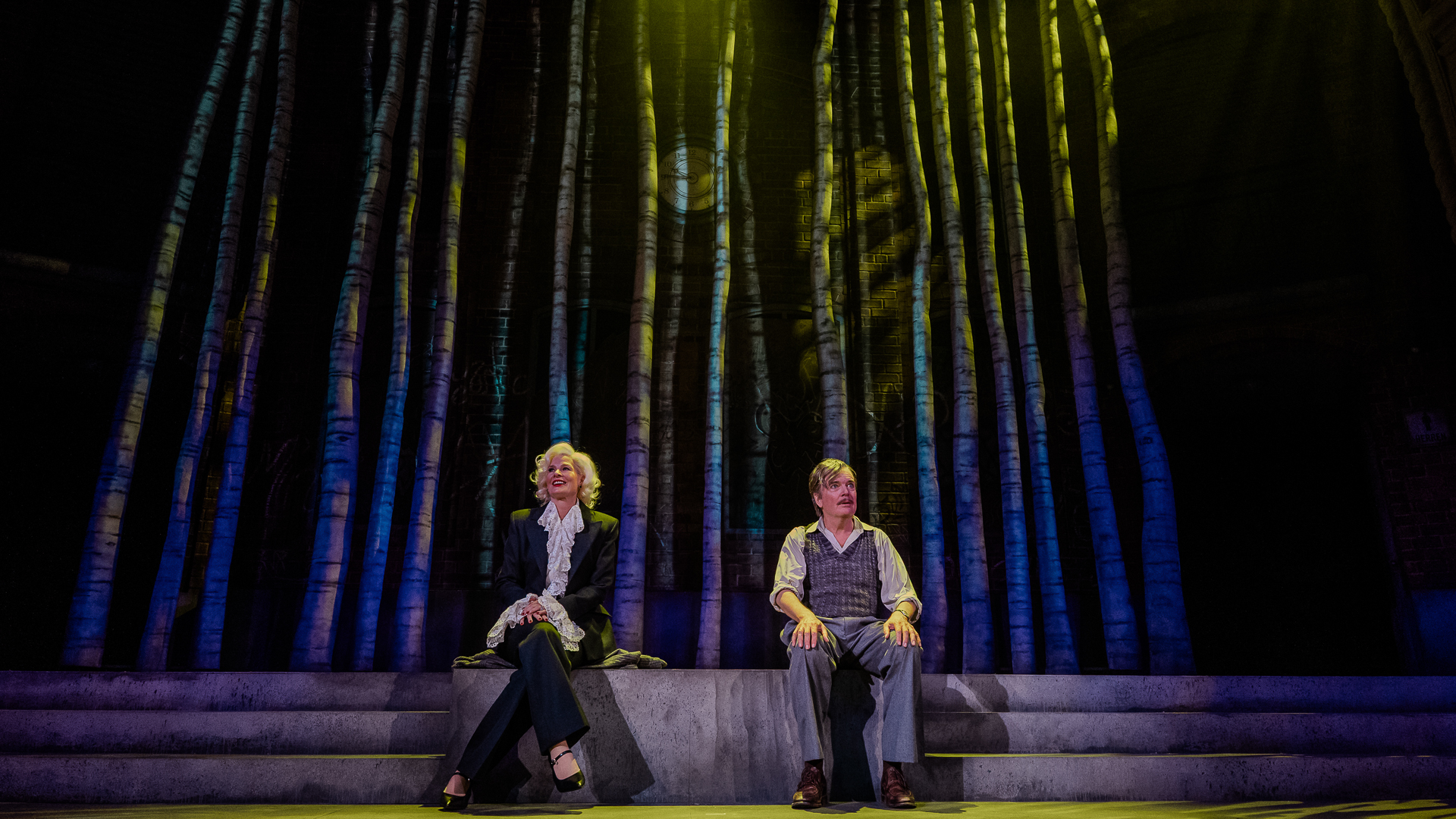
Main Photo: Melinda Hamilton and Jefferson Mays