






Composer Zach Redler found himself in unfamiliar territory when Opera Montana asked him to write the music for A River Runs Through It. He wasn’t a fisherman, and the metaphors of Norman Maclean’s story weren’t personal to him. What drew him into Maclean’s world was something more universal: family, prodigious talent and the painful realization that loving someone does not necessarily mean you can save them.
Opening Friday at Opera Montana, the new opera, with a libretto by Kelley Rourke and Matt Foss, presented Redler with a particular musical challenge. Maclean’s story is filled with tragedy, but it is fundamentally quiet, contemplative and steeped in memory. How do you add music to something whose power resides partly in its silences? For Redler, the answer has involved spaciousness, poetry and discovering that sometimes music breathes most deeply when it stops.
Q: In A River Runs Through It, Norman Maclean wrote, “To him, all good things, trout as well as eternal salvation, came by grace, and grace comes by art, and art does not come easy.” Do you share his philosophy? And if so, what’s the grace that was part of the creation of this opera?
That line almost exact is quoted in the opera, which is fun. There’s also something that comes to mind, “Art Isn’t Easy” from Sondheim, from Sunday in the Park with George. Those themes definitely resonate with me.
In terms of the grace, I think just being asked to write the music was some divine providence for me. This has been such a life changing experience. So if there was personal grace, then it was definitely when Opera Montana asked me to write the music.
Michael Sakir at National Sawdust said that you were the only composer Opera Montana wanted to do this. What made A River Runs Through It something you wanted to do?
I had not read the book. I still have not seen the movie, and that’s on purpose. When they asked me, I read it that evening. I knew the title, but I didn’t really know what it was about.
First of all, I love exploring family drama in theater. We all have families in some form or another, whether it’s blood or not, and there’s going to be stuff there. So mining out the family drama in the story kind of hooked me in, pun intended. But I’m not a fisher. I do not fish. I do not fly fish. So the metaphors were beautiful, but they weren’t personal.
Really what was drawing me in was prodigious talent in Paul. And with prodigious talent oftentimes comes struggle. Paul’s struggling with this, and on top of that you have Norman and really almost everyone in his life trying to save him. But there’s a big part of him that knows who he is and is resigned to that. It’s gut wrenching to watch someone crash and burn and you can’t do anything about it.
Then on a much more macro level, what was really exciting for me was the musical possibilities to paint the landscape of the river. These were my first times in Montana a couple years ago, and just the spaciousness, call it God, call it nature, call it whatever you want, there is something that hits you.
What is your philosophy in writing a piece that has such emotion in it, where you find the right balance between the music providing the emotion or leaving space for the singers to provide that emotion?
There needs to be the balance. What’s really beautiful about the collaborative team, me, Kelley and Matt, but also with this cast, is that there’s so much trust there in terms of finding what’s right for the piece. I have a score. A score is a bunch of ink and there are dynamics and all that stuff. But then when it starts to come alive, there needs to be that wiggle room.
In an ideal world, the way we’re trying to craft the piece is that it just tumbles forward, that there’s lots of forward momentum.
We wrote it in such a way that audiences will be in the piece and not step out of it to applaud.
There’s one moment where I think I wrote in the score, literally take ten seconds of silence. I love silence in theater. It’s uneasy. We’re uncomfortable with silence oftentimes. But that’s where we start to breathe together too. It’s not just in the pulsing of the music.
For people familiar with the story, is it important to have musical subtext that foreshadows what’s going to happen later? Is there a juxtaposition of what’s being sung versus what’s really going on?
I try to use certain themes to help with that. The first time Paul sings this line, the words are, “Sooner or later, even the big ones make a mistake.” It’s meant to be like they’re fishing. It’s this really lively number.
That comes back a lot in the orchestra. When Norman gets the phone call that Paul has been killed towards the end of the show, there’s the longest period of instrumental music in the show. It’s like 45 seconds, but it’s a fugue. And the subject of the fugue is that line. Whether or not the audience knows it, there’s a current that’s helping them along.
I reread the story in advance of this interview, and I was struck that even with the tragedy at its center, it is ultimately a quiet story. It’s a meditative, contemplative story, mostly about memory and grief. How do you add music to it without disrupting its inherent approach to storytelling?
There’s a danger of setting poetry, setting something like putting a hat on a hat. There is a danger in there. I think the spaciousness honors that meditative quality. And then the bigger moments are coming out of the grandeur of the environment that he’s describing.
Everything else, I would say, is grounded in the character. You can have this lively music and a lot of movement and some dense stuff without losing that meditative essence. It’s how do we balance all of those elements?
I watched the National Sawdust presentation, and the thing that really resonated with me is there was actual poetry in the libretto. Was poetry a guiding principle in the creation of A River Runs Through It?
I can’t speak for Kelley, but she’s an incredible writer and has spent the last three decades creating translations of canonical works. Those older works already are just tight poetry. There’s something to that.
In terms of the economy, Kelley is just an expert at it. And it is poetic. We had been batting around the idea, how do you open this kind of a show? Especially because we did not want a narrator. Kelley sketched out this idea of an opening that existed outside of time, where it’s a little bit more abstract. Clara, the mother, is singing, not necessarily in her character, but kind of in her character. And the opening lines are, “In the beginning were the waters and the waters teemed with life.”
That spoke to me. Obviously it’s biblical and it’s poetic. That really kick started the composition of the whole piece.
I like the idea of that opening because the story itself is timeless. Maclean’s writing is timeless. Taking it out of time at the beginning seems to create a work that could mirror the timelessness of what Maclean offered.
I think so. I hope so. It sits there only for a little bit, and then slowly the elements start to form out of the ether. You start to see the characters arise as themselves until finally the company sings that hook in the beginning and then we fade into the first scene.
We end in that same liminal space, but now having gone through that journey, the characters are themselves and Paul is able to reflect from the beyond. I think it’s a nice bookend.
In listening to the music performed at National Sawdust, I got a sense that it possesses qualities found in both opera and musicals. Is that part of your natural DNA or something you specifically wanted to bring to this work?
For better or worse, it’s who I am. I grew up with musicals. I love musicals. At the same time, I was classically trained and played in orchestras and wind ensembles.
There’s something about the immediacy of the language that is more typical in musical theater than it is in opera. I think we get a little bogged down sometimes in those distinctions. What seems to be emerging from a subset of American composers is this in between world. It can be crunchy when it needs to be crunchy. It can move through tonal centers when it’s flowing, and then it can sit down and have one, four, five chords when it needs to.
For me, I love sitting in that in between where you can draw them in, maybe give something challenging, but know that there is always a touch point or a release so that they can follow the music. And most importantly, leave room for the text to be heard and understood.
Since you’ve spent nearly two years immersed in the world of fly fishing, do you think there are parallels between the ritual of fly fishing and the practice of being a composer?
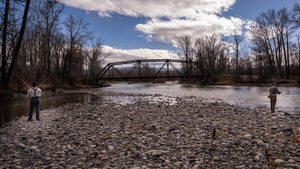
The thing that comes to mind is the metronomic aspect of fly fishing, or at least a certain style of fly fishing. That was very influential. They got me lessons. It was January, so we did fly fishing lessons in a gymnasium. I was taking notes on different tempi for different dramatic situations while fishing.
The flow state is probably another parallel. Speaking to a lot of people out here, many of them go out to fish with no expectation of catching fish at all. They go out to meditate on the river.
The rod is just a mechanism of meditation. It might as well be rosary beads.
When composing, I’ll joke about it and I’m terrified at the beginning of a new project. But then I know from experience that a couple months later I’ll wake up and there’s a piece. There’s something that happens where you lose track of time and space and you merge with whatever the piece is. Merging with the river is something that we hear and it’s written about. It’s an art.
Maclean ends his story by saying, “I am haunted by waters.” You’ve been living in this world. Is there anything that you’re haunted by, and did that inform the writing you did for this opera?
I’m certainly haunted by whatever piece I’m working on. It keeps me up. The themes, the music, the characters keep knocking at the door. There’s something eternal about it.
Going back to the composing of it, “haunted by waters” is not literally in the opera, but I think metaphorically there’s very little resolution until the end. These themes keep haunting and never ending.
Norman Maclean was quoted as saying that the thing he hoped he could do most through his teaching was to “help bring forth the best that’s within you.” How has writing A River Runs Through It brought out the best in you?
The piece has changed my life in many different ways. I think the best parts of me that it’s brought out is a rebalancing into the gray. I spent a lot of my life in black and white thinking. It wasn’t just this piece. It was also years of therapy and meditation and all that stuff.
Coming out here, reconnecting with people that are right at the food source, it cracked open this grayness in me that has permeated to different places. And I think that gray, that ability to listen and evolve and listen to yourself, started to crack open that in me.
A River Runs Through It will be performed at Opera Montana September 18th – 20th and 24th and 27th. It will also be performed by the Missoula Symphony Orchestra October 3rd and 4th.
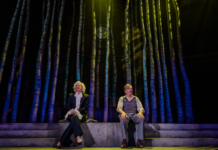
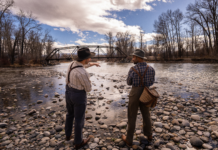
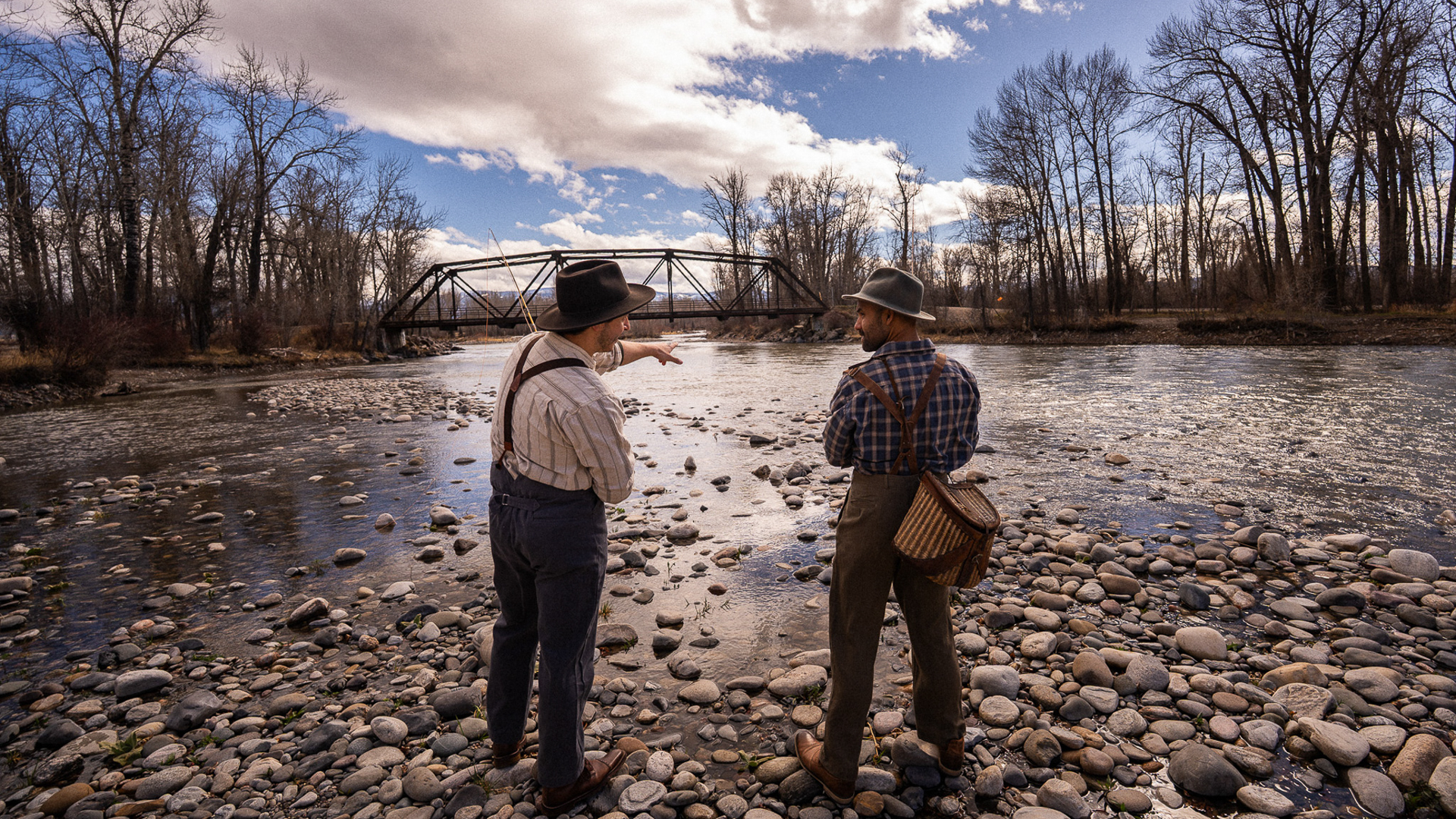
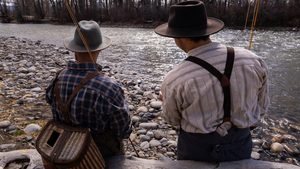
Main Photo: Michael Kuhn and Schyler Vargas for A River Runs Through It (Photo by Claire Kleese/Courtesy Opera Montana)