






Composer Jeremy Beck found the inspiration for his Four Dorothy Parker Songs in the wit, rhythms and unexpected turns of Parker’s poetry. The songs receive their world premiere September 27 as part of New York Festival of Song’s A Perfect Rose.
“I hate writing, I love having written.”
Dorothy Parker’s famously tart assessment of the creative process seems an appropriate way into Beck’s encounter with a writer he knew more by reputation and her celebrated bon mots than through her poetry. A chance discovery of a collection of Parker’s work changed that. As he read, certain poems began suggesting rhythms, melodies and musical possibilities. What started with reading Parker became an exploration of how music might illuminate her humor, her cynicism and the carefully constructed turns that make her writing unmistakably her own.
Q: Before we talk about the songs themselves, I want to ask you about something Dorothy Parker famously said: “I hate writing, I love having written.” On the cusp of the world premiere of your four songs, do you agree with her?
I understand where she’s coming from. There have certainly been times in my own experience where I’ve been glad to be finished with a piece of music, either I had a deadline to meet or it was a particular struggle. But at the same time, I’ve also had the experience where composing is just an absolute joy and to live in the world of a particular piece, I almost hesitate to finish because I know that piece will move on in some ways independently from me. And it also means I’ll have to move on to the next, and I may not know what the next is.
How did this particular collection of songs come to you? Was Dorothy Parker someone you had always appreciated?
It was not a commission. Dorothy Parker, famous figure, very well known. But if I’m honest, I really only knew some of her clever bon mots. I didn’t really know her actual writing, her poetry, her stories, her reviews.
Perhaps two or three years ago, I went to a library sale and found a complete edition of her work. I took that as an opportunity to really get to know her work. As I was going through it, certain pieces started to click with me and suggest themselves as, “Maybe this would make a nice setting. Maybe this would be something fun to work with.” The first couple of songs grew out of that feeling. Then this past winter I was at Copland House with a residency, and I finished the other two songs up there.
What are you looking for in someone’s poetry that sparks the idea that this could be something you could set to music?
It may be that the nature of the text, the nature of the story, perhaps a turn of phrase resonates with me personally in some way. That doesn’t always mean that selection will work in a setting, but it does bring me to consider taking that on.
Sometimes it’s really just the rhythm of the words. What I will do upon reading something that suggests some interesting rhythms is speak the poem aloud and see how it fits in my voice. Sometimes even with those rhythmic phrases, certain melodic ideas may emerge as part of that. Then the train is off and running and I’m ready to work.
Three of the four pieces you selected were part of Parker’s first collection, Enough Rope. Was there something in her earlier work that you found particularly resonant or inspirational?
Part of it, to be frank, is that it had moved into the public domain. But it may just have been the particular poems in that collection that happened to click with me or drew my attention in some way.
One Perfect Rose gives its name to the concert:
Why is it no one ever sent me yet
One perfect limousine, do you suppose?
Ah no, it’s always just my luck to get
One perfect rose.
Parker seems to be making fun of what was then a traditional way of courting someone. What was it about One Perfect Rose that appealed to you?
I liked very much her sense of humor in these. Sometimes I feel like song recitals, song compositions could use a little more humor. That certainly drew me into some of these settings.
That was part of the interest in One Perfect Rose. She sets this up as this traditional, almost a love song, and then it takes those little turns where she makes fun of what she had just been writing about. That introduces musical possibilities and also little dramatic ways for the soprano to play with the piece.
It felt, as I was writing it, that this would be something a singer might really enjoy, taking on that little sort of game playing.
Parker performs another kind of reversal in Love Song:
My own dear love, he is strong and bold
And he cares not what comes after.
His words ring sweet as a chime of gold,
And his eyes are lit with laughter.
He is jubilant as a flag unfurled―
Oh, a girl, she’d not forget him.
My own dear love, he is all my world―
And I wish I’d never met him.
Each stanza is set up as happy, bouncy and seemingly simple, followed by a deeply cynical final line. How important is it not to musically give away the joke before Parker gets there?
It’s a challenge, but what I enjoyed about that process was trying to find the musical language that would support and underscore what Parker was doing in setting up that twist at the end of each stanza. As we continue through the piece, there is a build in that twist. There’s always some kind of change in the musical texture to meet that twist and help project it for an audience.
When one is reading a poem, it’s on the page and one can move slowly and go back and forth. But when the poem is set and being sung in real time, the music can really do a lot to help the audience hear that text as it unfolds, since the listener doesn’t have the opportunity to go back and double check what had been said.
Is it important for you as a composer not to feel that you have to be a slave to the rhythm of the text?
I don’t feel necessarily compelled in all circumstances to match the rhythm of the text. But for me, particularly in the context of song, I want the audience to understand the language, to understand the text in real time. To the extent that what I can do creatively can support that ability for comprehension, that’s an important goal of mine.
I noticed in the songs I heard that you rarely repeat words Parker didn’t repeat herself. How true should a composer remain to the original text?
I think that should be an important consideration, a critical consideration. But there is an opportunity sometimes in repetition to underscore a certain point, to elevate a certain part of the poem or perhaps the emotion underlying a particular part of a poem.
With the addition of music and the unfolding of the piece in real time, that kind of careful repetition, I think, does not take away from the poem. At least in my view, and I hope Ms. Parker would agree, it helps to underscore what has been put into the piece.
You’ve written that you compose from your heart and your head, giving neither priority in your artistic work. How does that approach apply when you’re getting into the heart and mind of someone like Dorothy Parker?
It’s really taking the language and her choices in the language. Some of that language from the twenties is going to be unfamiliar. Part of that, from her perspective, I believe was intentional, to harken back in Love Song or One Perfect Rose to some of the over-romanticization of some of these actions.
I take those not just at face value, but go into, “What is Parker’s intention here? What is it that she is trying to communicate? And how can what I do add to the support of her intention and not take away or diffuse from what motivated her to write the poem in the first place?”
I wonder what Dorothy Parker might think of having her poetry set to music. In 1956 she told The Paris Review, “You mean my verses. I cannot say poems. My verses are no damn good. Let’s face it, honey, my verse is terribly dated.” Seventy years later, what do you think of her assessment of her own work?
From what I understand and have read about Parker’s life, it was not always a happy one. I think she could often be self-deprecating about herself, her work. As much as she might have little sarcasms to share about other people, I think those were equally self-directed.
If she were here, I’d like to sit down, get a cup of coffee or a drink and try to convince her otherwise, that there is great value in what she’s chosen to share and that I hope, in my setting, I can bring some further little attention to the work that she’s created.
You are also a teacher in addition to being a composer, but I think the best teachers continue to learn throughout their lives. What did you learn from Dorothy Parker’s writing?
I’ve always enjoyed working with text. I’ve written much instrumental music, but I’ve also enjoyed working with text really my whole compositional life and have not always found texts that I felt I could work with. I certainly never tried to force myself onto anyone’s writing with my notes that I thought would not make a good fit.
My interest in reading the Parker collection was simply to learn more about her writing and to learn about her. The fact that I found that kind of resonance for various reasons with certain pieces communicated to me that there are still possibilities out there for setting for which I will have a natural affection. I enjoyed that process.
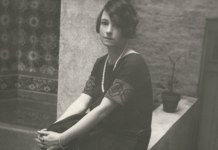
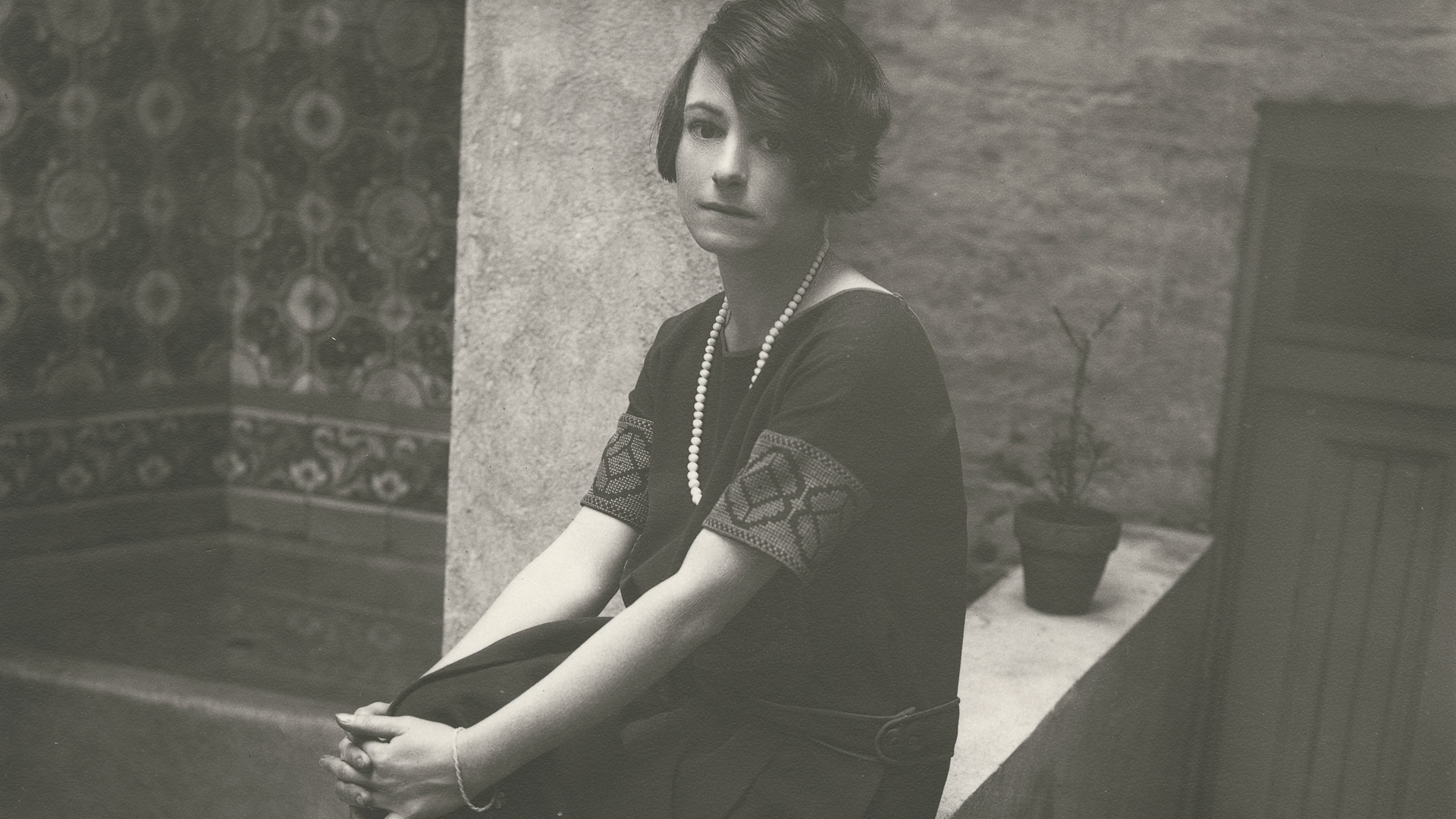
Main Photo: Dorothy Parker (Courtesy New York Public Library Archives)