








Darko Tresnjak has waited roughly forty years to direct Friedrich Dürrenmatt’s The Visit professionally. Now, with a new production at Pasadena Playhouse, the director is finally returning to the play he first encountered as a teenager and directed six months after reading it again as a student at Swarthmore College.
For decades the project remained something Tresnjak wanted to do but increasingly suspected might never happen. The scale of the play made it difficult to produce.
Audiences might know Dürrenmatt’s name without knowing The Visit. Eventually Tresnjak stopped expecting the opportunity. Then Pasadena Playhouse Artistic Director Danny Feldman revealed that he loved the play too.
The passage of forty years has changed both the director and the world in which he is directing it. Tresnjak believes The Visit, written in the aftermath of World War II, speaks with particular urgency to the present. But rather than explain what audiences should see in it, he would prefer to put the play onstage and allow them to decide for themselves.
Q: Jefferson Mays told me that The Visit has been deeply personal for you since you were at Swarthmore in the mid-eighties. Why?
I read it as a teenager and then I read it in college, and I directed it six months later. It gave a shape to my life. I decided to become a director because of this play.
I think I found my voice. I was born in Europe 20 years after World War II. When you’re born in those societies, there are things that are unspoken. You have to move on, but there’s this air, this shroud of mystery about what happened. What happened to women? What happened to women’s bodies?
I don’t think there’s a better time to stage The Visit in the United States right now. I’m glad it took 40 years because I think the play speaks to this moment.
What is it about this moment that makes the play speak to you so strongly?
I’m not going to explain politics to the press. I can stage the play and then the audience can draw conclusions. That’s the wonderful thing about being a director. Sometimes a story that you put on stage can express exactly what you’re feeling about the current moment in American politics or global politics.
The original doesn’t specify the denominations after billion or million. It was clearly written to be done in all ages.
How has your relationship with The Visit evolved over those 40 years?
I always dreamed of directing it. Then when you become an artistic director, there’s always a reason not to do it because it’s demanding, it’s big, it’s a courageous swing. Theater people love it, but audiences don’t necessarily know it. It’s a hard play to produce.
Danny Feldman loves the play as much as I do. That’s why we’re doing it. At some point I stopped expecting that it would happen because you don’t want to be hurt. I’ve had many blessings in my career. I’m not going to complain. But it was a wonderful surprise that this is happening.
You’ve described The Visit as perhaps your favorite play outside of Shakespeare. What is it about its construction that has kept you fascinated with it?
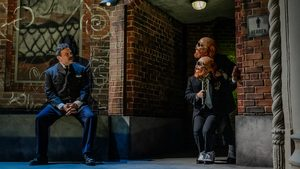
I’ve directed two productions of Titus Andronicus. The Visit is emotionally violent. It works as a stage thriller. It works as a feminist revenge comedy, but it’s not a fantasy. It’s a cautionary tale about democracy. It’s an inversion of a medieval mystery play. It’s an allegory about the Marshall Plan.
You can just enjoy it as entertainment, or you might see something of your own world in it. It’s remarkably constructed. It’s swift.
Does a director have to decide which one of those plays he is directing?
I don’t think a production should be a thesis paper. You have to let it be all those things.
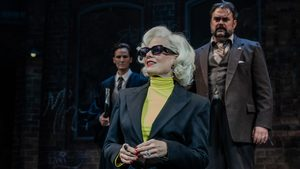
Charlotte Devaux, our costume designer, did a lot of research. Claire often looks insane in productions. You look at the clothes and think, is this somebody who is trying to look younger? Claire may not be nice, but she is the only character in the play who doesn’t tell a single lie. She’s utterly forthright. She’s not a hypocrite.
In the wake of Me Too, the character has evolved for an audience. I have my own take on her.
The town is called Güllen, which translates roughly as manure. Yet so much of your work has a strong visual sense of beauty. What role does beauty play in creating this particular world?
I don’t perceive my work as always being elegant. Alexander Dodge, our set designer, grew up in Switzerland near where Dürrenmatt grew up. He went back and visited Dürrenmatt’s hometown. The set is informed by that firsthand experience. There is a certain grand ugliness to it, and then it morphs.
You’ve directed opera as well as theater. Does The Visit feel operatic to you?
There have been opera and musical adaptations of it. It has epic demands, and it has its own piece of music.
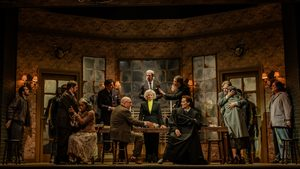
This play is very hard. I’ve directed 14 of the 17 actors before, so there is great trust in the room. One of the things I learned from opera is back-phrasing. American actors like to back-phrase. In French opera or a French musical, everything is dotted rhythms.
The subtext in this play is very complicated, but the surface lines have to be energized. It’s like Shakespeare. You have to attack the lines almost in a dotted rhythm. It’s very hard. You have to do it again and again and again.
We’re heading into seven and a half days of tech, and it needs to get on the beat of the play.
How important will the audience be in determining whether you’ve found that beat?
When I’m in previews, half of me is focused on the stage and the other half is absorbing the audience. With a less-known play like this, the cast and director learn from the audience.
I don’t believe in surveys for artists. Marketers can use surveys. An artist should sit in the room and feel the audience, smell the audience. I’m curious where the sinister humor is. I’m curious where the laughs are. When we did Amadeus, there were laughs where I never expected them.
Does live theater take on a different importance now, particularly as artificial intelligence becomes more present in our lives?
Congregating with live actors is a completely different experience. I have more faith in theater now and the need for theater in the face of AI because nothing can replace it yet.
Dürrenmatt wrote, “Our inhuman world has become more humane, but how?” What role can theater play in helping make an inhuman world more humane?
Theater is how I experience life. Rehearsal heals me. Ballet heals me. Books heal me. Movies heal me. If the work I do provides that for other people, that’s wonderful.
My favorite thing about my own work is if you can seduce the audience, then you can punch them around. First seduce them, then slap them around. Bring them in, and then take them somewhere that maybe changes their worldview or exposes them to something they didn’t think they wanted to see.
To see my interview with Jefferson Mays, please go HERE.
The Visit continues at Pasadena Playhouse through October 4th.
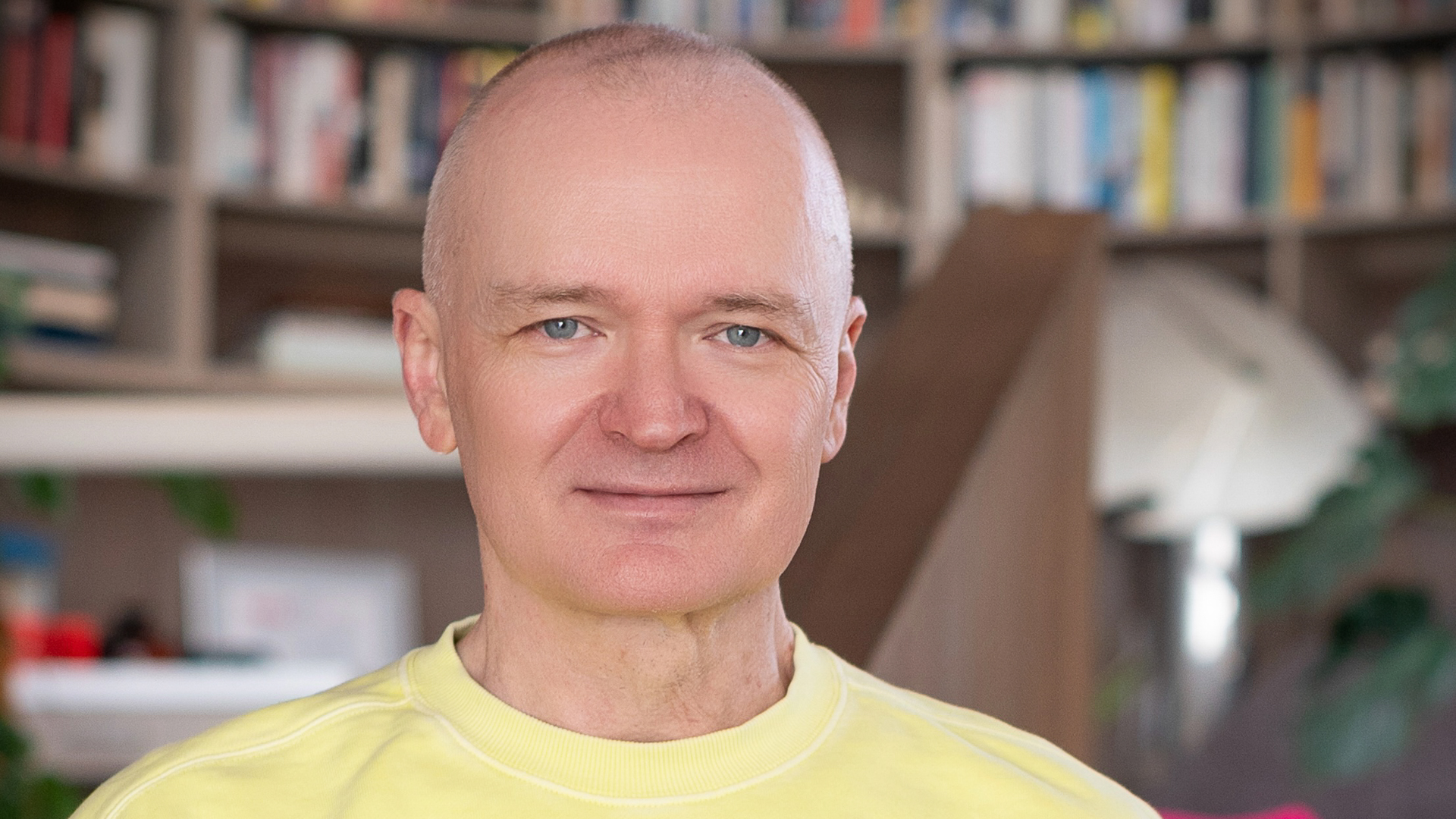
Main Photo: Director Darko Tresnjak (Courtesy Pasadena Playhouse)