







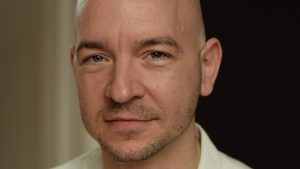
“I was blown away by the creativity and spectacle,” Scot Kokandy says of seeing Starlight Express at the Chicago Theatre when he was ten years old. “It takes you for that two, three hours. It takes you out of reality.”
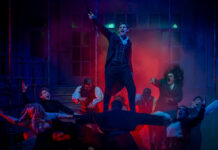
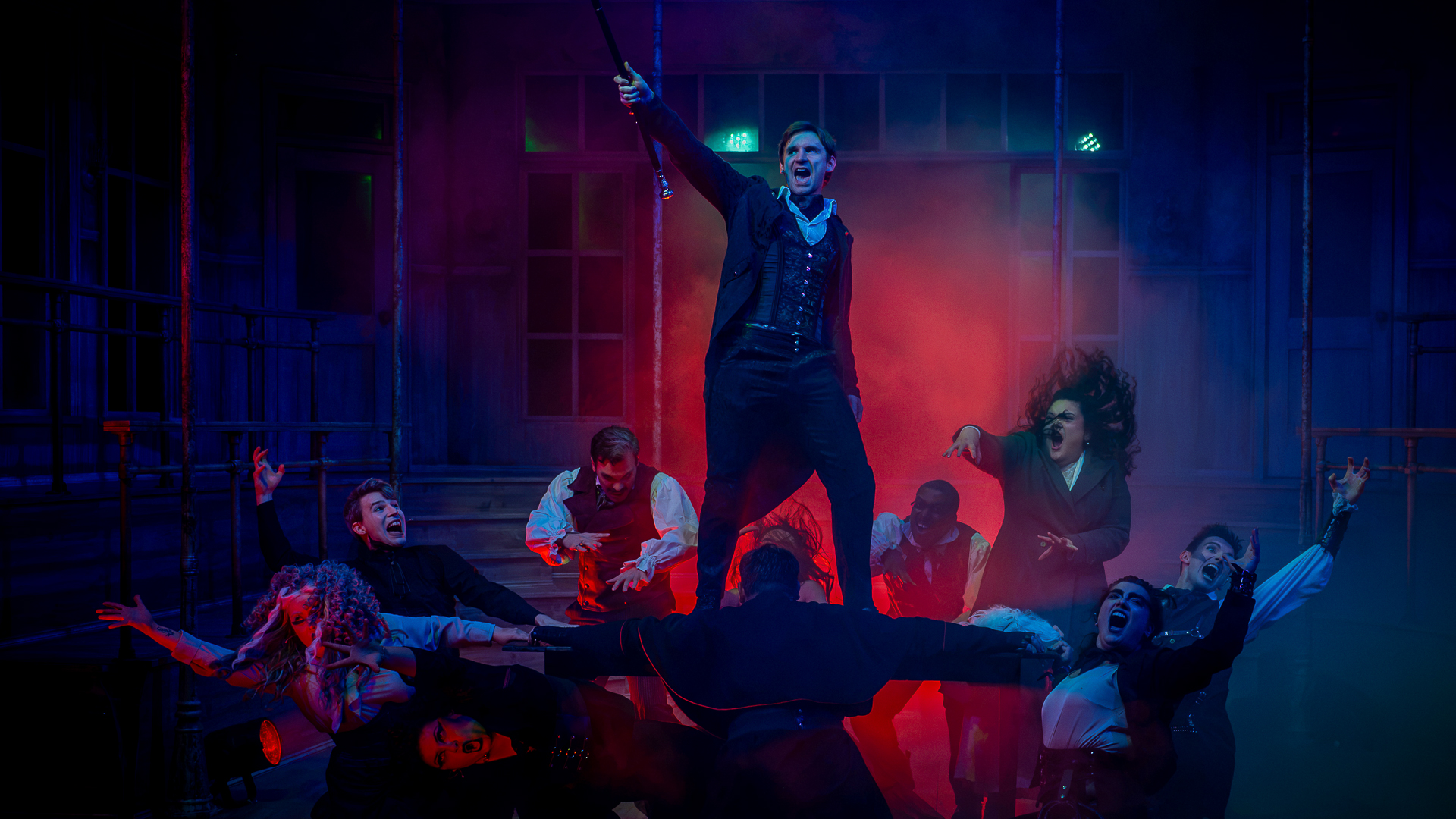
Thirty-six years later, Kokandy finds himself producing musical theater just four blocks from where that fascination began. Kokandy Productions currently has Sunday in the Park with George at the Chopin Theatre and Jekyll & Hyde at Broadway Playhouse, presented with Broadway in Chicago.
A Clockwork Orange: A Play with Music, the company’s 27th production, begins performances at the Chopin Theatre on November 5th.
The journey from Starlight Express to Jekyll & Hyde, the first musical Kokandy saw on Broadway and one his company now produces, reveals something about the producer he became. The spectacle that captivated a ten-year-old remains part of the equation. So does something more fundamental: what happens between a musical and the people watching it.
Q: What was the moment when you first thought that theater, particularly with an emphasis on musical theater, would be what you wanted to do with your life?
I’ve always enjoyed theater. In grade school, high school, I acted. I feel fortunate that I had family that exposed me to the theater at a young age.
In 2010, I was on the Jeff Committee for about two years. What that did is it opened my eyes to a segment of theater that I didn’t know prior. I would often go to the big shows, the touring shows, the downtown Loop shows. I didn’t really realize that you could put on a show in a 25-seat theater without a bathroom. All you need is a space and some actors. It exposed me to the idea of, oh, well, you don’t need a huge budget and 1,500 seats.
One of my mottos is carpe diem, live each day as if it were your last. I have it tattooed on my arm. So I thought, well, let’s try to put on a show. I grabbed folks that I had worked with before and did it. And then here we are 15, 16 years later.
Why musicals? I just like musicals better than plays. I also think there are fewer of those options. If you look at what’s playing in Chicago, you’re going to see a lot more plays than musicals. So it was my interest in musicals, but also somewhat of a business decision to try not to compete with all of the plays.
Since some of the early shows you saw were written by Andrew Lloyd Webber, I want to ask you about something he’s quoted as having said: “What strikes me is that there’s a very fine line between success and failure. Just one ingredient can make the difference.” What do you think that one ingredient has been for Kokandy Productions?
I think the thing that we’ve done is selecting musicals where there is a story to be told that we feel an audience is going to relate or connect with.
When Derek Van Barham, the producing artistic director, and I are looking at shows, the questions we ask ourselves are: Why this show? Why now? We want to make sure that the shows we select have an entry point.
Especially after COVID, what we found is people were looking for an entry point. Either it was known, it was a movie, it was a popular musical, it was a musical that didn’t do well on Broadway. We have a reputation of actually making it work in the basement of the Chopin or a more intimate setting.
It starts with the show and then the ingredient of building the humans. I feel fortunate and blessed that these humans have crossed our paths because that’s really what brings a show to life.
You talked about an entry point for the audience. An entry point for you was when you were ten years old and saw Starlight Express. What do you remember most about seeing that performance?
It was a family outing. It was my parents and two or three aunts and uncles. We had orchestra tickets and I was blown away by the creativity and spectacle of the racetrack.
I remember the spectacle and just the experience of being somewhat magical. It takes you for that two, three hours. It takes you out of reality. And I still feel that’s a great thing that theater does. It can transport you to a different time, a different place, something you may be familiar with or may not be familiar with.
A ten-year-old doesn’t have a lot of autonomy at that age. What did you do with that newfound excitement?
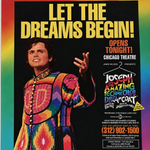
I wanted the soundtrack. Every time a show came to Chicago, I would ask my parents to go. In high school, my friend and I drove ourselves to see Joseph and the Amazing Technicolor Dreamcoat with Donny Osmond at the Chicago Theatre probably three or four times. We would sing the soundtrack and go to the show.
Do you recognize something from that early enthusiasm, that early passion that started building within you, that still shows up in your taste today?
At that time I was really transported. I was taken to a different place. It left an impression. So when we’re looking at answering that question of what show and why now, Derek and I think about that very often. What is it going to be from an audience perspective?
When I’m watching a preview and giving notes, one could say it’s with a producer hat on. But what I’ll say is it’s often from the audience hat. What is going to be the experience of the audience? Why else are we doing a show? What is that relationship between what’s being presented and the audience? That’s a very important thing for me.
Let’s go back in time again to July 24th, 1998, because that is, I believe, when you saw Jekyll & Hyde as your first Broadway musical. What was that night like for you?
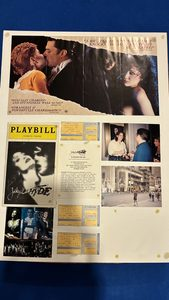
It was my first trip to New York. It was my parents and my sister, an aunt and uncle and my grandmother. I’m 100 percent confident that of the family I was the one that picked what shows we were going to see.
I remember going to the theater and that was my first time in a New York theater. I said, “Oh wow, these are kind of small and tight theaters.” They had syringe pens on the seats that looked like a syringe, but it was a pen that said Jekyll & Hyde on it with red fluid. I think I have it somewhere.
We were in the orchestra, super close. I was blown away by the experience. I stayed at the stage door to get my Playbill autographed. From that point on for years, it was a musical that I would often just listen to. I loved the music. Frank Wildhorn knows how to write a tune. There was something about the show, but really about the music, that just stuck with me.
When we were thinking about what show might work upstairs at the Chopin, I’ve always had that show in conversation. We thought, well, that might work up there. We’re going to go bigger. And we sure did, with the biggest set we’ve ever built, the biggest orchestra.
We said, “Well, that’s it. We’re going for it.” If this is the show that kills us, hopefully we’ll have fun doing it.
Obviously you want to be commercially successful. It doesn’t hurt to be critically successful as well, but how important would it be for you personally to inspire somebody seeing their first show at a Kokandy production and going down the same journey you’ve had with a passion for musical theater?
I never thought about that. I think that would be great. My high school theater department, I invite them to all of the shows. They were there last week with a group of about 20. They took a little bus and came to see Sunday in the Park with George.
Not everyone is exposed to it. I was fortunate that my family exposed me to that. Hopefully it opens the mind and eyes: “Oh my gosh, who did the lights?” or “Oh my gosh, this sounds great.” Or just sparking, “Oh, I want to put on a show one day.” Hopefully that’s happened.
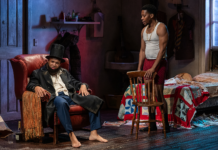
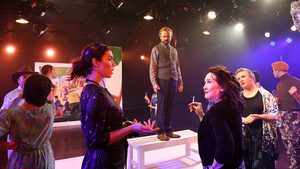
Sunday in the Park with George is the fourth Sondheim musical that Kokandy has done. Sondheim said, “The more restrictions you have, the easier anything is to write.” Does that axiom also apply to producing?
I can relate to it. Even the constraints of the studio in the Chopin. If you have a restriction or a constraint, what are you going to do with it?
Audiences have become very interested when we announce that we’re doing a show in the studio theater at the Chopin in what that configuration is going to be because it’s pretty much every time been different. When we went up to the main stage, inherently the possibilities became more, which could translate to being more difficult with more options.
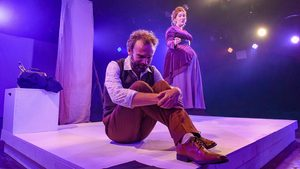
I love the idea that Seurat is trapped by his own work. Your production of Sunday in the Park with George, I don’t think if you had a larger space, would necessarily have happened that way.
Exactly. I think part of the reason we have a loyal audience base is the experience of seeing any show with 100 people and 12 or 14 actors. It’s very different than seeing a show proscenium with 1,200 seats or 800 seats.
There’s something to be said about that audience-cast exchange when you’re that close and intimate.
I think audiences that have experienced that want to experience it again.
With A Clockwork Orange, this will be Kokandy’s 27th production. What do you know now that you wish you knew when you first started? And do you think there’s anything you lost from those early days that could benefit you today?
Every show, and still every show, we learn so much. The thing that we learned maybe midway through our history is to do longer runs. When we did The Great American Trailer Park Musical in 2012, I think it was 18 shows. Now we do a minimum of 44 shows. You have to spend the same dollars to get to night one if you’re going to do two shows or 300 shows.
Theater people are an amazing set of humans. I have a business background and people go to the theater and say, “Oh my God, this is a great show.” This is not a knock on them, but they really have no sense of how it all came together, especially in a storefront theater with limited resources. I think a lot of people would be blown away by the number of people and the amount of work that’s done to get a show ready for the first audience.
In 2012, you got to realize your big dream by producing The Great American Trailer Park Musical. What are the big dreams you have now moving forward?
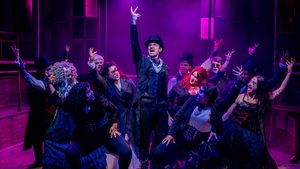
One that wasn’t necessarily even on my radar, but should have been, was partnering with Broadway in Chicago. That has been an amazing highlight personally and professionally.
I hope it’s not the first and only time. Maybe every year or so, present downtown at a larger space some of our musicals. Someone said, “Oh, you should take Jekyll & Hyde Off-Broadway.” Perhaps. Maybe. I don’t know the economics of that.
I never dreamed that Kokandy Productions would be presenting a show on Michigan Avenue in the heart of Chicago. It’s surreal. The first day of load-in, I just went outside and got emotional. The other day I was walking by and it’s like, wow, this is pretty darn cool.
Derek and I always think we have to control what we can control, and that’s picking shows, bringing the best talent, actors, creative team, and doing the best we can. What a critic says, what an audience reacts is going to be what it is. We just try to control what we can control.
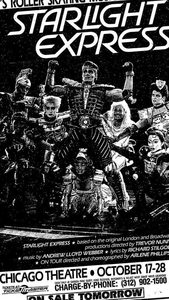
I’m going to conclude by asking you about the toughest critic that you have to face, which would be yourself. When you think about that ten-year-old boy sitting in the orchestra section at the Chicago Theatre seeing Starlight Express, what do you think would surprise him most about where your love of theater has taken you so far?
I think what would surprise him most is that 36 years later he produced a show four blocks down the road. That same guy that was sitting there wanted to do it and was able to do it. Probably a ten-year-old would have been like, “What are you talking about?”
So, we did it. We did it.
Jekyll & Hyde continues at the Broadway Playhouse Theatre through November 8th.
Sunday in the Park with George continues at the Chopin Theatre through November 29th.
A Clockwork Orange begins November 5th at the Chopin Theatre and runs through January 10, 2027.
Main Photo: David Moreland and the cast of Jekyll & Hyde (Photo ©Amy Boyle Photography/Courtesy Broadway in Chicago)