






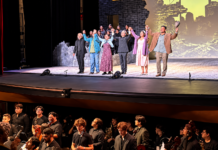






For more than half a century, Paul Williams’ songs have woven themselves into American culture with startling ease — melodies that slipped into our collective memory long before many listeners even knew his name. From The Rainbow Connection to Evergreen, from Bugsy Malone to the Carpenters’ biggest hits, his work is so ubiquitous that it’s easy to forget the artist behind it. But two people who have certainly not forgotten — and who are determined to make audiences remember — are Christian Borle and Skye Mattox.
From December 6–8, the two-time Tony-winning Borle (Peter and the Starcatcher, Something Rotten!) and acclaimed performer-choreographer Mattox bring The Lovers, The Dreams and Me: The Songs of Paul Williams to the 92nd Street Y’s iconic Lyrics & Lyricists series. What began as a shared fascination during the pandemic has evolved into a deeply personal, lovingly curated tribute that includes both Williams’ classics and unexpected corners of his career — with Williams himself woven into the evening.
In a conversation that stretched from vinyl listening rituals to artistic partnership, recovery, Muppets, movement, and the strange serendipities that have accompanied this project from the beginning, Borle and Mattox talk about their creative journey, their first meeting with Williams, and why his music — and presence — still feels like a gift.
What follows are excerpts from our conversation that have been edited for length and clarity. To see the full interview, please go to Cultural Attaché’s YouTube channel.
Q: Because we live in an era where people don’t necessarily know people who had major careers that were more than ten years ago, who is Paul Williams?
Christian Borle: That very question was one of the reasons that we wanted to put this show together because we I discovered Paul Williams in 1999 through his movie Phantom of the Paradise, directed by Brian De Palma. And it’s this crazy rock musical. And I fell instantly in love and did a deep dive on Paul Williams and realized that he wrote just about every song that you recognize from the last forty to fifty years. And then during the shutdown, Skye and I were living together. She moved in two weeks before the shutdown.
Q: Good timing on your part, Skye.
CB: I introduced her to Phantom of the Paradise and then we went down. He was in a way like our shutdown balm. So then she listened to Bugsy Malone.

Skye Mattox: And that became kind of my Phantom of the Paradise. I became instantly obsessed. I mean, I knew of him, but I didn’t know the person behind the music. My entry point into Paul Williams was through A Christmas Carol growing up as a child of the 90s. So I knew him, knew all the words to his songs. And that was a formative childhood movie for me, I think. And so I knew him, and then that was kind of our touch point. We were watching it for Christmas one year, one of our first Christmases together. And he goes, Oh, that’s Paul Williams’s music.
CB: And so it began.
SM: And there we went. And then I found the Bugsy Malone soundtrack and it was done. It was over. I was like, I’m obsessed with this person who is this?
Q: And then I assume there were these moments when you go, Oh, he wrote that and he wrote that and he wrote that… Were there any songs you later discovered were his, and you’d been hearing them your whole life?
CB: Well, there was one point in the last couple of years, everything around Paul has this kind of serendipity. We’ve been working on this for a year now, but it’s really accelerated in the last month. And within the last month, all of these coincidences have been happening around Paul Williams. But one happened a couple of years ago. We were at her grammy’s house looking through records and looking through old sheet music, and on top of the stack was the sheet music for Rainy Days and Mondays. Which was not a song that I was overly familiar with. And so we had to put that in the show, obviously. For grammy and for Paul.
Q: So how far did you go into the Paul Williams catalog before the idea of a show began?
SM: It kind of occurred to us pretty early on that we wanted to do something with him. And that was a great thing to have during the pandemic of just this dream of like what if we could work with him? What would we do? What would we want to approach him about? And then it just so happened that he decided to take a meeting with us and we just threw tons and tons of ideas at him. And this was the one that seemed the the closest to actually coming to fruition. And a great way to just sort of get to know each other and it’s been a crazy ride because we’ve just been able to run wild with this material, this body of material that inspires us to no end. So we’ve just we’re spoiled for life.
CB: There’s something too about Paul. We got a record player and have been buying vinyl and so we got as many Paul Williams records as we can find and started more of our education that way. And there’s something about his songs that they hit you immediately. He is tapping into something that is not intellectual and it hits you in a very deep place in your soul. The series that we’re doing this for is called Lyrics and Lyricists. And so there’s a real emphasis on listening to the words and trying to tap into why he chose certain words, what certain words mean. But the fascinating part of this process with Paul is that he doesn’t always know where they come from. He is tapping into something, a lot of it is instinctual, a lot of it is emotional, and that all comes out in the sound. So it’s gonna be a fascinating balance of trying to explain everything to people while at the same time saying there’s no explanation.
Q: Well it’s interesting that you said you listened to vinyl because I feel like vinyl forces you to be an active listener…
CB: That’s right. There’s something ceremonial about it. I mean, we have our little station and we put the the cover there and we throw the ball for the boy [their dog] who’s being very good right now.
SM: And to listen to an album as it was meant to be listened to, side A, side B, from start to finish. It really kind of makes you look at an artist in a different way because you’re hearing how they meant it to be heard.
Q: Tell me how the meeting came about — and what the meeting was like.
SM: Well we just asked.
CB: And asked.
SM: And he is president and chairman of the board at ASCAP and so he has an office in Midtown. And so we ended up meeting him there.
CB: And his fabulous manager Nancy.
SM: Yes. Fabulous is doesn’t even cover it. She’s amazing. And we I think we beat them to the the offices and so we were kind of mid check-in sign-in process, and they came up behind us and it w I what did he even say? You remember what he said.
CB: We turned around, we weren’t expecting to see them yet ’cause we wanted to we pictured being ushered into his office, but there he was in his diminutive, adorable form with his spiked hair and his energy and he just said, I’m having major deja vu. This is a good thing. Which is the kindest way to start off a meeting. It immediately disarmed us and relaxed us.
SM: Greeted us with a hug, instantly warm and friendly and puts you at ease and because we were vibrating very on a very high frequency.
CB: And still are, I don’t know if you can tell. But then we sat down and we basically pitched him a hundred and twenty three ideas and now here we are and it’s almost December sixth.
Q: There had been a documentary on him which made him seem… less than eager to participate. But he must be grateful people still care.
SM: Yes. I think so, yes. I know so. He says it I mean, being grateful is just woven into his being. He is just the most grateful, big hearted person. And he’s got a healthy ego.
CB: Like I think a lot of like fabulous artists do, but he he has it in check. But I think it tickles him that there’s an evening of his music. And he’s been very trusting and he’s entering into it ready to be surprised. And surprised he will be.
Q: Yet he is part of the show.
CB: He is quite the raconteur, and we have chosen we’ve he’s woven throughout the show. He’s essentially the host, but we also want this to be for him. So we’ve chosen the moments where Paul’s gonna be out there. He loves talking to an audience, he loves having someone on stage to talk to, so he’s gonna be engaging with the cast. And so he’ll he’ll be there throughout the evening and he’ll be telling some fantastic stories. He very he was very sweet. He said, I have a bunch of core stories, and I can give you the one minute, the five minute, or the fifteen minute version. Just let me know which one you want. So I think we’re gonna hover around the five minute versions of these stories.
SM: But also listening to him talk is its own thing too. He’s I mean, he’s just a fountain of wisdom and stories and the people he’s met and the experiences he’s had. You’re enraptured as soon as he starts talking. He’s an amazing guy.
Q: What stood out to you most about who Paul Williams is today, having come through so much including the highs and lows of fame and sobriety?
SM: I mean, for me, it’s just how gracious he is and big hearted, like I’ve seen before, and he’s just grateful for I think a a second chance at life, after his sobriety and in his recovery and being able to sort of spread that word and also help people through it. And I have to think, you know, every sort of trial that you go through molds who you are as a person. So he would not be that person had he not gone through all of that. And that is a central part of our show as well. We do talk about that and that’s a big part of his life too, is being able to talk about his recovery and his advocacy around it. So that was really important to us to include in the show.
CB: He says he’s passionate about two things, music makers’ rights and recovery and advocacy around that. But one of the things that struck us too…We asked him if he wanted to one of the ideas that we brought up. Are you interested at all in a bio-musical? Which was not our first choice, but we were just throwing everything at him just to see. And he said, No, I don’t want to look back. I don’t want to look at all the stuff that I’ve done. I’m still doing so much. And I think at 85, what’s so amazing about him is that he is still collaborating with new people. People don’t know about his collaborations with Daft Punk. They will after our evening. Portugal the Man, I think, is such a fascinating collaboration. And he’s working with Guillermo Del Toro on a Pan’s Labyrinth musical.
SM: Paul has had a life on stage and I think is going to continue as well. He’s still going. He’s still working. He’s still being creative and all that on top of being the president of ASCAP. He’s got the spirit of you know, oh, I think he even said the other day, he’s like, I’m nine. He’s just he’s a little kid, in the best way.
Q: Let’s talk songs. How deep into the catalog are you going?
CB: Going pretty deep, spanning a bunch of different eras. We want to keep some things a surprise. I don’t think it will be a surprise that we’ll have selections from Phantom of the Paradise and Bugsy Malone, ’cause we want to introduce people to those amazing scores.
SM: I think there was probably, I don’t know, six months ago, probably a version of the show that went even deeper. But because the show can’t be five hours long, we’ve had to cut personal favorites and maybe even songs that people wouldn’t recognize from some of his records that maybe didn’t make the charts. But there are some of our personal favorites or that feel to us like it describes Paul as a musician and as a lyricist. But I think the crowd who knows his pop career and his work with the Carpenters and various other major artists, they’ll be happy.
CB: But we hope that people will listen to these songs and do their own deep dive. We also have intermission music too. We can play some music during intermission.
SM: There’s just too much to do in the show.
Q: Are you doing any of the songs from Ishtar?
CB: He talks about Ishtar. I’m sorry to disappoint you that there’s no Ishtar in the show.
Q: How important was casting singers who could handle the range of voices that have sung his material?
SM: I think more so than the singing aspect, finding these amazing voices to sing this material. Which we have. They’re amazing, obviously. But I think the thing that made our brains go immediately to our four cast members was there’s just not a false note about any of them. They’re all so grounded. They’re all doing it for the right reasons. They’re in this business for the right reasons. We think Paul is gonna love all of them and they’re gonna fall in love with Paul. They’re just very special performers.
CB: There’s an open heartedness to all of them. There’s a truth-telling quality to all of them. John Cariani is a Muppet, so that helps. And we chose people who could move a little bit, if that gives you a clue as to where we might be heading in the evening. And we chose people who don’t have necessarily traditional musical theater voices. I think that’s something that Paul was interested in having voices that had their own quality and flavor to them.
SM: Which was sweet because we had already cast them when he told us that. And so we were like, Okay, I think we’re headed in the right direction.
Q: Skye, given that he just brought up movement — was that something you wanted to incorporate?
SM: Yeah, definitely. I think his music kind of calls for it, especially with the Muppets and stuff. I can’t imagine really just kind of standing and singing a a song that was on the Muppets or Muppets Christmas Carol. When I listen to Paul’s music I just want to move and I end up kind of dancing in the kitchen anyway. I think we both knew that movement and staging was gonna be a part of the night. It kind of ended up becoming more of a a bigger part of the show than we anticipated, I think, as the show evolved. We had one song, which I will not spoil, that Christian actually had an idea for. He was like, What if this just becomes like a a piece told through dance? And I was like, Oh, that’s great.
Q: And so we have a ballet. Evergreen – the ballet.
SM: [laughing] But yes, it is a pretty central part of the night. But not so much as to steal focus from Paul’s music.
CB: The one thing we didn’t want to do with the show is have everyone standing there with note cards saying “In 1979 Paul met this person…
Q: Since you moved in just before the pandemic and started this adventure, this is also your first time working as husband and wife. What have you learned about each other as artists?
SM: What have you learned about me?
CB: I think I have learned that the ideas are unceasing, which is thrilling. If we don’t agree on an idea, there’s always another idea. One of my mantras is bad ideas always lead to good ideas. And we’ve been very good about balancing our work life relationship. I think I’ve learned that I’m a little bit of a micromanager.
SM: I think we both can be that way. We’re both very similar in the way that we work, which is great. Because there’s never any sort of like feelings hurt. That idea is almost there, but it’s not quite and you know, it’s just building on whatever is the best idea wins, and there’s no sort of, oh, that was my idea and you don’t like my idea. It’s very much a collaborative effort. I’m also at a point where I’m kind of transitioning out of performing being my primary way of getting a paycheck and into more a more creative line too. So this is very much like a big transitional period for me. It’s just nice to have so much trust in your creative partner and know that there are no bad ideas.
CB: I mean there are some bad ideas.
Q: Paul said the moral of the Phantom of the Paradise experience was to be careful what you call failure. This was after a young teenager years ago asked him to sign a copy of the album. That young man grew up to be Guillermo Del Toro and now he’s working with him. Have there been moments in your own lives where something unsuccessful became a watershed moment later, maybe not for you, but someone else?
SM: Definitely. I mean, for me, I think it was more on a personal note. Just going through hardship and a journey with mental health. Coming through that and feeling, even for years at a time, feeling like in a dark place and that you were never gonna get out of it. Then you do get out of it. And so you have that confidence within yourself.
We were talking about Paul’s recovery and I think mental health are all kind of part of the same thing. So Paul and I really connected over that and over feelings of isolation. Just how one can sort of do that to themselves when really the antidote is human connection. I think my personal hardships in the past, not necessarily creative, have prepared me for this in particular. I think just taking this next step in my career into this and feeling like okay, I can do this. I’m confident and I’m just gonna just see what happens and take everything as it comes.
CB: I’ll get back to you in ten years and let you know what I learned from Tammy Faye.
Q: But you learn more from failures than successes, don’t you?
CB: I think in terms of humility, yes. I have learned more from being humbled. It always makes me laugh when people win the Academy Award and they say, This is so humbling. I’m like, that’s not the meaning of humbling.
SM: Ego boosting, I think.
CB: Yeah. I have learned more from from being smacked down than I have from any winning any baubles.
Q: But that doesn’t mean there wasn’t good work, does it?
CB: No, that’s true.
Q: Some Like It Hot did not run anywhere near as long as it should have…
CB: No.
Q: I don’t understand why. I thought it was pure joy.
SM: I thought so too.
CB: Thanks. Yeah, it’s a tricky business. If there was a formula, we’d all use it.
To watch the full interview with Christian Borle and Skye Mattox, please go HERE.
Main Photo: Paul Williams (photo by Salvador Ochoa/Courtesy 92nd Street Y)