








There is a moment during my conversation with Carmen Lundy when she recalls what it took to make her first album. After moving to New York, she booked her own gigs, walked the streets putting posters on bus stops and made demo after demo in pursuit of a record deal that never came. Eventually, she paid for the recording herself.
That album, Good Morning Kiss, was released in 1985. More than four decades later, Lundy is still doing things her way.
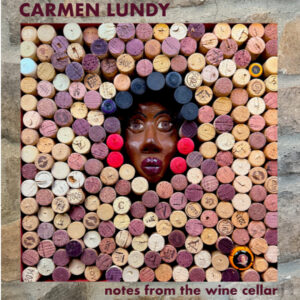
Her new album, Notes from the Wine Cellar, finds the singer, songwriter and musician responsible for virtually every aspect of the music, from writing the songs and creating the vocal arrangements to playing multiple instruments and arranging horns and strings. Some of its music is new. Other songs waited decades for Lundy to decide their time had come.
The album arrives as Lundy prepares to be celebrated as a 2026 NEA Jazz Master. It is a particularly fitting moment to consider not simply where Lundy has arrived, but how she got there.
Mary Lou Williams once said, “Anything you are shows up in your music. Jazz is whatever you are, playing yourself, being yourself, letting your thoughts come through.” Assuming you agree with her, how has that philosophy guided you through your career?
I didn’t know she felt that way, but I could have said the same thing. If you’re not yourself then you spend your career sort of copying someone else, imitating or sound-aliking. If you are not being yourself then you’re kind of not being true to your audience either.
It’s not supposed to be easy. It’s not supposed to be quick. Nobody wants to be a flash in the pan, even if that’s cute for a minute. Doesn’t last. I think you’ve got to develop your skills along the way. Hopefully, you’ll be supported by other fine artists who will give you some direction, a pat on the back when you need it and send some opportunities your way.
At the end of the day, you’ve got to show up and you’ve got to show out and really put yourself out there.
I guess we have to describe you as the Prince of jazz music because you are such an underachiever on Notes from the Wine Cellar. You wrote all the songs, play Fender Rhodes, acoustic guitar and percussion, created the backing vocals, did keyboard programming, arranged the horns and strings and designed the album cover. How does this hands-on approach allow you to shape your music the way you want it heard?
There’s something about orchestration that fascinates me. There’s something about the sound, the massive, the warmth. So when I get into my studio and I’ve got these tunes I’m working on, I want to try and figure out a way to incorporate those sounds.
When I get to a project and I start writing and I’m with that melody, I start to consider shapes and forms and where the music is moving to allow space for those ideas, not to fill up every space with my voice. My voice doesn’t have to cover every note, every bar of the music for the music to speak.
If I can come up with a way that everything sounds like it’s shaping and supporting me and I’m just up there floating and flying somewhere, I’m happy with that.
When I’m in the process of composing new thoughts, new feelings, new musical ideas, I record them. I’m recording all of the time. That’s what I do. And the guitar helps me to think of the space in the music in a way that the piano doesn’t.
The opening track, “In the Rain That Day,” seems to do exactly what you’ve described. Was there a sense of discovery when you decided this was one of the songs that had to be on the album?
This song was written with Harry Whitaker. We actually did a demo tape of this tune back in the early eighties. It was an incredibly straightforward rock and roll tune. But I always loved the chord changes, particularly in the bridge. I knew that I just couldn’t wrap my own head around trying to bring this forth the way we had done it originally.
So I picked up the guitar and I just started, maybe kind of Joni Mitchell-ish or something, just guitar and vocal. I reintroduced myself to the tune that way.
I’m recording it after the umpteenth try and I thought, why don’t I try putting the bridge first? That’s where the orchestration idea came in. That’s when I thought, let me just make this thing sound filmic, like you’re waking up and the sun is rising along with you waking up or something like that.
Harry and I worked this tune inside out. It sat for 40 years. This song just sat somewhere in my archives. So I went into my archives and I said, “It’s time. Let me just go back and give this another look. Let me give it another go.”
So here we are, opening track for Notes from the Wine Cellar.
Do you know when something you’ve written needs to become part of an album, or are there songs that simply have to wait until their moment comes?
They have to wait until their moment comes. I can’t tell you how many albums are sitting, waiting.
Music and songs have their own personality, their own time. They come when they’re supposed to. There’s a time and a space and when people are ready to hear something.
Sometimes you’re more open to receiving a musical thought or idea than another time. And I consider all of this when I’m putting together a project.
Does your own relationship with a song continue to evolve as you bring it out into the world and start performing it?
Yes. There are many songs that I have sung and performed with complete conviction and commitment and I don’t understand what the heck I was singing about.
There’s a tune, “Get to the Church on Time.” I needed to address something in my personal life with a relationship with a parent. I needed to find a way to address that and I was avoiding it, avoiding it. When I finally did it was the most cathartic. I felt like I had just purged some kind of emotional tension that I had lived with most of my life, most of my career.
I was in the process of taking these intense courses on art discourse. Nothing to do with melody and rhythm and chord changes, just visual art. But something about that course tapped into a part of me that needed to be dealt with. So up comes this tune.
I’m really glad. I’m real happy about that. I can move on.
In a 1995 interview you talked about the value of “being out there and learning it from the ground up, becoming a seasoned artist.” Thirty-one years later, what do you think that younger Carmen Lundy still had to learn?
I’m fortunate in that when I did enter the performance life, I had great examples. When I moved to New York, I saw everybody. Not just singers. I mean Dizzy, Miles. To be able to see the masters on a regular basis, you can’t replace that. For me, those are the lessons.
When you’re exposed like that from the ground up and you have this generosity of spirit from all these great artists, because they were not unapproachable individuals, somebody helped them the way they helped me.
My first night ever at the Vanguard, I hadn’t even moved to New York yet, and being allowed to sit in with that band. That was a generosity of spirit. That was welcoming. That was supportive.
I used to book myself for the first seven years I lived in New York. I used to walk the streets of New York putting my posters up on all the bus stops. My goal was to get a record contract, to move to New York City and start making records. And guess what? I made demo after demo after demo and never got a record deal.
But the first record I did, I recorded at the famous Rudy Van Gelder Studios. It was my money and my band, and with the help of Harry Whittaker and at the time my manager, Father Peter O’Brien, we made Good Morning Kiss, my first album. People still show up at clubs with that album for me to sign the cover.
You have to understand that everything can’t happen for you right away. If you stick to your guns and if you get back in the woodshed and you work at your craft on a daily, no matter what it takes to make the ends meet, and you work at it, and then you work, and you work, and you work. That’s the key to never letting up. To just stick to your aspiration.
It does come to fruition. Maybe sometimes not when you want it, but when it does come, you had better be ready. Because those opportunities don’t come as often as you might think.
In 2015 you said, “I think I want recognition for my work and for my contribution musically and the quality that goes with what I do.” Eleven years later, you’re an NEA Jazz Master. Does this recognition answer what you were expressing then?
Yes, it does.
The highest honor one can receive by our United States government and the American people, to be recognized as a genuine master of the music, which is an ongoing, unrelenting challenge, is to work at this craft and to try with everything you feel and know to render a musical offering at its highest quality.
That is not something you do by yourself. It’s not something that you do alone. There are many, many people along the way that you bring with you, the same way someone brought me along when I was 19 or 20 years old. I got to do the same thing for that little 19, 16-year-old, 20-year-old. Those musicians, those artists, those beautiful people are part of my journey too.
For whatever it is I’ve accomplished, without them I couldn’t have done it. This is not a singular effort.
There are certain things that are very singular about it. The discipline to sit and work and to learn and teach, and to learn from those you teach.
To have received this now counts for a lot. But that’s not why we do it. You don’t say, “Someday I’m going to be recognized as an NEA Jazz Master.” That’s not what we do.
But yes, it’s a great thing.
Let’s go back to late 1970 or early 1971, when you were 16 years old and made your first recording on an acetate disc. What did that 16-year-old imagine artistic life might look like?
We got this opportunity to make this record. The songs were called “The Price of Silence,” the A side, and the B side was “Boy, I’m the Girl for You.” So we go in the studio, I think it was Criteria, still a famous studio. We’re in Criteria Studios, we do these songs. And, of course, to acetate, we get the demo.
Stephanie and I, our families are tossing this acetate back and forth. You would have thought they would have given us two. They did not.
We actually believed that getting to school every day would be via limousine. We thought that we were going to be transported to our last year of high school in a limousine. We thought that we would be wearing the top, top, top, top fashion of the day.
We just had this idea that show business was the answer and was going to take us wherever we wanted to go for the rest of our lives. That’s what we thought.
Aren’t you happy it didn’t quite work out that way? Don’t you think you’re more richly rewarded this way?
I don’t have the personality for that. First of all, I’m not that kind of gal. Look, I love a beautiful thing. I love the beautiful vase and the beautiful car and a beautiful house and all those things. But it’s not my personality.
When people say, “Oh, you’re a diva,” I’m like, no, the diva is over there somewhere. Keep looking because the diva doesn’t stop here.
Maybe at some point when I was younger, I thought that was part of the persona that one should sort of carry in the world, but it’s never been the true me and it isn’t the true me. Fortunately, I’ve evolved and lived enough and had a few rough, rough patches in life.
I think of my mother as I speak to you now, and what a wonderful, wonderful mother I had, and how devastating it is to not have her around anymore. To this day, still devastating, thinking of her every day.
I feel very, very fortunate to be a Jazz Master, to still have a healthy voice, to really be able to come to the stage with musicians who I believe really look forward to those performances that we bring together.
I’m really grateful for those things. I do not take it for granted that the audience still wants to hear, that you still want to talk to me about my work.
Note: Carmen Lundy had very recently undergone cataract surgery before our interview. This accounts for her not always looking forward. It is with her permission that I reveal that information.
Watch the full interview which includes stories about recording her with her brother, Curtis, seeing Ella Fitzgerald, Betty Carter, her early days in New York, Roy Hargrove and so much more.
All photos courtesy of Carmen Lundy.