











Pam MacKinnon is directing a comedy about three women who want to ban books from their local school library. She doesn’t share their politics. But that doesn’t mean she isn’t interested in understanding them.
Stephanie Alison Walker’s Adirondack Chair Circle, receiving its world premiere at Chicago’s Steppenwolf Theatre Company on November 1st, explores what happens when a group of suburban women turn their convictions into political action.
As their movement gathers momentum, their friendships and assumptions about one another are tested. Watching and commenting on all this human behavior is a crow who finds the women endlessly fascinating.
MacKinnon has directed 22 world premieres, including works by Edward Albee and Bruce Norris’s Pulitzer Prize-winning Clybourne Park. For her, Walker’s play offers an opportunity to explore the humanity of people whose beliefs she opposes. Staged in the round, with audience members looking across the stage at their neighbors, the production arrives just two days before the midterm elections.
Q: After reading a draft of the play, I was reminded of something Oscar Wilde wrote for Sir Robert Chiltern in An Ideal Husband: “When the gods want to punish us, they answer our prayers.” Does that suggest something about these characters and their journeys?
What a fun quote, what a fun prompt. This is a play about a small group of women who have gotten together over drinking white wine and they plan to ban books in their school library. They’re a very local group, part of a national movement. And their movement starts to pick up steam.
Whenever you have a big goal outside of yourself, things can get complicated. There can be fissures among friends, there can be doubts that creep in. You can be amazed that someone you thought you knew turns out to be someone quite different when ideological hot button topics take over.
Stephanie’s written a very savvy comedy where everyone discovers things about themselves. Some people have dramatic shifts over the course of the two-hour play and other characters hunker down. It’s a very psychologically driven play.
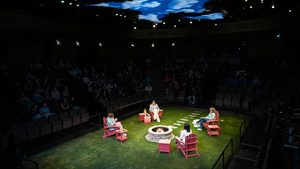
We’re doing it at Steppenwolf in their theater that’s in the round. It’s harder as a director to control some comedy because I’m unable to really control where people are looking. But it’s also really gratifying because there’s something about performing this play in an arena. The set is this backyard with some Adirondack chairs, but the set in some respects is audience looking at audience.
It’s a very contemporary political play about neighborhood, about school board meetings, about activation at the grassroots level.
You have audience looking across the way and seeing their neighbors from the Chicago area. It makes the audience a bit complicit, which is a fun way to enter a comedy as well.
Which is also the best reason to put it in that space at Steppenwolf.
Yeah, for sure. When the co-artistic directors, Audrey, Glenn, and I started to read plays, we knew it was for this space. I very much gravitated towards Stephanie’s play. There were some plays that fell away immediately because they wouldn’t work well in this arena space. But this one did. It’s a circle of chairs on a lawn.
There’s something about the architecture of the theater, surrounding these people by community, that really pressurizes this comedy and story.
In a 2018 interview, when you were assuming your role at ACT, you said you had to have an immediate personal connection to a play. What was that connection with Adirondack Chair Circle?

I’m an inherently political person interested in the topicality of this play. I think what I meant by that in that interview about a personal connection goes deeper than that. It’s not so much a personal connection academically in my brain. It’s a personal connection that is visceral. When I read a play and it actually churns something in my heart or in my belly, that’s when I get excited.
Steph Walker has written a play that doesn’t belittle these women. I’m not politically aligned with most of the characters in this play, but yet I wind up feeling for them in fits and starts.
That makes for an interesting read. It’s a personal connection at the human level, if not the ideological level. And you get to enter a backyard of someone that otherwise I wouldn’t necessarily get to know.
When you’re working with a playwright on a new play, how do you distinguish between what needs to be solved on the page and what can be solved or discovered in rehearsal?
We’re four or five days away from opening and we’re in a preview process where we perform at night but continue to rehearse during the day. We’ve learned a lot from audiences. Sometimes it’s about, oh, we can land that laugh in a better way, or an actor shouldn’t move on that line because they’re drawing attention when we want attention to be placed elsewhere.
Other times it needs to be solved on the page. Actually today, we’re putting in a pretty substantial rewrite to one scene. Steph has tinkered with it, has rewritten it a couple times. She wanted to make sure that every character had their due in it, warts and all.
We could feel that the audience was leaning in and we want them to lean in even more. That’s everybody’s job. It’s tech, it’s staging, it’s acting and it’s also on the page.
What responsibility do you feel to the playwright when you’re the first director to present their work to the world?
I really appreciate that collaboration with the playwright. I see my job as trying to mine the playwright’s intent. What is the story that the writer wants to tell? Every playwright is different. Every process is very different, which probably keeps me coming back for more. There’s nothing cookie cutter about it.
Some writers bring a play to the table only when it is quote unquote done. I’m thinking of a longstanding collaborator, Bruce Norris, or Edward Albee. When Edward was alive, I did a few world premieres by him as well. It’s on the page when you get it.
There are other writers where we’re going to be putting in new language late in this process. But it’s not, oh my goodness, that’s a panic. That’s when we understand it fully. We’re learning together how best to effectively land this story.
You’ve talked about wanting plays that allow women to be messy, complicated and to have points of view. Walker has certainly given you women who fit that description. What interests you about characters who don’t behave the way audiences might want them to?

That’s where it all lies, right? Therein lies the drama, therein lies the interest. We go to theater or we crack open a big book to both have a mirror held up to perhaps our behavior, which isn’t always proper, as well as get to peek into worlds where we don’t always belong or aren’t always welcome.
People are inherently contradictory. People are inherently messy. Stories interest me when I’m surprised, and not just gratuitously surprised.
Oh, I didn’t know that I would actually find that person’s argument compelling because at first I found that person kind of despicable. But she said something that I now have to take home and I want to talk about further or think about further.
I find the conversations after the play are juicier when we go through an experience with characters that keep on shifting in front of us. Our allegiances keep on ebbing and flowing.
Edward Albee is one of my favorite playwrights, particularly Who’s Afraid of Virginia Woolf? He was comfortable creating difficult, contradictory and even unlikable characters. How has working on his plays influenced your approach to these women?
It’s an accumulation at this point in my career. It’s not that Edward’s work narrowly defines how I step into this play. Each world that I’m directing, that I’m part of creating with a group of new collaborators, is its own thing. But of course, marching through a career, I now have different tools, different interests.
Steph has written a play with a lot of laughs, but it’s also very psychologically grounded. Edward’s plays aren’t always considered comedies, but without those laughs, you don’t go to the darkest places. Both obeying the laughs as well as where the pathos is, is always very interesting to me.
Characters that are funny, that know that part of how to get your way might be to use humor, are always very interesting to me. That was definitely a big part of Edward’s, both going through life but also on the page. If a play doesn’t hold any humor, it’s not for me.
What interests me about satire is that you find something funny and then realize it shouldn’t be funny. How important is that recognition in this play?
Steph is really interested in exploring the core women who are doing something that I could consider kind of dastardly and anti-small-D democratic, but she’s interested in exploring why, taking their motivations quite seriously. Some of their motivations are emotional, psychological, and some are certainly ideological.
I lean into stories where there are moments where I feel badly for characters. Situations that put people in states of discomfort or extreme loneliness, that’s when I really start to lean in. Steph has definitely put that on the page. All that feels very messy and human and in there is both comedy as well as pathos.
Crows have a complicated place in mythology, and this play opens very interestingly. What does Crow represent to you? Do you approach a character who isn’t human differently?

I would say I don’t, to answer your second question first. There’s a character whose name is Crow, and that character is a bird in this play. This bird has his own psychology. At times it’s quite naive, at times very astute. Every character has its own emotional temperature, its own psychology.
Crow is very observant and has a relationship with the audience. At times he can be narrator. The playwright kept reassuring us that Crow sees one character in particular in this play as his favorite TV show.
There’s something about an outsider looking in, delighted by both explainable behavior as well as strange behavior.
The audience very much bonds with this narrator character. There’s something very theatrical about a man playing a bird. The physicality is different, the relationship with the audience is different. In some respects, it’s my job as director to make sure that Crow is the frame of our story and not our story.
Stephanie Walker says theater reminds her to be more curious about the world. What does theater remind you to do?
That’s a good quote of Steph’s. It reminds me to attend things with my neighbors. It reminds me to be in community. It takes a lot of people to put on a play.
It reminds me of something inherent to our species, to want to gather around that campfire, tell a good story and participate in story. It reminds me to build and attend something with my neighbors.
Edward Albee wrote, “The condition of the theatre is always an accurate measure of the cultural health of a nation.” What does Adirondack Chair Circle tell us about the cultural health of this nation, particularly since you’re opening two days before the midterm elections?
There’s a balkanization in our body politic that is scary.
Do you think as an artist you have any role in trying to move the needle on the health of this nation through your work?
That’s a tall ask. But even bringing people together, there’s something delightful about this arena in the round space. People watching other people laugh across the way. People hanging out after the show. Every show has a 20-minute guided talkback and people do stay and want to talk.
There’s also something in this play about attending school boards. The participatory nature of what these women are doing is a reminder of what you can do.
Adirondack Chair Circle is in previews. The official opening is November 1st and the play runs through December 6th.
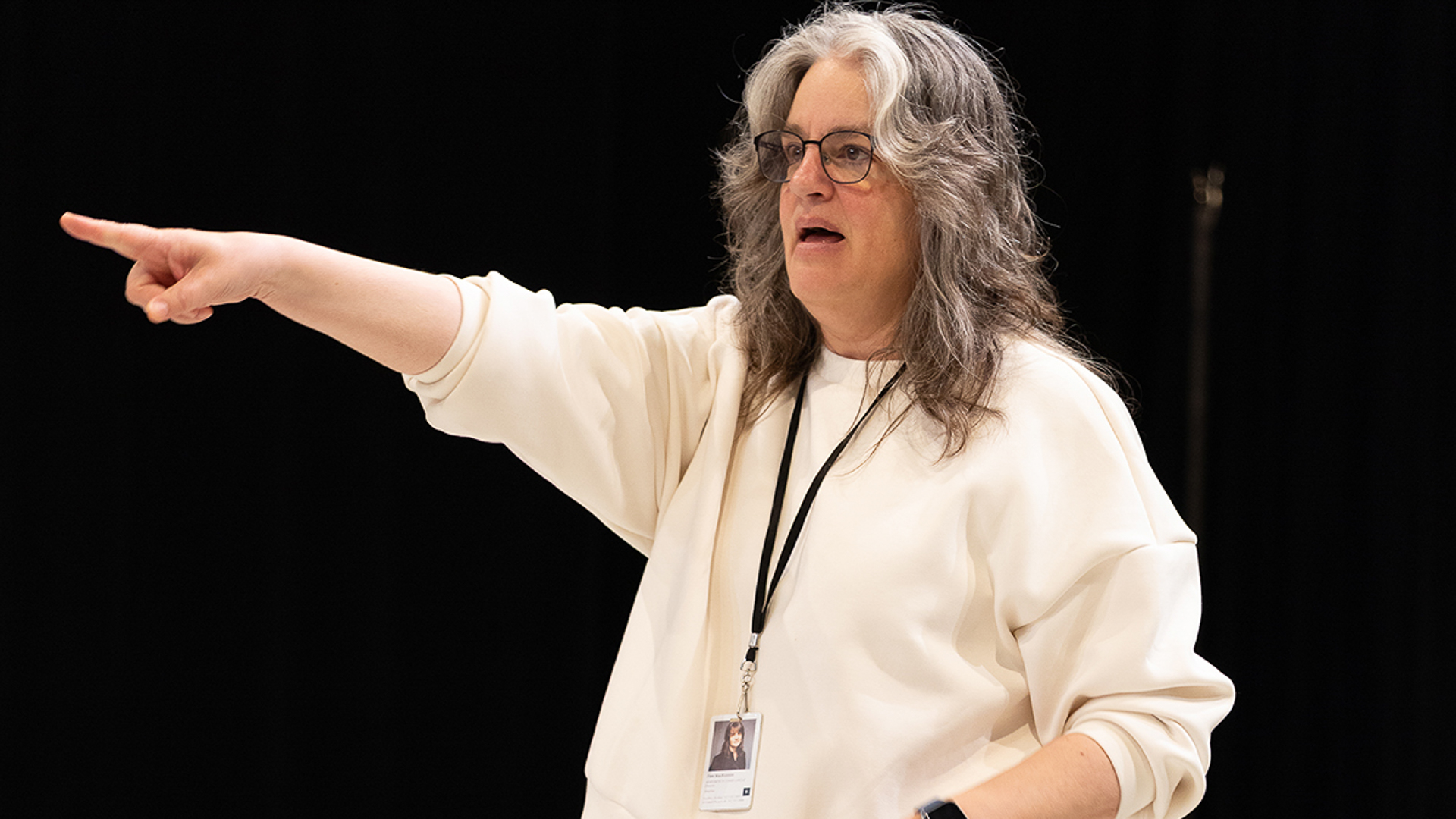
Main Photo: Pam MacKinnon in rehearsal for Adirondack Chair Circle (Photo by Joel Mooman/Courtesy Steppenwolf Theatre Company)