

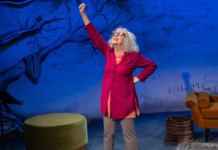




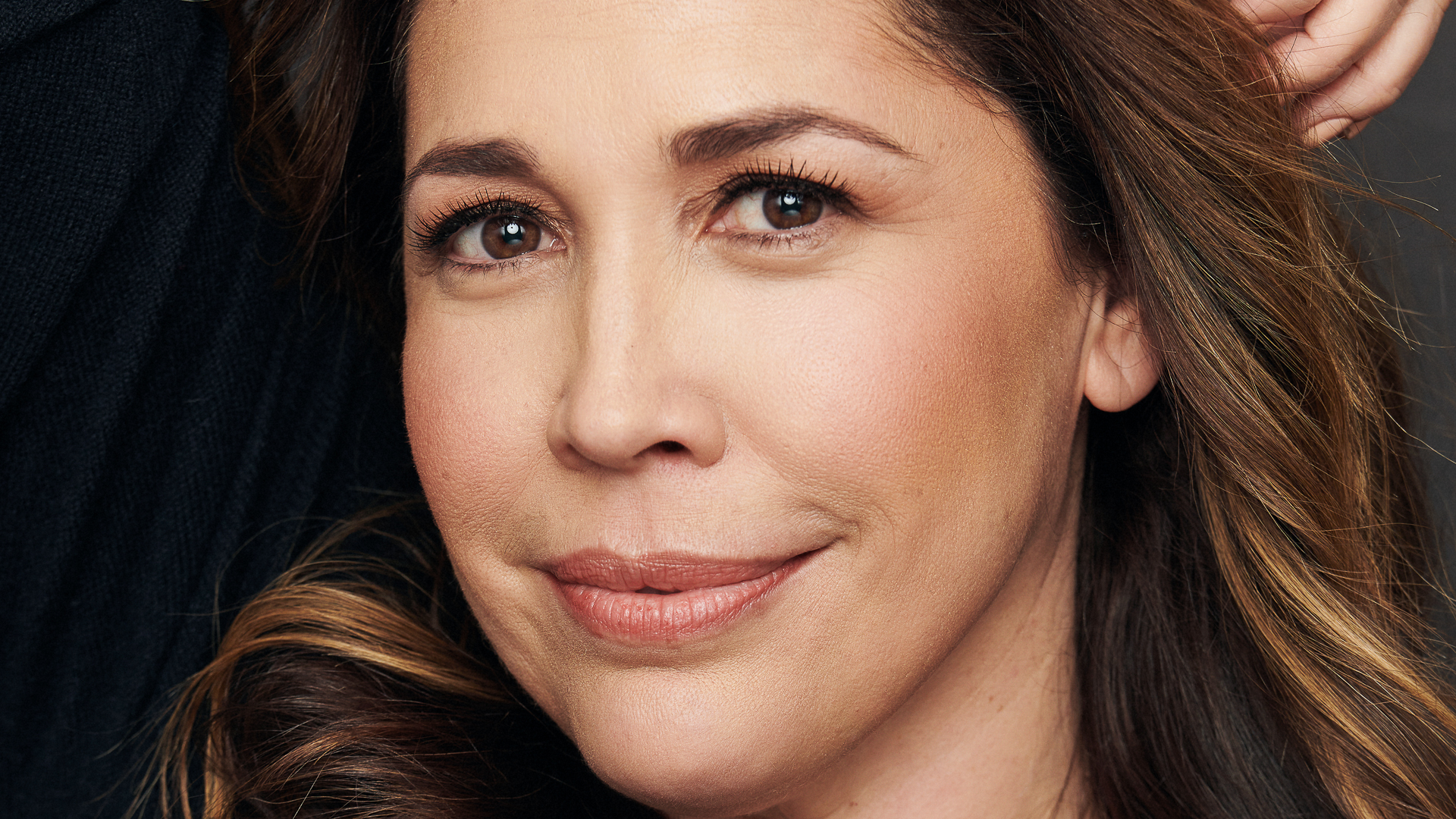

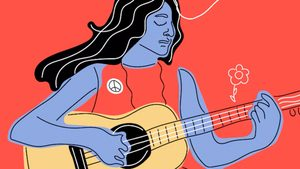
Andréa Burns created and stars in Diamonds and Rust: The Artistry and Activism of Joan Baez, which will be performed at New York’s 92nd Street Y November 7th through November 9th. Written by Karen Zacarías, the show celebrates one of America’s most influential singers and activists.
Burns, whose Broadway credits include In the Heights, The Full Monty and On Your Feet!, was approached about developing the tribute.
What she discovered along the way surprised her.
Q: In a 2009 interview with BroadwayWorld, you described yourself as “a Venezuelan Jewess from Miami Beach who grew up loving Broadway.” How and when did Joan Baez enter your life?
Actually, Joan Baez really entered my life this year. Stephanie Alvarado-Prew, who is the Artistic Associate Director at 92nd Street Y, approached me with this. She said it was really her dream to have a tribute, an American songbook tribute to Joan Baez. And she said, “I’ve been thinking about you for years.”
I thought, wow, I’m flattered, I am delighted. But she’s not a big person artistically who had influenced me before. So I came to this project almost like it’s an assignment, like I’ve become a scholar, which was really cool. It’s a different kind of experience than someone coming in and saying, “I’ve loved Joan Baez my whole life.”
I find that a lot of people in my particular generation would say, “Oh yeah, Joan Baez, wow, love her. What are the songs again?” Whereas people in my parents’ generation can name you all the songs. Interestingly enough, the Gen Z-ers, the people in my son’s generation, are tremendously excited about this show and about her. I’m sure some of it has to do with the Timothée Chalamet movie, A Complete Unknown, that it reintroduced her image to audiences.
When you were approached about this, was one of your first questions, “Why me?”
Yes. She said, “Well, she’s a soprano. You’re a soprano. She’s half Mexican. You’re half Venezuelan.”
She had seen me in a show called The Gardens of Anuncia by Michael John LaChiusa. I played a character that was kind of a muse, an aunt to a young artist. She said there was something about the way your character was singing to bring out the best in someone that made me think this would be a good fit.
What’s so fun about this is when someone says, “This is you,” and you think, “I don’t really know what.” It’s really fun to do the deep dive and come out on the other side and say, “Okay, now I know why.”
Leading from that space is what eventually created this show, this evening for me.
Was there one pivotal moment where it went from being an assignment to something you couldn’t wait for audiences to see?
Yes. I think the more I learned about her, I couldn’t believe how actually kind of punk rock she was. You talk about someone who is on the cover of Time magazine at 19 years old, and she’s this crystalline soprano. She’s not this edgy rock singer, right?
She’s also someone who, although she is half Mexican, her family was Quaker. Some people didn’t even know she was Mexican. She presented as white. She really was the definition of what we now call an ally, but that title came with a big risk.
She was out there singing to the people, singing gospel, singing about civil rights, singing about slavery. People were really thrilled that she was lifting her voice up for the causes.
She’s not someone who comes into the audience to kill, you know? She’s someone who comes in to actually nurture. There’s something so divinely feminine about the way she comes to us. Even as a teenager, she sings almost like this mother figure. These are all things that we don’t consider necessarily kind of sexy in show business, and yet people couldn’t get enough of it. I found that to be tremendously exciting.
In her memoir, And a Voice to Sing With, Baez wrote, “I was born gifted. I can speak of my gifts with little or no modesty, but with tremendous gratitude, precisely because they are gifts, and not things which I created, or actions about which I might be proud.” I think there’s actually a lot more modesty in her assessment of the way she used those gifts. Do you agree?
Yes, that’s what spoke to me, quite frankly, as a singer. It was an incredible penny-drop moment for me because I have always considered my voice a gift to me in that it gave me direction. It gave me something to follow, a mode of expression.
But I love the idea she has just reframed for me that it’s really not about me. My job is to take care of it. She’s been quoted as saying she’s in charge of the maintenance and delivery of it, but she can’t take credit for it. And I found that incredible.
This concert is coming just after the midterm elections. It must be an incredible moment to be telling her story.
It is. However, whichever way it goes, it’s going to be a powerful evening because one thing that has really stuck out for me about her is her ability to unite and unify. Particularly in these divided times, I’m very excited about being in a room with about 500 people and getting together in the name of what I think our highest aspirations are, which is human connection and human respect, and this music that just elevates your spirit to a place where you have hope.
And you’ll be on the very same stage where Baez made her New York City debut in 1960.
Can you believe it? It’s something that I tell myself as I’m preparing all of this music, which is new for me. These aren’t songs I’ve been singing for years. I keep telling myself she’ll be there, a little bit of her pixie dust will already be on the stage.
I just think how wonderful that her music and her message are going to fill the same space and affect people during a political time once again, over 60 years later. It’s just miraculous.
The show takes its title from one of her best-known songs, Diamonds and Rust. I think it has one hell of a kick-ass opening line: “I’ll be damned, here comes your ghost again.” What do you hear in those words that makes them so powerful?
I think anyone who’s been through a breakup, especially a messy one, hears those words and knows exactly what that feeling is. No matter how long relationships last, the bigger ones stay inside of us forever. We have little fragments, sometimes shrapnel, that stays inside of us forever.
It’s also interesting because that was such a public relationship. People and fans were invested in it. That made the song especially exciting because everyone has an inside take, especially when she mentions Washington Square and things that are very iconic to the couple.
I just think it’s one of the greatest breakup songs because we know those feelings. We know what that shattered-heart place is and the trying to rise above it.
That person was Bob Dylan, whose songs she also performed. In fact, she recorded songs by Leonard Cohen, the Beatles, Robbie Robertson and many others. You’re now taking on her repertoire. What have you learned about interpreting someone else’s music from listening to how she interpreted theirs?
It’s very hard to get past the voice. Her voice is so beautiful. I’m so enamored of the actual instrument and the fact that she was such a total natural talent. I’ve been in voice lessons from a young age, so part of it is giving myself a little grace to go, “Okay, I am not Joan Baez at 18.”
But what’s so beautiful is her message. The messages are so strong, and she couches them in these little beautiful lullabies. Make no mistake, you’re hearing something quite beautiful, but she is often singing about her dissatisfaction and pain in what is happening politically. It’s undercover revolutionary. It’s really cool.
Mostly I’ve dropped into, “Why? Why did she sing this song? Why was it important that people hear it?” Things are starting to pop up that are the same things she sang about then, but they feel quite relevant today.
Baez paid a steep price for her activism, including death threats, FBI surveillance and lost economic opportunities. Yet she persisted.
She persisted. She’s such an outlier. The 1980s happened, and suddenly no one’s really interested in peace and love and music and my fellow man anymore. It’s about the dollar and getting ahead.
She never disconnected her political activism from her music. At that time, not everybody wanted to hear that anymore.
A particularly telling moment that we talk about in the show is that We Are the World happens. Everyone my age knows that moment, that recording, how incredible it was getting all those artists together. But you can’t think of anything more Joan Baez than that. And yet she was not asked to participate. She just wasn’t popular enough. She’s the one who had actually been doing that kind of work the whole time.
Later they do Live Aid. I think somebody finally decides to secure her a spot, but it’s like the 9 a.m. slot. And she does it. “This is your Woodstock, everybody. I’m here to remind you what we’re doing.”
I couldn’t help but feel protective of her. How could they do that? Yet she did not let the fact that she was not, quote unquote, on top stop her from continuing to do what she does. She never stops.
Do you think artists today have an obligation to speak out, even if doing so might cost them something?
I don’t think anybody has an obligation. I think it’s a choice. And it’s a risky one. You can take inspiration from someone like Joan Baez. She said something so great, which was, at Woodstock there was nothing risky about performing. The only risk was not being asked, because ultimately that’s where the tide was. Everybody wanted to be part of that.
What’s risky is raising your voice now. Raising your voice when it’s not welcome, saying you’re not happy with the status quo and that you hope for something better.
I don’t know that anybody is obligated to do anything, but I know my admiration goes to those who do. You risk your popularity. You risk fans who decide, “No, we’re no longer going to support you.” It makes it all the more courageous to witness everything she’s done.
You were asked in another interview what you hope audiences will feel after seeing this show. How do you want to feel at the end of each performance?
I want to feel in community with them. I want to feel like my voice and their hearts have met somewhere in the middle.
In these times where we’re all alone in our homes, looking at our phones, having meetings through Zoom, a live voice and a live audience get to have what, for me, is Holy Communion in a theater. That’s what I’m hoping for.
Baez once said, “You don’t get to choose how you’re going to die or when. But you can decide how you’re going to live now.” Has creating this show changed anything about how you want to live your own life?
It’s just scratching the surface for me. I’m at a point now of examining how this is going to download into my being. I wish I could tell you, “Yeah, I started a protest group and we’re all hitting the streets.”
I think I’m going to learn a lot. I’ve been so amazed by her. I’m going to learn so much more after the weekend of communion, quite frankly.
But I can definitely feel the molecules shifting.
Main Photo: Andréa Burns (Courtesy 92nd Street Y)