









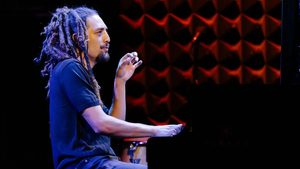
Some albums impress me with their virtuosity. Others challenge me intellectually. Then there are those that simply make me happy to be alive. Pianist and composer Mathis Picard’s The Sound Orchestra, being released November 6th, belongs in that last category. Its infectious rhythms, exuberant brass and musical imagination brought an enormous amount of joy into my world.
But there’s more to Picard’s music than exuberance.
His compositions build tension and release it in moments of exhilarating musical abandon. That release, often called The Drop, is central to the album’s appeal. As I listened more attentively, my excitement made room for the emotional depth that makes this album so rewarding. I consider it one of the best albums I’ve heard this year.
Our conversation began with music and became something much more personal.
Q: Your teacher and mentor Kenny Barron is quoted as having said, “I gave myself a soft inner challenge to really take my time, that whenever and however I had an impulse to touch the piano gently, I’d make good on the promise, to allow the listeners some sanctuary in the music and to let it be so for them.” How does this perspective inspire you and how important is it for you to do the same thing with your own music?
Mathis Picard: I think he’s touching on a really important point that music has to serve yourself as well as the audience. Life can be so crazy and busy, and the emotions can go all over the place that when it’s time to finally play music and create something, you have to come at it with a certain gentleness. But really the sanctuary part speaks to me because it has to be this place of healing, this place processing everything that’s come before and what will come after.
When I listened to The Sound Orchestra, I immediately thought of the depth and breadth of Duke Ellington’s work. How influential is he for you?
I’m very honored that you hear that connection. But I am going for that. The humanism of his music, he wrote his music for the personalities that he was working with. And that’s something that I’m always thinking about. Who’s playing this trumpet part? Why did I want them to play that? How can this person’s individual taste come through in the music?
The second aspect is the harmonic expression that Duke Ellington was able to get. I’ve always loved that feeling that he got, which was the relationship between the horn section, the brass and the woodwind, going back and forth between these two entities with the harmony. I’m always trying to bring that aspect onto the rhythms that I’m feeling currently.
Those rhythms emanate this massive amount of joy. What joy did creating the album bring you?
For me, it brought a lot of self-discovery but especially self-acceptance of the kinds of rhythms and musics that I really enjoy. I didn’t grow up in America, so I didn’t grow up with American swing necessarily embedded into my everyday life. My mom listened to a lot of classical music. She listened to some Malagasy music. My father listened to rock music, but also to some funk. And there was actually some Kenny Barron albums in the house.
So the joy for me was to be able to accept and discover myself and finding joy and pride into the sounds that I was creating. It was like a relief, you know, for me.
Do you think we need more joy in music now than when you first started performing?
I think everyone wants different emotions in life. I certainly enjoy having joy in my life and having joy in music. That’s a big reason why I connect with music. I think beyond joy it can bring me hope.
But that being said, I think there’s a very strong value to having a cathartic experience with music if you’re feeling sad and the music helps you access that sadness. I’m looking for music to be more human and more in touch with all the emotions of humanity. And I think as we enter an age of AI, the most important thing for me is that the music can help us access the full spectrum of emotion.
What can you say with an orchestra that you couldn’t say with a solo piano album?
I only have two hands, right? So I can juxtapose even more ideas next to each other. I can uplift the voices of people that I love. When it’s a solo project, you can write about someone you love, but I think there’s something really special when you can just put the microphone to someone whose voice you love and say, go ahead, share with the world what you got to say.
That’s the main aspect that I love, writing for an orchestra and working with other people is hearing their opinion. As a writer, that’s very exciting for me to be able to put a context in which I’m looking forward to hearing what someone can do with it and how they can interpret it, which would be completely different to how I do it.
You’ve compared the ten members of your horn section to the ten fingers on your hands. How did you make their performances feel like an extension of your playing?

We were lucky that before recording this album, we’ve been performing this music for two years. And for that reason, I feel like the musicians really started to find the corners that they enjoyed in the music. There’s so many different points where I can point out and say this, I didn’t write this. I didn’t write emotionally how people should play that. It’s just we played it over and over again and so people started finding things that really spoke to them and bring it out forward.
You spoke years ago about The Drop, building and building until that moment of release. I immediately thought of Wagner’s Tristan und Isolde. It made me wonder whether some of the most exciting ideas in contemporary music have been with us for centuries.
I think tension and release is one of the most prominent underlining when it comes to creation. Whether you read it in a story and characters are going through development and then there’s conclusion, whether we’re watching dance, whether we’re having conversation. Tension and release is sort of a universal understanding that perpetuates through all art forms.
Whether it’s in Wagner or we’re talking about electronic dance music or in a movie, we understand that and we understand that through nature as well, through the seasons. Humankind has been trying to express this very essential force of tension and release since the creation of the world.
The album artwork features a lemur, which you’ve described as your spirit animal. Given your mother’s roots in Madagascar, how does that part of your ancestry find its way into the music?
It’s all over this album. There’s a track called Ho Azy which means for her in Malagasy and for her is for my mother and there we use a Malagasy rhythm called the salegy, and that’s a celebratory rhythm. I think that track is the most immediate, clear dedication for Madagascar and for my mother.
Also having multiple percussion instruments, Kofi Hunter is playing djembe and congas, and then Ivan Yanez who’s coming from Cuba, he’s playing timbales and shakers and cowbells and trying to have this polyphony of rhythm and sound happening at the same time. Everyone trying to describe rhythm together as individuals in a collective.
In your book Where. Music. Lives., you argue that great art comes from a lived life. How much of your life can we hear in The Sound Orchestra?
Up to today. I’m a firm believer in trying to live something before trying to write it down. In order for me to write the music or to write the words, I have to experience it first. So everything you’re hearing on The Sound Orchestra album are ideas and beliefs that I’ve dived into in my life, for sure.
But you’ve been performing this music for two years. You’ve lived new experiences that will inevitably inform what comes next.
Oh, absolutely. And that’s the beauty of music is that the next albums can take on what you’ve learned from the past projects you’ve made. What is cool for The Sound Orchestra is I’m also inviting other people’s experiences. It’s not just about my experience. It is also about their and our experience as a whole.
To this day, I could probably play The Sound Orchestra album, and it would sound different to the way that it was recorded in this one moment of time. So music is a living entity.
You don’t want to be robotic. People strive for absolute perfection, which to me is impossible to achieve. Once you’ve done that, where do you go?
Yeah, I mean, what is perfection? We aim to live a perfect life. You can do everything you can to live a perfect life, but you can’t help the outer things that will affect your life that will supposedly now make it imperfect. And so what is perfection?
That’s one of the beauties of this music that I love. How can you be perfectly imperfect? I’m confident that no matter what happens, you can find your center and change and be malleable and work with what one would assume is imperfection, but maybe at the end of the day it’s not that.
It’s perfect the way it is.
And isn’t the irony that we expect these plot twists in movies and books and other forms of storytelling, but we don’t want them to happen in our own lives?
Yeah, I mean, we hope that no one we love gets hurt or we hope that there is no pain, absolutely. But what we do hope is for exciting changes and for inspiring developments, but we can’t choose that, right?
We also can’t expect the pendulum to swing in only one direction. I believe we share a passion for pianist Martha Argerich. I love how egoless she seems when she performs. How do you reconcile that surrender with the confidence required to lead an orchestra?
One of the things that I love watching, I love watching how she performs and you’re so correct, there’s this effortless mastery. She’s able to perform the hardest music ever, but when you look at her, it seems, you know that it takes a lot of work, but there’s something about it that is so breathing.
I’ve taken that on when it comes to leading a big band. I guess the thing is to not be forceful because as soon as you have force and you’re trying to force something then you have tension. If you want the water to be flowing it needs to be relaxed and in order for it to be relaxed you have to be open for the plot twists that happen while you’re creating the music.
And the plot twists, when you’re dealing with a big band, there are plenty. Someone can’t make a rehearsal. There’s so many individuals going through their lives that you can’t have tension. You have to consistently be open to the plot twist. And it makes you a better person, in the end.
Earlier I referenced Duke Ellington. Clark Terry wrote in his autobiography that Ellington regularly used the phrase, “Simplicity is a most complex form.” What is the role of simplicity in your music and your life?
Well, here’s a good example. There’s a song called Inner Child on the album, The Sound Orchestra, which is actually an arrangement of the fugue that’s from the Preludes and Fugues album. And when I was writing a fugue, I was dealing with my thoughts of myself as a composer thinking, okay, a fugue’s complex. A fugue is complicated. How can I, the ego in me is trying to decide, well, what kind of cool decisions, musical decisions I can make to make this as fancy and complicated as possible.
But I realized that the reason why I enjoy music when I was first listening to music as a kid had nothing to do with the intellectual. It really had to do with the heart. I couldn’t tell you what a flat five chord was. I just know that the feeling felt good.
And in terms of simplicity, I had to take a step back and look at a more simple source of inspiration, which in turn is actually a more complex source of inspiration. It’s very complex to go back to your roots, your feelings, your raw emotional feelings of music that are connected to your childhood experience, especially as an adult. And so in seeking the simplicity of those emotions, you have to go through a complex inner working that allow you to be vulnerable for that simple, simple is an interesting word, but for the basic living forces that we all have.
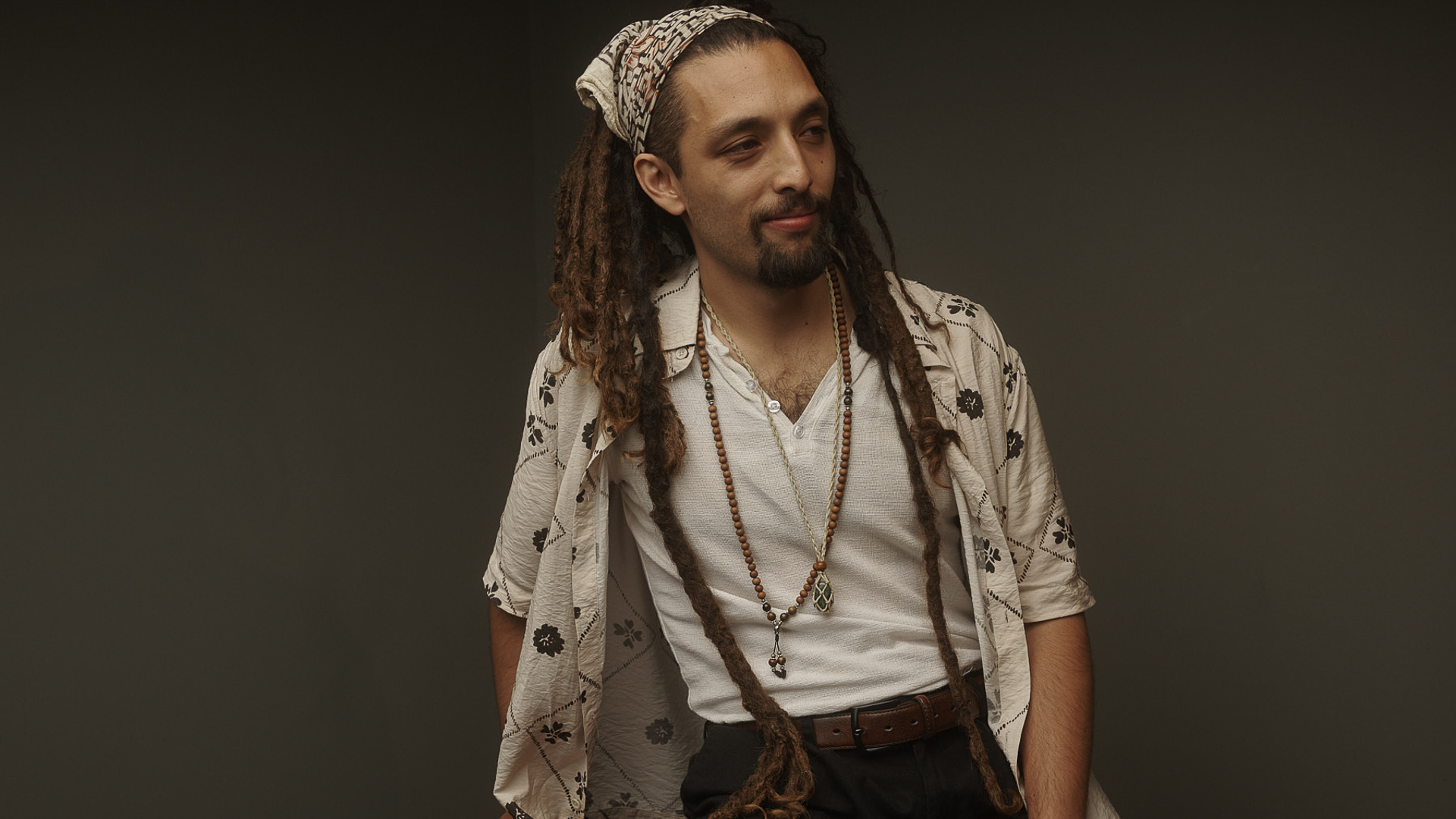
Main Photo: Mathis Picard (Courtesy La Reserve Records)