










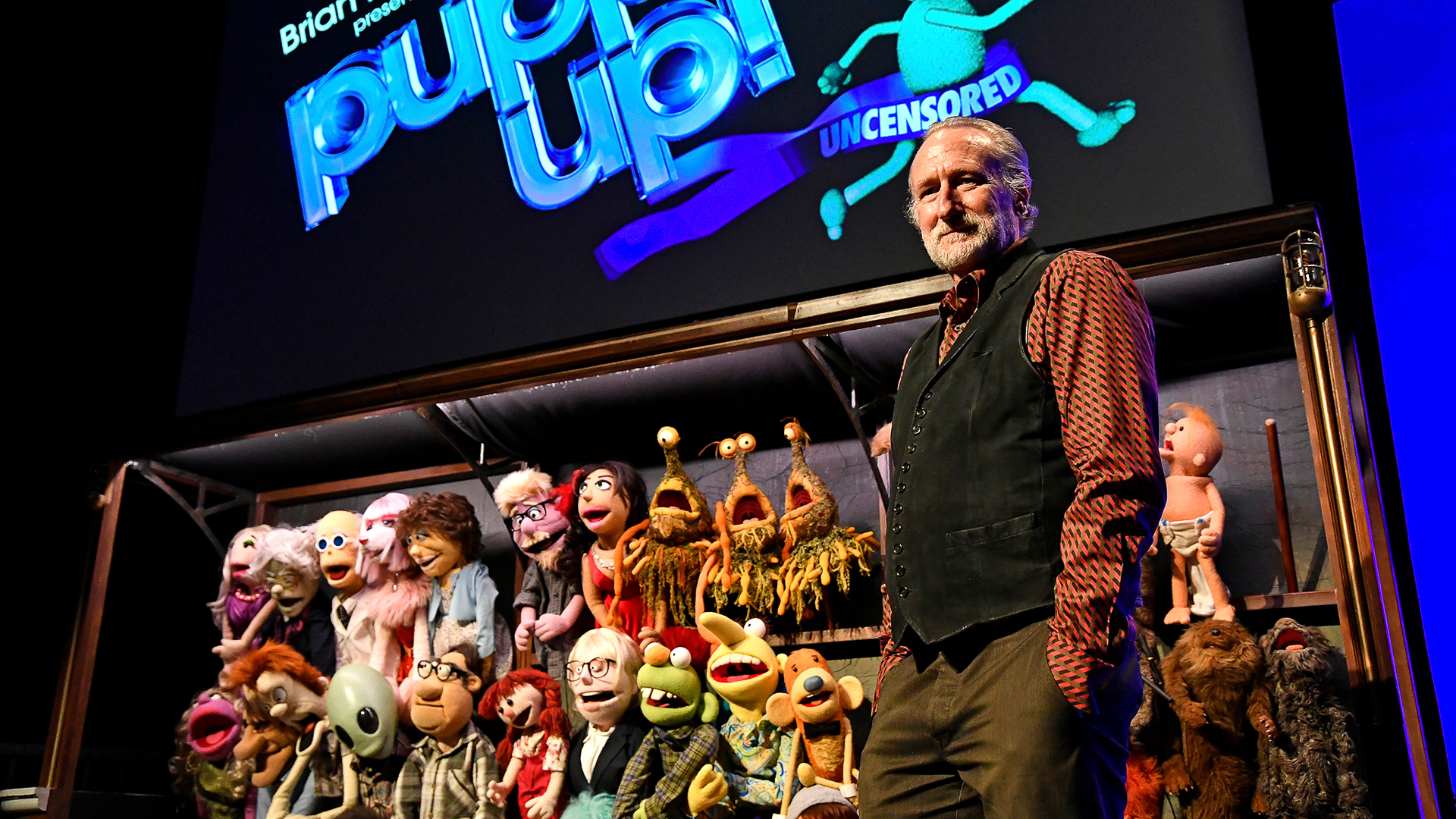


Brian Henson has spent more than two decades proving that puppets can do far more than entertain children. Since its earliest workshop performances, Puppet Up! has evolved into one of the most distinctive live comedy experiences anywhere, blending improvisation, audience participation and Henson style puppetry into a show that is never the same twice. The production returns to The Montalbán in Hollywood from July 31st – August 9th, bringing six puppeteers, dozens of characters and twenty years of creative evolution back to Los Angeles.
For Henson, Puppet Up! has become much more than a stage show. It has become a place to explore creativity, collaboration and risk while continuing a philosophy that stretches back to his father, Jim Henson. Rather than simply preserving that legacy, Brian has embraced perhaps the greatest lesson Jim ever taught him: don’t repeat yourself.
Q: In It’s Not Easy Being Green, your father talked about putting one’s self out on a limb, taking chances and risking being called a do-gooder. Over more than twenty years of Puppet Up!, how have you done that?
Well, improvising means exposing yourself completely. You’re living an actor’s nightmare. You’re on stage, everyone’s looking at you, but you don’t have a script. It’s embracing that, emptying your mind and flowing with the moment. That’s super exciting.
My dad always brought a sweetness to his work. When Kermit sings “Halfway Down the Stairs” on The Muppet Show, that’s a purely sweet moment you never would have found on prime time television then. He was always positive. The glass was always half full. He took enormous risks to do what he felt was right, and if he believed something was wrong, even if it hurt him personally, he would walk away from it.
With Puppet Up!, we’re not cynical. It’s really a study of how absurd people are and how wonderful that absurdity can be. Working from audience suggestions keeps every performance connected to the people we’re entertaining. We also recreate pieces my dad created in the 1950s and 1960s that haven’t been seen in decades. If there’s an overarching theme, it’s that people are fascinating. We’re ridiculous sometimes, but that’s part of what makes humanity so much fun.
How vulnerable did you feel when you first put this idea in front of an audience?
The invited performances at Henson Studios weren’t actually the scary part because I knew most of the audience. Patrick Bristow, who created the show with me and still directs it, suggested putting it in front of people because stage fright actually sharpens improvisers.
I remember telling him we weren’t really a theater company because our kind of puppetry always works in front of a camera. That’s when we decided to simply put the camera onstage. The audience watches the performers create everything in real time while the big screens show what the camera sees. We always say it’s really two shows happening at once.
Then we were invited to the Aspen Comedy Festival. Suddenly we were performing for a discerning audience, and I was terrified. That’s where I started learning that improvising as a puppeteer is actually different from improvising as an actor.
As an actor, you want the character to become you. In puppetry, the performance is out at the end of your arm. Sometimes your own hand surprises you. I’ll walk into a scene thinking I’m going to play an Italian chef, and suddenly my puppet decides it’s a French mime instead. The character catches even me off guard.
The other difference is that when a puppet fails, I don’t take it personally. If my puppet is struggling, I’m laughing right along with the audience. Those scenes often become even funnier because the embarrassment belongs to the puppet, not to me.
How has your relationship with Puppet Up! evolved over the past twenty years?
It actually started because I wasn’t trying to create a show. I was trying to discover a fresh kind of comedy that really suited what puppets do well. We were asking comedy writers to write sketches, but something wasn’t clicking. Then my wife introduced me to Patrick Bristow and we started improvising instead. We realized the performers themselves understood puppets better than anyone else.
That changed everything. Now Puppet Up! has become the way people train to become company level puppeteers at The Jim Henson Company. It’s a unique way of developing characters and voices because you’re discovering them instead of inventing them on paper.
What impact have the changes we’ve seen in society over the last twenty years had on what audiences respond to and on what Puppet Up! chooses to make fun of?
I think today there’s a kind of immovable black and whiteness to a lot of people’s opinions. You’re either on this side or that side. There are certainly things you don’t do now that you might have done twenty years ago. As a performer, there are some characters that simply aren’t appropriate anymore. But I’d say the bigger change is that people seem much less willing to change their minds.
Conversation used to mean people could say, “I’ve never thought about it that way,” or, “Now I’m reconsidering how I feel.” Today, a lot of people’s positions are fixed before the conversation even starts. That’s something we make fun of in Puppet Up! Put two puppets onstage with completely immovable opinions and let them hash it out. Hopefully the audience recognizes a little of themselves. Because it’s happening through puppets, people don’t feel attacked. They laugh instead.
I’ve worked in the film business for forty years, and I’ve seen what happens once the cameras stop rolling. I have to imagine the puppeteering world has always had that same wonderfully blue sense of humor.
Absolutely. The puppeteers my father naturally gravitated toward all had wonderfully blue senses of humor. My dad did. Frank Oz certainly did. Jerry Nelson, Richard Hunt and Dave Goelz. Some of my favorite memories growing up were watching them between takes because what happened after the cameras stopped rolling was often funnier than what happened during filming.
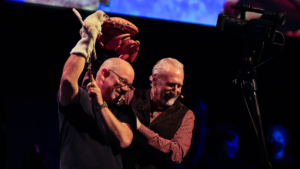
That’s one of the things I love most about Puppet Up! My dad never really had an opportunity to put that side of the performers in front of an audience. It was something they did for each other and for the crew. Now we can build an entire evening around that spirit of play. Some critics who had been particularly hard on work I’d directed after my father passed away came to see Puppet Up! and said, “Now I understand. This feels like Jim Henson’s sense of humor.”
I’ve watched a lot of your father’s late night television appearances over the years. He always seemed more than comfortable improvising through whichever character happened to be on his arm. How much did witnessing that influence you?
I saw it all the time. He was much more comfortable answering questions as Kermit than he was answering them as Jim Henson. He genuinely felt protected when he had a puppet on his hand. It liberated him. He could respond much more naturally than he could as himself.
When you’ve created a character yourself, you’re never consciously thinking, “What would this character do?” It happens organically. After a while, even you are surprised by what your character does because you’ve spent so much time bringing that personality to life. The more you perform it, the more alive that character becomes.
I’ve watched a number of interviews with your father over the years, and something Arsenio Hall once said has always stayed with me. He talked about how the Muppets connected with the child inside every adult. What is it about puppets, and about Puppet Up!, that still reaches people that way?
I think puppetry as an art form has probably been around longer than almost anything else. There’s something inherently delightful about taking an inanimate object and convincing people that it’s alive. That’s incredibly engaging because the performer is only doing part of the work. The audience is doing the rest in their own imagination.
With a Marvel movie, everything is completely realized for you. You can simply sit back and watch. With puppetry, your brain has to participate. Your imagination completes the illusion. That’s one of the reasons puppetry has survived for so long and probably always will.
The other thing my dad always understood was that, even if a character was a scoundrel or a con artist, there was still an innocence about them. If you’re trying to create the illusion of life, it’s much more fun if that life is enthusiastic about being alive. More than optimism, I think enthusiasm is really the thread that runs through so much of what our company has created. Those characters are completely present in whatever moment they’re living.
How important has it been for you that your work and your sense of humor become your own and not simply feel beholden to your father’s legacy?
I don’t ever feel restricted by the legacy. If anything, the greatest thing my dad left my siblings and me was the idea that you shouldn’t repeat yourself. Don’t copy somebody else. Do something original. If it fails, that’s okay. The important thing is that you tried.
Obviously, people expect me to work with hand puppets and animatronics, and I love doing all of that. But what really feeds me is working with talented creative people. That’s always been the most satisfying part of my career.
I’m not trying to create a legacy for myself. Maybe one day someone else will look back at my work and decide there is one. That’s not something I think about. For me, it’s the journey. It’s the experience. It’s sharing that experience with other highly talented creative people. That’s what feeds me.
I want to close by going back to It’s Not Easy Being Green. Your father offered what he called some simple advice: “Always be yourself. Never take yourself too seriously. And be aware of advice from experts, pigs and members of Parliament.” How has Puppet Up! allowed you to always be yourself while never taking yourself too seriously?
I think those ideas really define what it means to be an improviser. Whether you’re working with a puppet or not, you have to be yourself. Being yourself means emptying your mind and discovering how you’re honestly going to react to whatever happens next. That’s what improvisation is.
When my dad talked about being careful with advice, I don’t think he meant you shouldn’t listen to people. He loved collaborating. He used to say people would ask whether a movie turned out exactly the way he’d imagined it, and he’d say, “No.” Once hundreds of artists start creating together, you’re no longer simply executing one person’s vision. You’re conducting an orchestra. What emerges belongs to all of those people.
And never taking yourself too seriously is probably an even bigger lesson today than it was then. Kids today are connected all the time. They’re constantly worried about being judged or embarrassed or teased for simply being themselves.
That fear of embarrassment is incredibly limiting. It’s really the other side of not taking yourself too seriously. If you’re comfortable laughing at yourself, you’re no longer vulnerable to everyone else’s judgment. Once you’re free of that fear, you’re free to create.
Main Photo: Brian Henson and Puppets (Photo by Michael Tullberg/Getty Images / Courtesy Puppet Up!)