





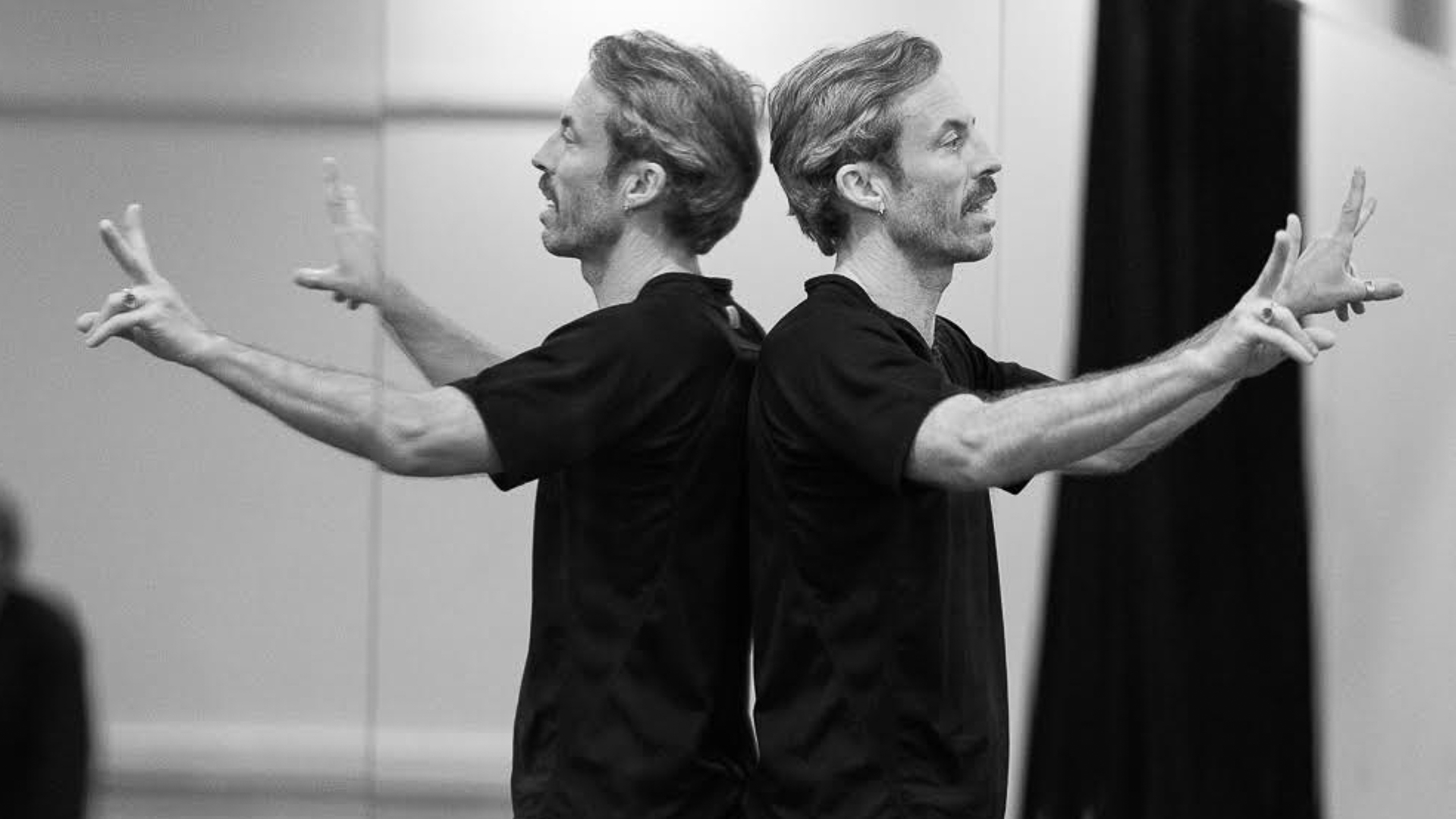


Dracula has been frightening and seducing audiences for more than a century. Bram Stoker’s creation has inspired countless interpretations, from Gothic horror films to ballets that transform the vampire’s supernatural powers into movement. For choreographer Nicolas Blanc, creating another Dracula offered an opportunity to explore the character’s emotional complexity.
Dracula, a Dark Shadow, is receiving its world premiere at State Street Ballet in Santa Barbara on October 30th and 31st.
With this work, Blanc creates his first full-length narrative ballet. Philip Glass’s score for Tod Browning’s 1931 film Dracula will be performed live by the Kronos Quartet. Blanc’s interpretation combines period costumes with minimalist staging and a more emotionally complex Dracula.
We discussed his interpretation, his rearrangement of Glass’s music and the story’s contemporary relevance.
Q: In Dracula, Bram Stoker writes, “It is wonderful what tricks our dreams play us and how conveniently we can imagine.” What role have dreams played throughout your creative life, and how did your imagination lead you to Dracula, a Dark Shadow?
I always, as a choreographer, wanted to do a story ballet. I love that I, as the choreographer and as a creator, have the ability to take a story and transform it to the stage and adapt it. I think it’s interesting to see how much freedom you have within the frame of the story.
The Guinness World Records reports that Dracula is the most portrayed literary character in all of film history, with over 500 films that feature him. What makes Dracula so inspiring for artists, and what made him inspirational for you?
I consider myself as more of a romantic choreographer. When I was approached to create Dracula, I thought it would be a great challenge for me to tap into something that’s a bit of a darker side. I’m really fascinated by that story because there is the idea of the fight between good and evil.
Dracula is a monster, but he’s also a figure of enormous romantic fascination. Do you think audiences need to feel sympathy for him, or is there something more interesting about allowing him to remain genuinely frightening?
It looks like my Dracula has some sort of romantic feeling towards Mina at the end of the ballet and reveals a more emotional side of himself towards Mina. Definitely not with Lucy or Jonathan, but with Mina for sure. My Dracula is not only an evil, soulless character, but deep inside has some sort of emotion.
It appears that there have been at least five other ballets based on Dracula since 1996. Knowing that other ballets exist, what have you chosen to do with this story that makes your Dracula distinctly your own?
This Dracula is a very condensed version. Instead of having Dr. Seward and Professor Van Helsing, I have decided, out of logistical reasons but also dramatically speaking, to only portray Dr. Van Helsing. Lucy’s fiancé is not part of the story either.
In 70 minutes, I had to make sure that the audience would understand the thread of the story, but I also had to make very crucial choices in how I would narrate the story from beginning to end.
Set design-wise, it’s not put into a Gothic, ultra-19th-century world. It’s a very minimal, abstracted Dracula.
Is that to mirror Philip Glass’s music?
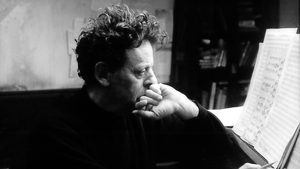
Absolutely. My set designer and lighting designer, Jack Miller, and I thought that in order to embrace the minimalism of the music, we needed to convey the entire atmosphere into something ultra-modern, despite the costumes by Ben Cortez, which are very 19th-century period.
We thought that the juxtaposition between a deconstructed 19th-century period costume and the minimalism of the set and lighting would create something very unique.
Philip Glass’s music was written to accompany Tod Browning’s 1931 film Dracula, which means that music was written to be in concert with the beats of Browning’s film and how he chose to tell the story. When you’re taking music written for an existing film, how does that impact how you structure your ballet? Or have you found ways to make it serve your own vision?
I decided for the ballet not to keep the album in the sequential order. I reworked the order except for the end, where the tracks are in order because those are the most incredibly beautiful, dramatic tracks.
I rearranged the order of the tracks to serve my own story, which has a ballroom and an asylum scene at the beginning of Act Two. I wanted to make sure there is a journey and an arc, musically and visually, that leads to that enormous moment at the end when Dracula is stabbed.
Does that mean you had to have conversations with Philip Glass about making modifications to the way his work was structured?
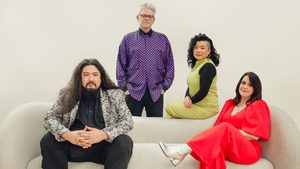
I did not have conversations with Philip Glass, but I did have ample conversations with the Kronos Quartet. We are all on board to respect the music the way it was written, but rearrange the sequence of the tracks.
In addition, the Kronos Quartet is going to implement sound design specifically designed for this production, as well as some narrated quotes from the book that will punctuate the music and the story along the way.
It was a given that the quartet would be onstage and not in the orchestra pit. Kronos is going to be present onstage on a big platform above the dancers, as if the quartet would be representing the musicians of Dracula’s court.
You mentioned earlier that this is your first narrative ballet. How does working with a defined narrative, particularly one as famous as Dracula, offer you both challenges and opportunities?
Incredible challenges. It’s not only about, “Let’s do a turn here, a lift here and a jump.” It’s important to make the audience understand the storyline and how Mina is devastated by the absence of Jonathan Harker, her husband-to-be, when he’s traveling to Transylvania.
I had the great advantage of being helped by Sarah Hay, my assistant and dramaturgy assistant on this production. Movement is going to inform the audience of sadness, love.
One of the things I find most interesting about Bram Stoker’s Dracula is that it’s not just a horror story. It explores sexuality, shifting gender roles, the conflict between science and superstition, the fear of outsiders. Which resonate most strongly with you, and how do you find expression for them in your ballet?
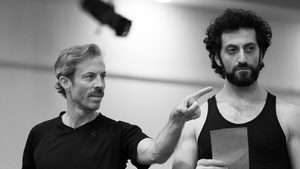
I decided to do a duet between Jonathan Harker and Dracula that’s slightly homoerotic without being very literal. What’s interesting about Dracula is that this character is attracting men and women alike.
As much as Dracula is seducing the women, I wanted to give some room for the audience’s imagination to think that Dracula was attracting men as well. I wanted to play with this ambivalence about Dracula’s character.
Despite the fact that we live in the 21st century and science has made enormous progress, the fascination for the underworld and the occult is still very relevant. People love to be frightened and questioned by that.
We also live in a time period where people are having less and less faith in science. What does Dracula have to say about the world we live in today, and how does your ballet speak to life in 2026?
We live in a world full of beautiful stories but also very tragic stories. Human nature is very often attracted by darkness and evil.
My Dracula is not very violent, but we live in a context of extreme violence. Perhaps there is something connected to the story of Dracula in the 21st century because of the fear of people we don’t know, the fear of foreigners, fear of science and what we know about diseases.
Every artist puts something of themselves into their work. How much does your own personal view of the world inform Dracula, a Dark Shadow?
All my ballets have been constructed around a sense of emotion. There is always an emotional context. I will never create ballets for the sake of movement only. I love putting an intention behind steps.
My first motivation as a creator is to make sure the dancers are conveying a strong emotion through my choreography.
What have you gotten out of this? What has most surprised you about what meaning you found in choreographing Dracula?
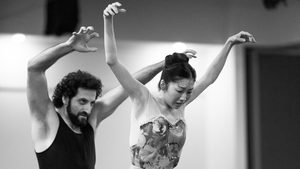
Probably the power of attraction between individuals and how relationships are not very straightforward, how there are different shades in a relationship, whether it’s attraction, conflict or love.
I think Dracula is the perfect vehicle to portray that sense of attraction and magnetism between Dracula and each of the characters. That was a learning curve for me, as well as a fascination to see that developing in a dance studio.
In The Jewel of Seven Stars, Bram Stoker wrote, “We learn of great things by little experiences.” What are the little experiences that taught you great things that have guided you through your career?
The time to reflect after each project, big or small. Each time I’m creating a new work, it’s difficult to have perspective while you’re in the creation process. But it’s important as a creator to step back afterward and look at what was well achieved and what I could have done better.
I try to stay humble. I think that as artists, we serve something bigger than us. We serve the art form in general. We are the messengers for something far beyond our name or reputation.
What we have to do is try our best to be true to ourselves and have integrity in our vision. Not necessarily try to follow a trend. The little experiences are also to think, let’s go back to what’s the core of us as artists.
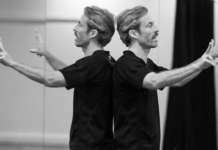
Main Photo: Nicolas Blanc in a rehearsal of Dracula, a Dark Shadow (Photo by Andrew Ye/Courtesy State Street Ballet)