

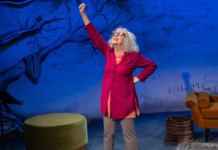





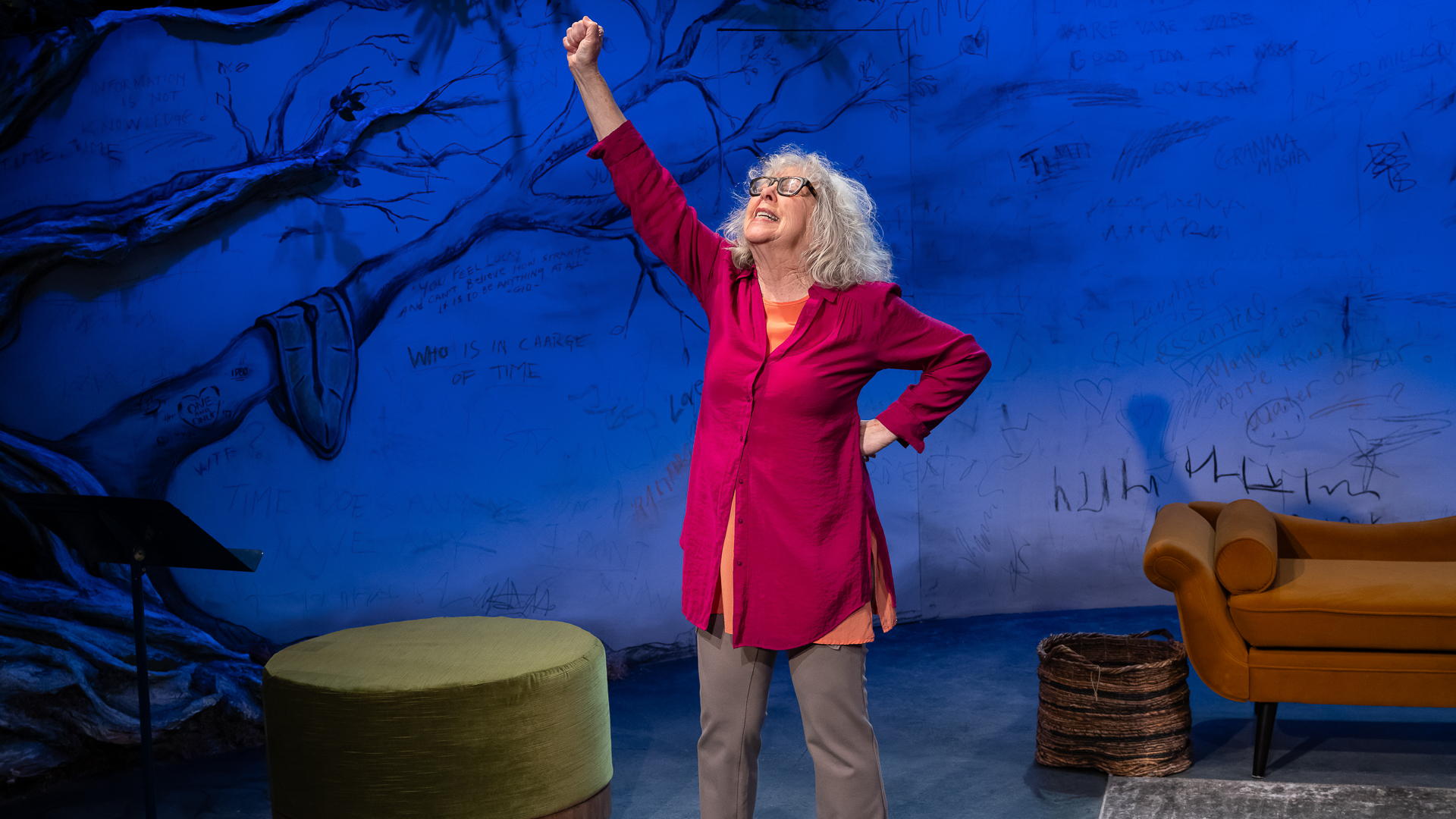

Kathryn Grody is about to turn 80. She’s performing seven shows a week, doing plank pushups while singing onstage and contemplating what she wants from the next chapter of her life. She’s also worried about democracy, the future of her grandchildren and whether she’ll retain the independence she treasures. None of that has diminished her enthusiasm for living.
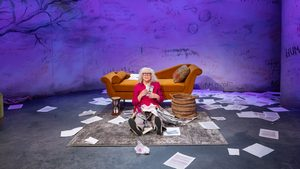
Her one-woman show, The Unexpected 3rd: A Radical, Rollicking Rumination on the Optimism of Staying Alive playing at George Street Playhouse’s Arthur Laurents Theater in New Brunswick, New Jersey, through November 1st, began as a response to the dismissiveness she experienced as an older woman. Four years later, it has become something more expansive: a funny, deeply personal and politically engaged exploration of aging, loss, gratitude and the importance of remaining connected to one another.
Grody, whose career includes ten productions at New York’s Public Theater, is perhaps equally familiar to audiences through the social media videos she makes with her husband, Mandy Patinkin. As she approaches a milestone birthday, she’s discovering that getting older offers unexpected freedoms, even as it presents new challenges. And she’s far from finished discovering who she might become.
Our conversation also included memories of Meryl Streep and Raúl Juliá, along with some unexpectedly emotional moments. You’ll find those stories, and more, in the complete video interview.
Q: Do you think that the actress who appeared as Janice in The Member of the Wedding at the Actors Theatre of Louisville in 1968 would have envisioned a second act, let alone an unexpected third?
Oh my God, Craig, do you do your research? I didn’t even remember the name of that character. That was my very first professional job, Actors Theatre of Louisville, Kentucky. And I chose it because it was eight roles in rep, and I’d never lived in a city where I knew no one, and I never lived in a place where it snowed.
I had a high school college beau, a very lovely guy who came to Louisville and he said, “Kath, when are you coming home to Los Angeles?” And I went, “Never. I’m never coming home.” And that’s about all I knew then. So it’s been a tremendously eventful, beautiful life with a lot of sorrow. It’s been human life, which I’m all in favor of supporting and having people embrace and not surrender to becoming the damn machine, which we seem to get a lot of pressure to do right now.
I believe you started doing versions of this show in 2022. How much has the show evolved in the approximately four years, and how much does what’s happening in the world influence that evolution?
Huge. When we did it in ’22, I was at Ground Floor in Berkeley, which lets you work on something for two weeks. And I went there with a second draft. I left with the 19th.
When I first did it, I was just pissed at the dismissiveness of anybody with white hair. Honestly, that November, it was almost like a standup. It was just like, “Oh, screw this age thing. I don’t feel any different than I did at 60.”
I’m so glad we weren’t picked up because it’s still a funny show, because I am a devotee of humor in every moment of life. But it’s a stronger, broader, more truer show, I think, because a lot has happened to me in these four years. I’ve had births and deaths, and I update it.
When I first started, I had my original hip because I talk in the show about assuming I would never need such a thing because I’m so exceptional. And here it is. I didn’t know I’d be a grandmother. Now I have two. I always update the show politically. I always update it personally.
A man was there the other night who said he just lost his wife of 54 years. And there’s a line in the show where I say, “Would you rather have a broken heart or an unused one?” He said that really helped him.
I guess it’s the social service aspect of me that very much likes talking about life in this precarious moment with people, and we encourage each other to not lose hope about ourselves or the world.
Given how topical the show continues to be as you perform it, are you hoping that there’s another booking relatively soon? Because you’re closing two days before the midterm elections. God only knows what you’ll have to say come Wednesday morning of next week.
I’m hopeful, but I’m not what I was last time, which was utterly sure of winning. I know we’re gonna win some of them and there are great people running against them, really not great people.
I want my Democratic Party to stand for something. And forget this centrist shit, frankly.
Goddamn, FDR, he did things, he had programs. You wanna call it socialism or you wanna call it being a good Democrat and not afraid to spend your money on things that help people, that’s how I feel.
Over the course of your life, what has been the process of becoming more fearless, not just in your life, but with each succeeding show, and allowing yourself to be unabashedly yourself?
I love that question. I read about two women. One wrote a book about learning to say yes in her 70s, and one wrote about learning to say no.
I’m a pretty conflict-averse person by nature. And I don’t like the feeling of anger or rage. I like making things nice. And sometimes that’s useful and sometimes it’s a real problem. So I think I’m a lot less careful in saying what I think, whether it’s publicly or privately. I sort of feel tick-tock, tick-tock, I don’t have time to be careful.
With this show, I’ve never been one to toot my own horn. I did ten plays at the Public Theater. Beloved Joe Papp and Gail Merrifield [Papp] are my mentors. And with this one, I was calling people. I have something to offer. I think it’s of value.
I think not being insensitive or unkind, but being less careful in situations where your voice matters.
I guess I would say mostly I’m just less frightened to be myself and less horrified if I have to take accountability for doing something obnoxious. One of the themes of the play is I want to evolve till my last breath. That’s what I want to do. I don’t want to be finished. I’m not finished.
Your husband, Mandy Patinkin, posted on Instagram how impressed he was about how alive you were in the most recent performance he’d seen. How alive do you feel while you’re doing it?
My husband, he’s been so unbelievable with this show. I think he’s seen it seven or eight times.
I feel as alive as I get. It’s a very strange thing. I do plank pushups at one point in the show while singing “Move On,” and I’m not a singer.
I feel my whole self. I feel I’m sharing who I was, who I’ve become, who I’m becoming. And I think my younger son said it best when he last saw it. He said, “Mom, it’s like you’re having a real conversation with people. You’re not acting a conversation.” And that’s what I feel.
I do feel very grateful for being able to do this on the eve of being 80. I can’t even imagine that I’m saying that number. It’s so extraordinary.
Five days after you close, you will be turning 80. How do you plan to celebrate?
I had told my family I’m gonna celebrate throughout the year. But my children took it over, and it’s no longer small. And now I’m in an anxious state of who’s invited, who isn’t invited, who will find out, who won’t.
I’ve been instructed by them to take care of myself and be well and not make any plans for the day or night. So I’ve just sort of let them do it.
It’s a very weird thing. Anything after 80 is gravy. I couldn’t imagine when I was 50 or 60 being in the body I’m in now, but I keep thinking, what will it feel like in five more years or six more years? Will I have another hip?
But I don’t want to be afraid of what I might not be able to do. I want to fully do what I can do now and see what happens.
You are the personification of don’t let a number dictate when the slow-go or no-go years happen. You’re going to have the Kathryn years.
I used to say I would like to go mid-conversation, and my sons would say, “And mid-gesticulation.” I’m terrified of the things that everybody’s terrified about, of losing your friggin’ mind.
You said in an interview with WBGO that you want to be an alive human being who continues to evolve. You obviously can’t control how that will take place, but how would you like it to take place? What is most important for you in the next evolution of Kathryn Grody?
I would be very happy if I had a functioning mind and a functioning body, could care for myself, if I could dress and shower and do all the other things humans need to do on my own. And that I continue to meet new people and make new friends of any age. And I would just damn love to see my grandchildren turn teenagers or even 20.
My dad landed on Normandy on D-Day. He was a son of Russian immigrants. He deeply, deeply believed in democracy, even a flawed one. And he thought if citizens participated. So all those 93 million Americans that didn’t vote, get up and out there and have the privilege.
We’re a baby country. And we’ve been a great experiment, and we are in serious trouble over losing it. And I am extremely hopeful that there are more kind people and decent people, even if we might not agree on policy or have the same notions, that really don’t like this inhumane moment and want to change it. So I am very, very hopeful.
I’d like to be a recognizable version of myself. To me and to anybody that knows me.
We’re living in a time where more and more people are practicing gratitude, and the idea of processing grief is something that we’re beginning to explore more deeply. Do you think there’s a link between the two?
I do. There’s a grief industry right now which can get a little suspect. However, we’ve gone from never discussing it, never being able to bear it, never being able to enfold it into your life, and I think it’s very helpful.
There’s a moment in the play where I’m talking about a new fragility I have about mortality, where I worry about how long will I be able to know my grandkids, care for them, will my mind or body be a gift or a burden?
And then my brother, who was a Zen Buddhist monk, says in the play, “Kath, those fears are just obsessional fears. They’re not real. And they eradicate the daily gratitude for what is.”
If you’re in the moment and appreciating the sun or the good weather or a smile on a street or something delicious, or a new thought or a poem, if you stay in that moment and see where that takes you, it’s quite amazing. And you have that practice of gratitude which fills you up enough to be there when you are in grief.
I talk in the play about my brother. He was the most important person in our family, my son’s closest person. And he died of a glioblastoma. And I can’t bear it. In the play, I say it’s been a year forever and a minute, but it has been three years this February. It doesn’t matter how we define the time. It’s an absence that stays pulsing for me.
I don’t think you get over things. I think you find a way of enfolding that in your life and know that the connection and the love is worth the heartbreak. That’s just what we have to do as humans.
Your husband said in a 2018 interview with Closer Weekly, “Getting older is one of the great privileges if you get to live long enough. It’s the most thrilling time I’ve known.” What thrills you today that is maybe new to you and to your life?
First of all, you have to send me that quote. I have to say that back to him. It’s not how he feels every morning.
My brother, whenever I would complain about any aspect of aging, my brother would get so angry at me and he’d say, “Kath, Mom and Dad died at 53 and 56. What they wouldn’t give for these aches and pains and political shit.”
I don’t know if I believe all the clichés. Oh, you get older and wiser. I’m smarter about some things and dumber about other things. I just think you have so many possibilities still. That’s the privilege.
When I say I wanna keep evolving, I can still have adventures, I can surprise myself. I can find new people to love. I can learn new things. I can impact somebody. I can be impacted. It’s that living thing.
I think the privilege of being old and relatively sentient and healthy is anything can still happen. That’s the miracle of it. If you never garden, you can learn to do that. Maybe I’ll learn to speak Spanish badly. It’s the possibility. One of my favorite lines from Sunday [in the Park with George] is “So many possibilities.”
My younger son gave my husband a gift years ago. He framed an empty white canvas. And on the back, he just wrote “So many possibilities.”
Before our conversation ended, I shared a personal story about taking my mother backstage to meet Mandy Patinkin after a performance of Mandy Patinkin in Concert in 1996. Grody reflected on the moments of kindness we sometimes forget.
It’s kind of great that people can remind us of moments where we did nice things in the world that we don’t necessarily remember.
I sometimes have a fantasy on my 90th birthday, not remembering shit, and people say, this is my favorite story. I actually said to my kids, please tell people not to bring gifts. I really don’t want anything. I don’t need anything. Just stories.
All photos: Kathryn Grody in The Unexpected 3rd (Photos by Mark Garvin/Courtesy the Production)