







Dame Jane Glover has a particularly busy September ahead of her in Chicago. She performs with Music of the Baroque at Ravinia on September 3, leads the annual Chicago Water Music performance on the Chicago River on September 9, and opens Music of the Baroque’s 2026-27 season on September 27 and 28.
Always at the front of her mind is the music.
It’s always the music that comes first.
Glover has also just completed her 50th season as a conductor. As she tells Cultural Attaché, she is having too much fun to think seriously about stopping and her schedule bears that out.
Q: Let’s start with someone that George Frideric Handel is quoted as having either said or written: “I should be sorry if I have only succeeded in entertaining them. I wish to make them better.” Do you share that perpsective and does it influence how you approach the music you perform?
I’ve never come across that. He certainly was the greatest entertainer. And I mean, one could almost say showman. He just had huge and unlimited flair for being brilliant in all sorts of musics.
We’re doing Water Music and Fireworks Music. The suites that he wrote for those occasions, which were very specific, had no business to work. The other one, of course, was written to be performed on a moving boat on the river. With no acoustic at all.
And yet, what Handel wrote for those two occasions some decades apart was completely brilliant and has survived the test of time.
But I mean, to make them better, I’m still thinking about that.
Of course, he was not just a showman. He was a fine composer in the most serious music, too. All his oratorios have such passion and depth and commitment and originality and clearly the religious message of all of them meant a great deal to him and his credo is somehow in all of them. And so if that is what he means by making us better, absolutely agreed.
You clearly know your way around this music. Do you share that kind of approach? Do you want to do more than just entertain people when you’re leading an ensemble?
Yes, I think the joy of making music is that it not only gives you aural pleasure and entertains you, but it should make you think, and often one does reflect on the human condition or one’s own condition or the fate of the world, and if music can do that, which it can.
I read an interview that you did with Bruce Duffy in the year 2000 and you were asked about being a role model for other women as conductors. What fascinated me about your response is you concluded it, as it was printed anyway, by saying, “I’ve been doing it for 25 years and in the words of the lady from Follies, ‘I’m still here.’” Of course, as a Sondheim fan, I love that you quoted Sondheim, but 26 years beyond that, you’re still here.
I know! I’ve just finished my 50th season in the profession. How about that? That’s amazing. And I have to say the diary is very full looking forward. And I can’t imagine spending these years of my life doing anything more fun and more enjoyable. I’m just so lucky to be asked to continue doing what I love to do. And at such a level too.
How do you think that second half of your 50 years has shaped you and your profession during that time?
Well, that’s an interesting question. For me, one of the things that has been the line that goes right through this last quarter century has been Music of the Baroque, because just after that I was appointed as music director to this wonderful organization which I love passionately.
It’s incredible that I’ve had this jewel of a group of musicians to return to time and time again through a quarter of a century. We’ve evolved together. Everything changes and shifts and I think reflects what’s going on. And I just love that group.
But with regard to the profession itself, and the question I was asked 25 years ago about being a role model, let’s bring up this question of women because that has changed hugely in the last, I would say, 10 years and five years.
When I started 50 years ago, it was pretty damn lonely, you know, and strange. And even I thought it was strange seeing my name on a poster. And yet, something sort of kept me going. And yes, I’m still here.
But so are a lot more now. I mean, obviously there’s the great Marin Alsop, who really is a role model. I would like to think I am a little bit too, not least because I’ve been at it longer than anybody else. And I’m always thrilled when I see so many women now doing so well in the profession. Not just as assistant conductors, but also getting fabulous jobs like the San Francisco Symphony and the San Francisco Opera and other wonderful, wonderful appointments.
So that playing field really did need to level off. And it’s still not completely level. It’s so much better than it was 25 years ago, but even as I say, 10 years ago. And I’m thrilled about that.
The music of Handel and Haydn—some of their most beloved works—is rooted in their religious convictions. What role does religion play in your own life, particularly when you’re approaching non-secular music?
That’s quite a personal question. As it happens, I’m a person of faith and I am a regular churchgoer, and it means a great deal to me.
So to do religious works like the Bach Passions and Messiah, which I do countless times—I mean it’s over 120 now—which is just in my DNA, this does mean a great deal.
But I always say to people, because a lot of people have no faith, and that’s absolutely fine, you know, or have different faiths, and it doesn’t matter. The point is, if you’re telling the story of the Passion, then as long as you tell it with conviction and the sort of dramatic and emotional and intellectual energy with which Bach wrote it, then you’re not letting it down.
If it happens to mean something to you as a religious experience and statement, then lucky you, you know, lucky me.
I’m an atheist, and it’s one of my favorite shows because the music is so deeply passionate. Whether you believe or not, if the music is done right, it’s going to transcend any of your opinions.
Absolutely. And it may, you know, it may open doors in other directions for you, which is also the point of music, really, isn’t it?
I was fascinated by a story that I read when Music of the Baroque performed Stravinsky and Britten and how you got just crucified almost for having done that, yet you were able to commission a new piece by Stacey Garrop for Music of the Baroque.
Yes, I mean, I love this orchestra, and so I thought, well, this is the best, just the most wonderful chamber orchestra, and we should be looking at, as well as 18th century music, which is where our heart is, we should look at neo-classical music.
When it came to our 50th anniversary, I said to our wonderful CEO, Declan McGovern, how about commissioning something?
Stacey, of course, is a fine composer in many genres, but she’s so respectful to what and who she is writing for. We asked her to write actually a piece that goes with the Music for the Royal Fireworks. It’s scored for exactly the same forces and is a sort of companion piece.
It’s called Spectacle of Light. Whenever I go to other orchestras when they ask me to play the Fireworks Music, I suggest they play this piece of hers. Audiences love it, the players love it.
I don’t think our hardcore Baroque audiences were offended by it because they could see she quotes Handel in it. The textures are very recognizable and yet you get these sorts of explosions of fireworks in the music. It’s brilliant.
You have talked on multiple occasions in interviews about the influence that Benjamin Britten had on you. And one quote that I read in The Telegraph in 2018, which I thought showed how cheeky you could be. You said, “He changed my life. It has often been told how wonderful he was with young boys. But let me tell you, he was wonderful with this fat school girl, too.” How was he wonderful with you?
He was gentle and probing and sensitive, and he obviously recognized something in—I mean, I was an awkward teenager, you know, but I worshiped him and his music, and he somehow responded to that.
He kept in touch with me and my family actually for a few years. He gave me a birthday present which I will never forget, tickets to Peter Grimes, which was the last one that Peter Pears ever sang in London.
And then, a couple of years later, before I went to university on what is now called a gap year, he invited me to be on his apprentice scheme at the Aldeburgh Festival, his festival. That was such an eye-opener.
He was conducting everything, he was playing chamber music, he was just doing everything. And I was a dog’s body.
One of those apprentice dog’s bodies, and going to six events a day, including rehearsals, and just having my mind opened and my life changed.
I just had the one conversation with him the night before I left, because I thought I have to thank him for this. And he saw me from the back of the room and came over and said, “There you are. Why haven’t you been to see us?”
He just was so kind. And the fact that he remembered me and was still sort of had my interests at heart, was just overwhelming.
And eventually I was able to say to Peter Pears in my adulthood, when I met him at Glyndebourne in the ’80s, that between them they’d changed my life. And by the time we’d finished this conversation, we were both in tears. It was absolutely wonderful.
When you have those moments, you can’t foresee what impact it’s going to have. But when you look back do you wonder what would have happened if that hadn’t happened?
Yeah, yes, who knows? I mean, one’s path is sort of arbitrary and accidental and that applies to all of us.
I think my life would be very different if I’d grown up in London, for instance, with access to so much, seven days a week, whereas I grew up in the middle of nowhere and didn’t have that. But on the other hand, here I am.
What do you think that nine-year-old girl who thought she was going to grow up to be a policewoman would think of the life and career that you’ve had?
Well, it’s very interesting. As it happens, when I was nine, quite apart from the policewoman thing, which I think was just because there was a program on television called Dixon of Dock Green, which was about a cozy policeman in the East End of London. I loved this television show. I thought that’s what I’m going to do when I grow up, I’m gonna be a policeman.
But the other thing that happened to me when I was nine was that I actually heard my first performance of the Messiah. And that was truly life-changing, because I was absolutely riveted by it from start to finish.
Although I’m sure I didn’t articulate it at the time, something in me told me that I was going to be a musician and that Handel would be important to me and indeed Messiah would be important to me.
And as I say, I’ve conducted over 120 performances and still love every bar of it. I never think, “Oh God, here we go again, Messiah.” No, I just can’t wait.
The first Music of the Baroque season concert features pianist Imogen Cooper in her final performances in America. Given how passionate you still are about music and what you do, is retirement even part of your vocabulary?
Look, while people are asking me to do stuff and while physically, I’m able to do it, I feel incredibly lucky and blessed and fortunate and challenged.
The travel gets harder and everything gets a bit harder the older you get, but I mean, the difference between me and Imogen, of course, is Imogen since the age of 12 has played the piano for six hours a day and I think she’s ready to stop that and I respect that.
I don’t have to do that as a conductor. We don’t have to retain the dexterity in our limbs and digits the way real performers do. We have to be able to wave our arms around and have something to say about the piece.
So no. I think the R word, I mean it sort of hovers at the periphery, but I don’t sort of—I bat it away.
With your baton, of course.
Of course. Of course.
I’m going to close with something that Haydn is quoted as having said. He said, “Young people can learn from my example that something can come from nothing. What I have become is the result of my hard efforts.” What can young people or even adults learn from your example?
I’ll just comment on what Haydn said first, because this is so typical of him. He made more statements like that, which just show his unbelievable modesty, as that does. He said, “I was forced to be original.” And this from the man who was just couldn’t help being original.
I don’t know that I think about legacy in a sense, but, um…
I mean, if you’re passionate about something and are prepared to work hard at it, I mean you can’t just sort of waltz through everything. One does need constantly to prepare and be organized. We have to have this combination thorough preparation and then imagination to let the thing fly when you perform.
And I think it took me a long time to learn that, and I think I’m still learning it.
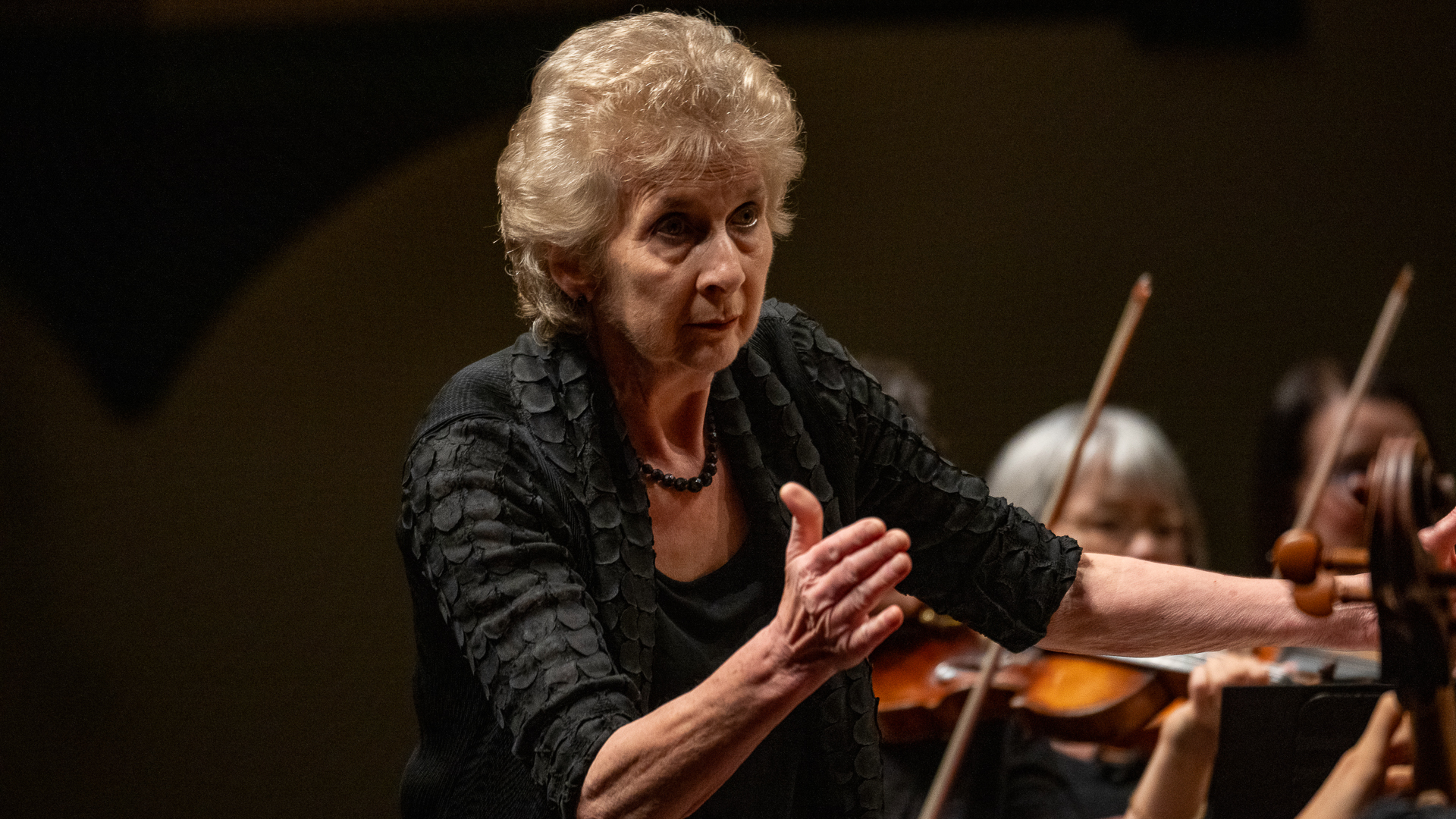
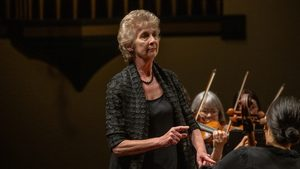
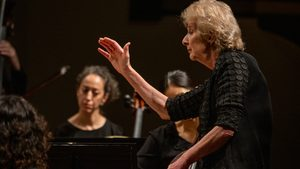
All photos of Dame Jane Glover with Music of the Baroque (Courtesy Ravinia Festival)